 LIVE DEMO
Proof of Opinion
Put your name on a take onchain, mint a shareable badge, others co-sign.
Ready now
$20Base
 Try it live
Job references that the referee signs once and you carry everywhere, privately.
Try it live, freeIfeoma leaves her startup and her old manager signs a reference in two minutes. She shares a link that proves it is genuine to each new employer, and can revoke it anytime, so her ex boss never gets ten phone calls.
Referee signing via email domain verification, encrypted reference vault, share link with expiry, verifier page.
Reshape it entirely: new features, your flows, your brand end to end, integrations you need. We scope it with you.
The VC standard supports it but no simple consumer reference tool was found.
W3C verifiable credentials and wallets (Velocity Network, Gen Digital/Accenture pilot) support holder-controlled employment credentials; no lightweight referee-signed reference product found.
Checked with web searches in October 2026. A search is not proof that nothing similar exists, and the market moves fast, so we recheck before every build.
Eligibility unknown; prior editions took existing early projects.
The complete Reference Relay app: a referee signs one job reference once, and the candidate carries it sealed, sharing a private, expiring link with each employer, with a paywall and checkout built in.
Every buyer gets the same finished app. Basic branding and copy changes come through a quick form.
Your admin side: revenue, paywall editor, users, rules and the agent log.
Referral and growth mechanics, switched on when you are ready to grow.
Candidates carry their references for free. Busy job seekers pay for Candidate Plus, and employers pay for a hiring team plan with bulk checks.
Gas for each attestation is well under one cent and can be sponsored by the owner. Payments arrive in USDC on Base by default.
Prices are yours to set. Illustrative, not a promise of income.
Job references the referee signs once and the candidate carries everywhere, privately.
Problem: References still run on phone calls. Good managers get called ten times per candidate, references vanish when a startup closes, and a PDF can be edited by anyone who forwards it.
Solution: The referee signs one reference in two minutes. Its fingerprint is attested on Base, the text stays encrypted in the candidate's vault, and each employer gets an expiring link that fails on any edited copy.
Why now: Cheap attestations on Base, embedded email wallets that hide the crypto, and small models that draft from bullet points make a signed reference practical for people who never touch a wallet.
Market: Job seekers in startup and remote hiring, the managers who give references, and the hiring teams and recruiters who check them, starting with tech employers.
The ask: Pilot partners: two hiring teams willing to accept the check page, and a place in an onchain consumer programme such as Base Batches.
Funding is never guaranteed. Check each program's rules.
Many hackathons require code written at the event. See the Regatta Boardfor each race's rule.
Custom work covers your own branding beyond name and colour, extra proof methods such as HR system or payroll checks, applicant system integrations, other languages and regions, and data protection reviews for your market. Scoped on a call, from $1,000.
Job references still run on phone calls. Good managers get called ten times per candidate, references disappear when a startup closes, and a PDF reference can be edited by anyone who forwards it. Candidates have no say over who reads what their old boss wrote.
The building blocks exist. W3C verifiable credentials and wallets support holder controlled employment credentials, and Velocity Network and a Gen Digital and Accenture pilot have shown employer issued credentials in practice. Research verdict: rare, medium novelty. We found no lightweight product where a single referee signs a personal reference once and the candidate shares it per employer with expiry and revocation. That consumer flow, plus a fallback for employers that no longer exist, is what is new here.
The referee's signature and proof they worked at the employer (work email code, or a co-signature from a company officer's wallet), the reference text and chosen traits (encrypted in the candidate's vault), a fingerprint of the letter, share links with expiry, and a private log of who opened each link.
Let a good word from a good boss travel with you, without costing them a phone call every time.
Two minutes, once Referees sign one reference and never get chased again. That alone makes managers say yes.
You hold the baton Each employer gets its own link that expires, and you can pull any link back without touching the reference.
Copies cannot lie Any edited PDF fails the check, and every printed copy carries a QR to the signed original.
Referee proof: A one time code to the referee's work email, or when the company has closed, a co-signature from a founder or officer wallet plus a candidate supplied payslip fingerprint. The method is shown on every check.
Signing: The referee signs in a Privy embedded wallet with no crypto knowledge needed. The letter is hashed and an EAS attestation on Base records referee, candidate, fingerprint and proof method.
Vault: The letter text is encrypted client side and stored in the candidate's vault (for example Lit Protocol access control or a simple encrypted blob store). Only the fingerprint is onchain.
Share links: Each link is a signed capability with an expiry. Opening it decrypts the letter for that viewer and checks the fingerprint against the Base attestation.
Revocation: Revoking a link is a cheap offchain update; revoking the reference itself (only the referee can) is an EAS revocation on Base, visible to every verifier.
Assistant: A small model (for example Claude Haiku or Gemini Flash via OpenRouter) helps the referee draft from bullet points and writes the monthly note. It never invents claims the referee did not tick.
Optimism option: The same EAS schema can be deployed on Optimism for owners who prefer it.
An EAS attestation on Base usually costs well under one cent in gas, sponsored by the app. Drafting help on a small model is a fraction of a cent per letter. Storage and email are cents per user per month. Example month with 1,000 references and 6,000 checks: a few dollars of gas, about $5 of model calls, roughly $30 hosting and email, under $40 total.
Every check page ends with 'Get your own references signed once'. Referees who sign one letter see how easy it was and ask their own reports to use it. The monthly 'pay it forward' prompt turns each happy candidate into a referee for someone else.
False referees: Someone could pose as a manager. Proof methods are shown plainly, weaker proofs are labelled, and employers can still call if they want.
Closed employers: Work email fails when a company dies. The co-sign fallback is weaker and must say so rather than look equal.
Privacy: Letter text never goes onchain. View logs are visible only to the candidate. Salary is off by default.
Legal: References carry defamation and data protection duties in many countries. Referees must see the final text, and candidates can request deletion of their vault.
Screenshots: A screenshot cannot be verified. The check page must say so instead of guessing.
Costs and tools are estimates at the time of writing. General information only, not legal or financial advice.
Nine routes from one vessel. Tap a port to open its chart.
References are still phone calls and unverifiable PDFs. Own Reference Relay and you run the private, signed reference vault, from your wallet and brand, that saves job seekers and old managers hours. The users, the recruiter relationships and the trust record are yours.
Some will ask for a call anyway. The verifier page shows the referee's verified email domain and signature, which saves the call for most. Start with tech and web3 employers.
References are encrypted and shared by link with expiry. Store as little as possible and let users delete everything.
You do not need to. Reference Relay arrives working, deployed from your own wallet with a written guide for every step. You will click, paste and fill in names. If you ever want a change you cannot make, the custom option or a freelancer can handle it, but the first launch needs no code.
Yes. The contract is deployed from your wallet on Base, the code sits in your own git repo, and the name and brand are yours. DEPLOYR does not hold your keys or take a cut of what Reference Relay earns. If you stop paying anyone tomorrow, the app keeps running on your wallet.
That is the most likely early outcome, and it is fixable. The paths below start with you as the first user, then ten real job seekers and the managers who vouch for them you can name today. If ten people you message do not care after you have shown it to them, you have learned something useful in a week instead of a year.
Free first reference, a small fee per extra reference or yearly plan for job seekers, and recruiter plans for verifying at volume. This ladder is a target, not a promise.
Illustrative stages, not a forecast. Results depend on you and the market; nothing here is guaranteed.
LIVE DEMOPut your name on a take onchain, mint a shareable badge, others co-sign.
 LIVE DEMO
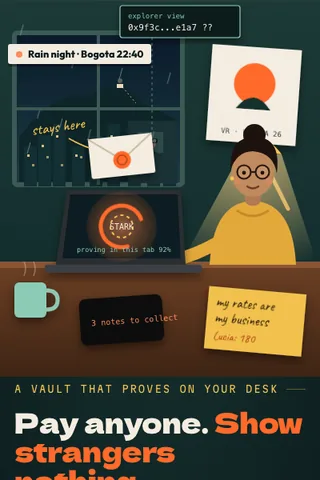
Create an account and prove your transactions in your own browser. Client-side proving on Miden, nothing leaks.
 LIVE DEMO
Prove your trading discipline, not your profits: stops honored, sizing kept, tilt avoided.
 LIVE DEMO
Caregivers and parents prove unpaid care work, privately, for loans and jobs.
 LIVE DEMO
Recruiters pay a small USDC fee to request verified proofs from candidates, who get paid.
 LIVE DEMO
Mentees attest that you changed their path, building a lineage tree of who you lifted up.
 LIVE DEMO
Prove you are over 18, a resident, or a degree holder without showing a single document.
 LIVE DEMO
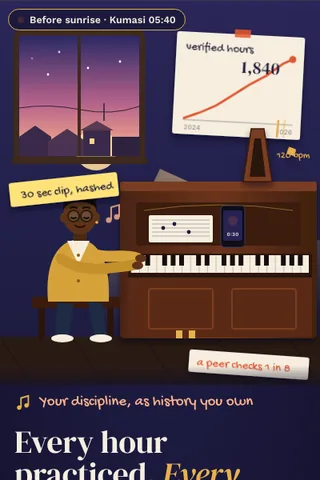
Timestamp every hour of deliberate practice and own the 10,000 hour proof.