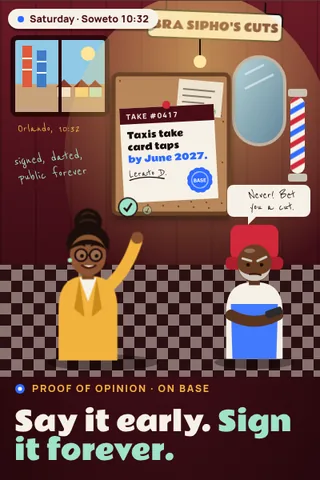
 LIVE DEMO
Proof of Opinion
Put your name on a take onchain, mint a shareable badge, others co-sign.
Ready now
$20Base
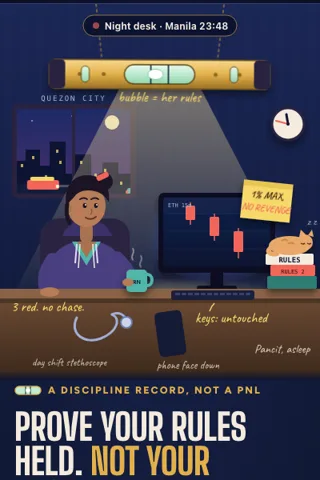 Try it live
Prove your trading discipline, not your profits: stops honored, sizing kept, tilt avoided.
Try it live, freeMira wants to join a prop desk but her PnL is small. Temperament reads her wallet history and proves she never broke her risk rules in 300 trades, which is what the desk actually cares about.
Rule declaration, wallet trade indexer, adherence scoring, attestations, shareable report. No trade execution.
Reshape it entirely: new features, your flows, your brand end to end, integrations you need. We scope it with you.
No product found that attests trading discipline against declared rules from onchain trades.
TradeRefinery publishes an offchain Rules Adherence Score and Nansen labels wallets by profit, but no onchain attestation of adherence to self-declared risk rules was found.
Checked with web searches in October 2026. A search is not proof that nothing similar exists, and the market moves fast, so we recheck before every build.
Eligibility unknown; verify rules.
Solana version; prior work allowed if new progress disclosed, verify rules.
The complete Temperament app: traders lock their risk rules on Base, scan their public history against them and send desks a verifiable attestation of self control, with no PnL anywhere and a paywall built in.
Every buyer gets the same finished app. Basic branding and copy changes come through a quick form.
Your admin side: revenue, paywall editor, users, rules and the agent log.
Referral and growth mechanics, switched on when you are ready to grow.
Keeping rules and proving it is free. Traders subscribe for weekly scans, tilt reminders and private reports; prop desks and communities subscribe to verify applicants and pay a small fee per check.
Desks pay a per check fee the owner sets (default $1). Gas for commits and attestations, well under $0.05 each on Base, can be sponsored by the owner.
Prices are yours to set. Illustrative, not a promise of income.
A verifiable record that a trader kept their own risk rules, committed before the history was scored, with profit deliberately left out.
Problem: Prop desks, trading communities and mentors want to know whether a trader follows their rules under pressure. The only evidence today is PnL screenshots, which are easy to crop and say little about discipline. Small accounts with real self control cannot show it.
Solution: Traders hash their rules onchain first. A read only indexer scores their public fills against those rules with an open, deterministic scorer, and an attestation on Base records the score, trade count and rules hash. Anyone can rerun it.
Why now: Public perp venues like Hyperliquid expose full fill and trigger order history, attestations on Base cost cents, and small models can write a weekly review from scored events without ever touching keys.
Market: Retail and prop-aspiring traders on Hyperliquid, Solana and Base, plus the prop desks, trading communities and mentors who evaluate them.
The ask: Two pilot desks or trading communities willing to accept attestations as a first filter, and ecosystem grants from Hyperliquid and Solana builder programs.
Funding is never guaranteed. Check each program's rules.
Many hackathons require code written at the event. See the Regatta Boardfor each race's rule.
Custom work from $3,000: your own rule types, extra venues or chains, a desk's applicant pipeline integration, private white label for a trading community, or extra languages. Scoped on a call.
Prop desks, trading communities and mentors want to know whether a trader follows their own risk rules under pressure. Today the only evidence is PnL screenshots, which are easy to crop and say little about discipline. Small accounts with real self control have no way to show it.
What exists: TradeRefinery publishes an offchain Rules Adherence Score inside its own journal, and analytics tools such as Nansen label wallets by profit. What we did not find: an onchain attestation that a wallet kept self declared risk rules, committed before the history was scored, that a third party can rerun and verify. Temperament combines a known idea (rule adherence journaling) with commit first rules and a public attestation. It is a fresh combination, not a new science.
Public fill history from the trader's own account (Hyperliquid fills and trigger order edits, or Solana and Base DEX swaps), account equity snapshots at entry time, and the trader's committed rule set. Profit and loss is read only to be excluded.
Make self control a credential, so traders are judged on how they behave when it hurts, not on a lucky month.
Proof for small accounts A trader with modest returns but unbroken rules finally has something a desk can verify.
The 1 AM nudge When a cooldown rule is about to break, the app reminds you of what you committed. Waiting becomes a visible win.
A steady line The weekly level and clean streak are satisfying to keep, the way a running streak is.
Wallet sign in: Privy embedded or external wallet. The app only reads; it never asks for trading keys or API keys with trade permission.
Rules commitment: The rule set is hashed client side with a salt and written to a small commitment contract on Base. Loosening a rule needs a 7 day delay; tightening is immediate.
Indexer: A worker pulls public fills from the Hyperliquid info API, and swaps from Solana and Base via an indexer such as Helius or a self hosted Ponder instance. Trigger order edits are matched by order id so partial closes are not counted as moved stops.
Scoring engine: Deterministic, open source rules evaluation: size versus equity at entry, stop moves away from entry, trades inside cooldown, daily cap, adds to losing positions. Same input always gives the same score, so anyone can rerun it.
Attestation: An Ethereum Attestation Service (EAS) attestation on Base records the rules hash, trade count, adherence score and a hash of the scored trade list. No PnL, no balances.
Coach messages: A small model (for example Claude Haiku class or an OpenRouter budget model) writes the weekly review and the tilt reminder from the scored events. It never sees keys and never suggests trades.
Notifications: Web push or Telegram bot for cooldown reminders and the Sunday review.
Per scan of 300 trades: indexer reads are free to a few cents on public APIs; an EAS attestation on Base usually costs well under $0.05 in gas at typical fees; a weekly review from a small model at roughly 3,000 tokens is under $0.01. Example month for 1,000 active traders with weekly scans and reviews: about $40 to $120 in gas and model calls plus about $50 for hosting and the indexer.
Every attestation is shared with someone who evaluates traders. Desks and communities that start asking for it pull new traders in, and traders invite peers to accountability groups with shared rule templates.
Mistaken for performance: Discipline does not imply returns. The app never shows or attests PnL and says so on every report. It is not investment advice.
Gaming with a clean wallet: A trader could attest a tidy secondary wallet. The attestation states which accounts were scored, and desks can require linked accounts.
Indexer errors: Misreading partial closes or liquidations creates false breaks. Scoring is open source, disputable, and versioned in the attestation.
Privacy: Linking a wallet to a real identity exposes history. Identity linking is opt in, and plain rules stay private unless revealed.
Regulation: Some jurisdictions regulate trader evaluation and prop firm marketing. The app only records behaviour and makes no offer of funding.
Costs and tools are estimates at the time of writing. General information only, not legal or financial advice.
Nine routes from one vessel. Tap a port to open its chart.
Temperament proves a trader's discipline from their own wallet history: rules declared, stops honored, sizing kept. If a third party runs that scoring, they own the trader relationships, the attestations and the report traffic. Own it, and every report carries your brand, every attestation comes from your contract, and the desks and communities that trust the score come to you.
No. Temperament never executes trades or tells anyone what to buy. It reads past trades and checks them against rules the trader wrote. Keep your copy and site clear about that, and never claim the score predicts profits.
The indexer, scoring and reports come built. You choose the chains, set the branding and share links. Adding a new exchange or chain later is developer work.
They can only be scored on wallets they connect, so someone could hide a bad wallet. Say this openly in the report: 'covers these wallets only'. Desks will still value a long, consistent record.
Individual traders often will not pay much. The money is in trading communities, coaches and small prop desks who need a fair way to judge people. Start there.
Yes. The attestation contract deploys from your wallet and the code lives in your git. Reports are issued under your domain.
Traders pay for a verified discipline report, and coaches, trading communities and small desks pay a monthly fee to screen and track their members. Revenue depends on desks actually trusting the score, so this is a target, not a promise.
Illustrative stages, not a forecast. Results depend on you and the market; nothing here is guaranteed.
LIVE DEMOPut your name on a take onchain, mint a shareable badge, others co-sign.
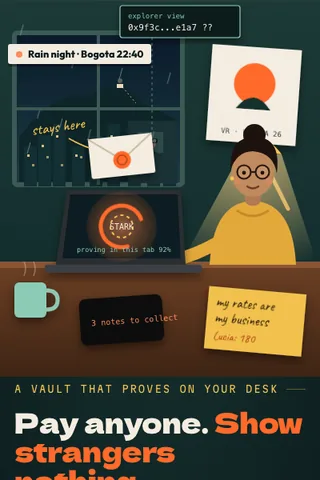 LIVE DEMO
Create an account and prove your transactions in your own browser. Client-side proving on Miden, nothing leaks.
 LIVE DEMO
Caregivers and parents prove unpaid care work, privately, for loans and jobs.
 LIVE DEMO
Recruiters pay a small USDC fee to request verified proofs from candidates, who get paid.
 LIVE DEMO
Mentees attest that you changed their path, building a lineage tree of who you lifted up.
 LIVE DEMO
Prove you are over 18, a resident, or a degree holder without showing a single document.
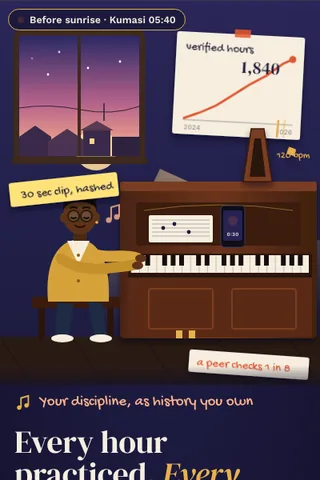 LIVE DEMO
Timestamp every hour of deliberate practice and own the 10,000 hour proof.
 LIVE DEMO
Real world good deeds, verified by a photo, a place, and a witness, saved forever.