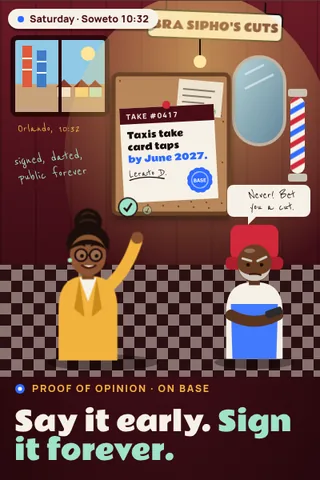
 LIVE DEMO
Proof of Opinion
Put your name on a take onchain, mint a shareable badge, others co-sign.
Ready now
$20Base
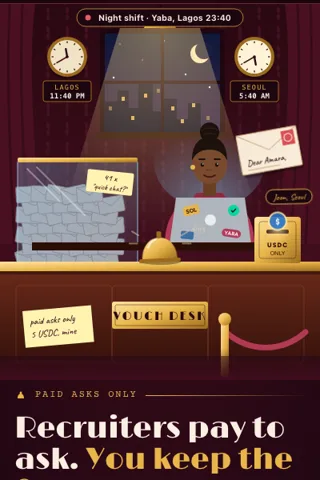 Try it live
Recruiters pay a small USDC fee to request verified proofs from candidates, who get paid.
Try it live, freeA startup wants proof of Solidity skill. They pay 5 USDC per verified request, the candidate approves and earns it, and spam recruiters disappear.
Request inbox, USDC escrow, consent release, proof delivery.
Reshape it entirely: new features, your flows, your brand end to end, integrations you need. We scope it with you.
No product found that pays candidates in USDC when recruiters request their verified proofs.
Gen Digital/Accenture and a patented smart-contract consent flow let recruiters request verified credentials with consent, but none pay the candidate per request.
Checked with web searches in October 2026. A search is not proof that nothing similar exists, and the market moves fast, so we recheck before every build.
USDC payments; eligibility unknown.
Eligibility unknown.
The complete Vouch Desk app: candidates set a fee for their attention, recruiters pay it into escrow to request verified proofs, and nothing is released without the candidate's tap, with plans and checkout built in.
Every buyer gets the same finished app. Basic branding and copy changes come through a quick form.
Your admin side: revenue, paywall editor, users, rules and the agent log.
Referral and growth mechanics, switched on when you are ready to grow.
Candidates never pay. Recruiters pay the candidate's fee into escrow and the owner keeps a small cut of each released fee; hiring teams pay monthly for a verified badge and searches.
Platform cut set by the owner (default 10 percent). Escrow gas is well under a cent and sponsored.
Prices are yours to set. Illustrative, not a promise of income.
Recruiters pay a small USDC fee to request verified proofs from candidates, who get paid when they approve.
Problem: Good engineers are flooded with low effort recruiter spam, while serious hiring teams cannot easily verify skills.
Solution: A candidate desk with a fee in escrow per request, consent based release of verified proofs, refunds on expiry, and a small platform cut.
Why now: Stablecoin escrow on Base costs fractions of a cent, embedded wallets and card onramps let recruiters pay without crypto setup, and attestations make proofs portable.
Market: Software and smart contract engineers, and the startups and teams hiring them.
The ask: Pilot with 200 engineers from two developer communities and 20 hiring teams.
Funding is never guaranteed. Check each program's rules.
Many hackathons require code written at the event. See the Regatta Boardfor each race's rule.
Custom work from $1,600: your proof types and issuers, ATS integrations, a community branded desk network, or other escrow chains. Scoped on a call.
Developers and specialists get dozens of recruiter messages a week, most of them bulk and unread, while the few serious hirers get buried. Recruiters, in turn, cannot easily verify claims on a CV. Both sides waste hours, and the candidate is never paid for the attention and the proof they hand over.
Closest existing: Gen Digital and Accenture have piloted digital credentials that recruiters can request with the candidate's consent, and a published patent describes a smart contract consent flow for releasing verified credentials. Paid inbox products exist for general messages. What we did not find is a flow where a recruiter's fee is escrowed per proof request and released to the candidate when they approve. The novelty is the payment per consented proof, not verified credentials themselves.
Attestations the candidate already holds (audit reports, code host exports, references, employment letters) stored as EAS attestations or signed files the candidate controls; public chain data such as contracts the candidate deployed; the paying wallet's history (how many candidates it paid, whether its domain is verified). Proof contents stay off chain and encrypted until release.
Make your verified work earn for you. Anyone who wants proof of what you can do pays a small fee to ask, you decide what they see, and spam stops being free.
Getting paid to read DMs The first 5 USDC from a recruiter feels like a small revenge on years of spam, and people tell friends about it.
The quiet inbox Going from forty blasts a week to two is an immediate, visible relief, and the weekly ledger shows it.
Proof gaps Seeing what hirers ask for and what you have not proved yet gives a clear next step, and a reason to come back.
Wallets: Email or passkey login through an embedded wallet (Privy or a Coinbase Smart Wallet) on Base or Arc. Gas sponsored by a paymaster, so recruiters only see a USDC amount.
Escrow contract: A small request escrow: recruiter deposits the fee with a request id and expiry. Candidate approval releases it to the candidate and emits a hash of what was shared; decline or expiry refunds the recruiter.
Proofs: Credentials as EAS attestations or signed documents. Release shares a time limited, encrypted link plus the attestation UIDs so the recruiter can verify the issuer independently.
Desk agent: A cheap fast model tier (for example Gemini Flash class or GPT mini class via OpenRouter) classifies requests against the candidate's rules, flags overreach like salary history, and suggests partial releases. It never releases on its own.
Abuse signals: An indexer (Ponder or a hosted subgraph) tracks how many candidates each paying wallet hits per hour and whether the company domain signed a message from that wallet.
Notifications: Push or email per request, plus a Friday ledger digest. Fiat onramp for recruiters who pay by card, offramp for candidates who want local currency.
Per request: one escrow deposit and one release or refund on Base, typically well under $0.01 each in gas at normal network load, sponsored by the app. Classifying a request with a Flash class model is roughly $0.001 or less. Storage of encrypted proofs is negligible. Example month: 2,000 requests cost roughly $20 to $40 in gas and models combined, against 10,000 USDC in fees flowing to candidates at 5 USDC each.
Every recruiter who wants a proof must land on the candidate's desk page, see how it works and fund a wallet; many of them hire people who then open their own desk. Candidates share their earnings card, which pulls in peers. Teams that verify their domain get better reply rates, which pushes other teams to verify.
Employment law and discrimination: Some regions restrict what hirers may ask, such as salary history. The agent flags those asks, and the app never stores them.
Privacy of proofs: Released proofs can be copied. Share minimal, time limited views, watermark with the requester, and keep contents off chain.
Fake credentials: A proof is only as good as its issuer. Show the issuer clearly and let recruiters check attestations themselves.
Paying to bypass the gate: A well funded bulk recruiter can still pay. Rate limits per wallet and per candidate, plus candidate side auto decline rules, keep it costly.
Tax and payments: Fees may count as income for candidates. Provide an export, and do not give tax advice.
Contract bugs: Escrow holds real funds. Keep it small and audited, with a refund path on expiry that does not depend on the app being online.
Costs and tools are estimates at the time of writing. General information only, not legal or financial advice.
Nine routes from one vessel. Tap a port to open its chart.
Vouch Desk makes recruiters pay a small USDC fee to request verified proofs from candidates, and the candidate keeps the fee. Running your own desk means the hiring community that trusts it, the fee on every request and the record of fair hiring all carry your name. You become the place where serious recruiters go because spam recruiters will not pay.
You don't need to. The app ships deployed to your wallet with a setup guide. Your real work is getting the first five recruiters and candidates to try one request.
Some will not, and that is the filter. Start with small startups that already waste hours on fake CVs; 5 USDC is less than ten minutes of their time.
Paying someone for their time to prepare a proof is ordinary, but employment and tax rules differ by country. Keep fees small, show them clearly, and do not use it to screen on protected traits.
Yes. The contracts deploy from your wallet, and the brand, domain and customer list are yours. DEPLOYR takes no cut of what you charge after purchase.
Records live onchain on contracts deployed from your wallet, so a page outage does not erase anything. Setup issues are covered by the get-it-shipped promise.
You take a visible fee on each paid proof request and sell monthly plans to recruiters and bootcamps for request bundles and a branded desk. Reaching $1M a year is a target to plan toward, not a promise. Volume depends on landing recruiters, not candidates.
Illustrative stages, not a forecast. Results depend on you and the market; nothing here is guaranteed.
LIVE DEMOPut your name on a take onchain, mint a shareable badge, others co-sign.
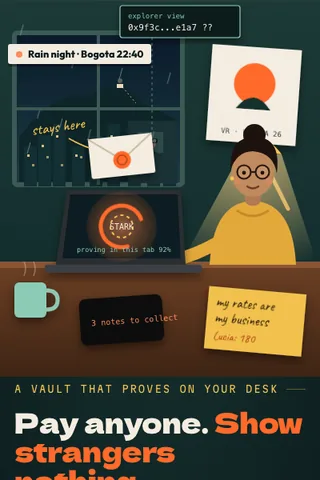 LIVE DEMO
Create an account and prove your transactions in your own browser. Client-side proving on Miden, nothing leaks.
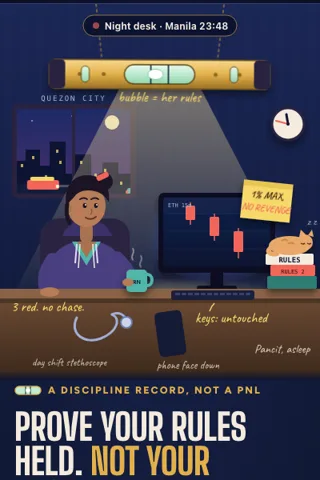 LIVE DEMO
Prove your trading discipline, not your profits: stops honored, sizing kept, tilt avoided.
 LIVE DEMO
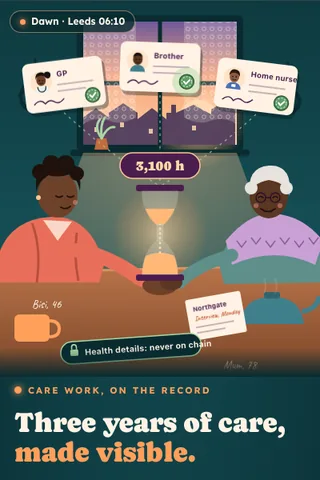
Caregivers and parents prove unpaid care work, privately, for loans and jobs.
 LIVE DEMO
Mentees attest that you changed their path, building a lineage tree of who you lifted up.
 LIVE DEMO
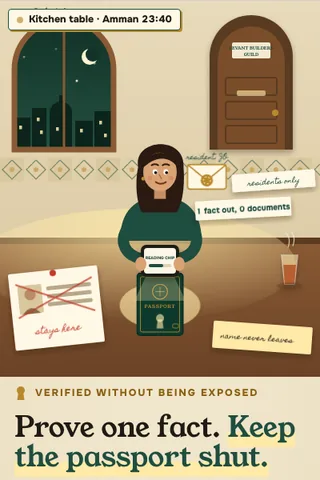
Prove you are over 18, a resident, or a degree holder without showing a single document.
 LIVE DEMO
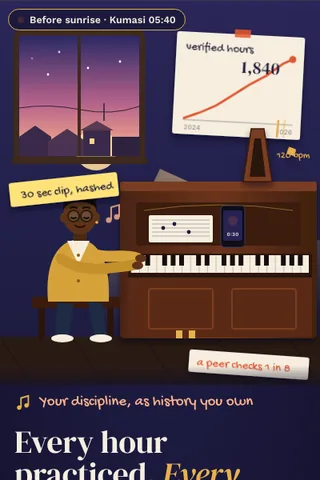
Timestamp every hour of deliberate practice and own the 10,000 hour proof.
 LIVE DEMO
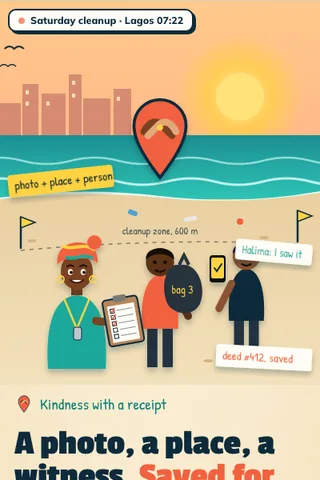
Real world good deeds, verified by a photo, a place, and a witness, saved forever.