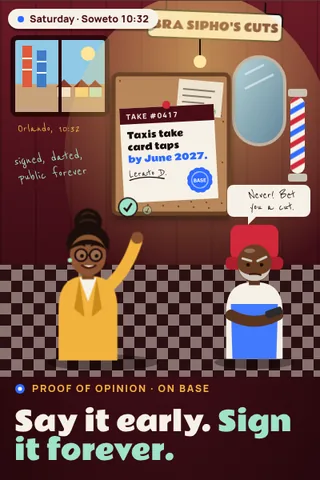
 LIVE DEMO
Proof of Opinion
Put your name on a take onchain, mint a shareable badge, others co-sign.
Ready now
$20Base
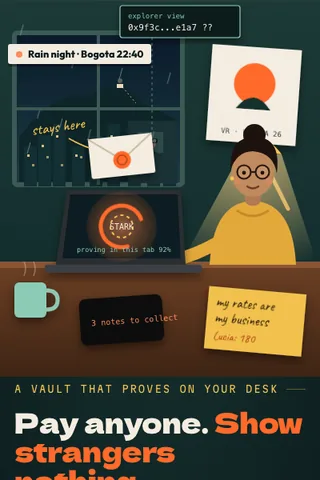 Try it live
Create an account and prove your transactions in your own browser. Client-side proving on Miden, nothing leaks.
Try it live, freeThe working app on your own wallet and git, one-click deploy, and the step-by-step guide that makes you the verifiable developer.
Reshape it entirely: new features, your flows, your brand end to end, integrations you need. We scope it with you.
The complete Private Vault app: people paid onchain create a private account and prove every payment in their own browser on Miden, so strangers see commitments instead of their income, with a paywall, owner console and vault assistant built in.
Every buyer gets the same finished app. Basic branding and copy changes come through a quick form.
Your admin side: revenue, paywall editor, users, rules and the agent log.
Referral and growth mechanics, switched on when you are ready to grow.
Private payments proved on your own device are free. People paid onchain every week pay for Pro tools, and small teams and DAOs pay a setup fee plus monthly for private treasuries.
Proving runs on the user's device at no compute cost to the owner. Miden network fees are small; check current terms before charging.
Prices are yours to set. Illustrative, not a promise of income.
Ordinary financial privacy for people paid onchain, proved in their own browser on Miden.
Problem: Public chains made paying people easy and made everyone's income readable. A freelancer paid in stablecoins can have her rates, clients and rent added up by anyone with an explorer.
Solution: The Miden web client runs in the page: accounts are private by default, payments are private notes, and STARK proofs are made on the user's device. The chain checks the proof and stores commitments, never the amounts.
Why now: Miden brings client side proving to the browser for the first time, and freelancers are increasingly paid in stablecoins.
Market: Freelancers, creators and small teams paid onchain who want the privacy a bank statement gives them.
The ask: Launch in the first wave of Miden apps and pilot with two freelancer collectives.
Funding is never guaranteed. Check each program's rules.
Many hackathons require code written at the event. See the Regatta Boardfor each race's rule.
Custom work from $300: your branding, a different payee flow, accountant integrations or a team treasury setup. Scoped on a call.
Public chains made paying people easy and made everyone's income readable. A freelancer paid in stablecoins can have her rates, her clients and her rent added up by anyone with an explorer. People who simply want normal financial privacy, the kind a bank statement gives them, have few easy options that do not depend on trusting a server.
Miden itself provides private accounts, private notes and client-side proving, and its own wallet and SDK already let developers create accounts and prove transactions in the browser. Other privacy systems such as Aztec and Zcash shielded wallets also exist. Private Vault is not a new privacy mechanic. What it adds is packaging: a plain, owner-branded app on Miden that makes the private choices the default, shows side by side what you see and what a stranger sees, asks before any delegated proving, and builds a weekly habit around collecting notes. It is a builder-status app for Miden first, and the value is in the experience, not novel cryptography.
Account state, private notes and the memo live in the user's browser storage and an optional encrypted backup the user holds. The chain stores account state commitments, note commitments, nullifiers and the verified proof. Public notes, when the user chooses them, put the amount and accounts onchain. The app keeps no server copy of balances or recipients.
Make ordinary financial privacy the default for people paid onchain, proved on their own device, with nothing to trust but math they can check.
The stranger's view Every payment shows two windows: your screen and what an explorer shows. Seeing 'amount hidden' next to your real payment is the moment people get it.
Six seconds, on your desk A visible proof dial in the browser tab turns a hard idea into something you watch happen locally, which builds trust fast.
The Sunday glass check A weekly two minute ritual: collect incoming private notes and see a score of how many payments a stranger could read. People keep the streak.
Miden client in the browser: The Miden web client SDK (WebAssembly) runs in the page: it creates the account, stores state locally and executes transactions in the Miden VM inside the tab.
Private accounts and notes: Accounts are created as private by default, so only a state commitment is onchain. Payments use private notes; public notes are an explicit opt-in per payment with a clear warning.
Client-side proving: STARK proofs are generated on the user's device. On low-memory phones the app splits work into smaller transactions. A delegated prover is optional, off by default, and always asks first because that server sees the inputs.
Note sync and collection: The client syncs commitments and nullifiers from a Miden node and finds notes addressed to the user, then consumes them so they become spendable. Optional note transport for private notes follows Miden's current tooling.
Encrypted backup: Local state can be exported as an encrypted file or saved to a backup the user controls, so a cleared browser does not mean lost notes.
Notifications: A small worker sends a weekly reminder by email or push with no payment details, only 'you have notes to collect'.
Hosting: A static Next.js app on Vercel or any static host. No backend database holds balances or recipients.
Proving runs on the user's device, so the owner pays no proving compute for local proofs. Network fees on Miden are small; check current testnet and mainnet fee terms before charging, as the network is young and terms can change. Hosting a static app costs about $0 to $20 a month. A delegated prover, if offered, is the main variable cost: a small cloud machine around $30 to $80 a month. Example month with 500 active users: hosting $20, notifications about $5, optional prover $50, so roughly $75.
Every private payment needs a recipient, and the recipient is invited to collect the note in their own vault. The share card ('0 of 31 payments readable by strangers') travels in freelancer and privacy groups. Being early in the first wave of Miden apps puts it on ecosystem lists when they go up.
Legal and misuse: Privacy tools can be misused. Keep clear terms, never market it for evading law enforcement or sanctions, add basic screening where local rules require it, and check rules before charging.
Young network: Miden is early and its APIs, fees and network status will change. Budget time for upgrades and say plainly which network a payment is on.
Lost local state: If the browser is cleared without a backup, private notes can become hard to recover. The app nags for an encrypted backup before the first payment.
Delegated prover leakage: A delegated prover sees transaction inputs. It is off by default, asks every time, and is labelled on the receipt.
Weak devices: Old phones can run out of memory while proving. The app splits transactions and checks block age first, and says honestly when a device is too slow.
Costs and tools are estimates at the time of writing. General information only, not legal or financial advice.
Nine routes from one vessel. Tap a port to open its chart.
Most wallets send your activity to someone's server before it ever reaches the chain. Own Private Vault and you run a client side proving app on Miden from your own wallet and repo, which makes you one of the early verifiable builders on a young chain. The brand, the users and the onchain record of shipping are yours.
It will change. That is the deal with early chains: you get to be early, and you will need to update the app when the network upgrades. Watch the Miden release notes and budget an hour a month for updates.
Private accounts are not the same as mixing stolen funds. Keep a clear terms page, do not market it for hiding from law enforcement, and check your local rules if you plan to charge.
You do not need to. Private Vault arrives working, deployed from your own wallet with a written guide for every step. You will click, paste and fill in names. If you ever want a change you cannot make, the custom option or a freelancer can handle it, but the first launch needs no code.
Yes. The contract is deployed from your wallet on Miden, the code sits in your own git repo, and the name and brand are yours. DEPLOYR does not hold your keys or take a cut of what Private Vault earns. If you stop paying anyone tomorrow, the app keeps running on your wallet.
That is the most likely early outcome, and it is fixable. The paths below start with you as the first user, then ten real privacy minded crypto users you can name today. If ten people you message do not care after you have shown it to them, you have learned something useful in a week instead of a year.
Free accounts with paid extras: a pro tier for power users (saved contacts, scheduled private payments, export), and a setup fee for teams and DAOs that want private treasury accounts. This ladder is a target, not a promise.
Illustrative stages, not a forecast. Results depend on you and the market; nothing here is guaranteed.
LIVE DEMOPut your name on a take onchain, mint a shareable badge, others co-sign.
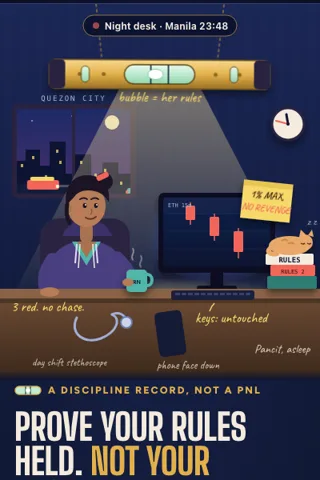 LIVE DEMO
Prove your trading discipline, not your profits: stops honored, sizing kept, tilt avoided.
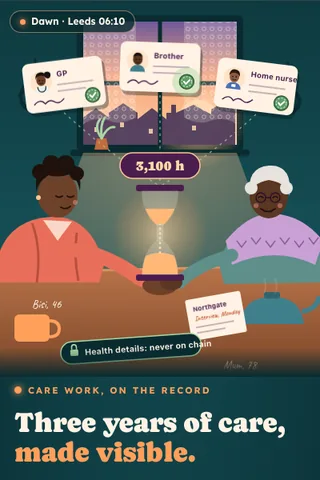 LIVE DEMO
Caregivers and parents prove unpaid care work, privately, for loans and jobs.
 LIVE DEMO
Recruiters pay a small USDC fee to request verified proofs from candidates, who get paid.
 LIVE DEMO
Mentees attest that you changed their path, building a lineage tree of who you lifted up.
 LIVE DEMO
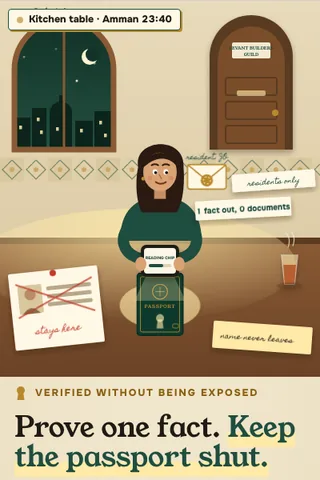
Prove you are over 18, a resident, or a degree holder without showing a single document.
 LIVE DEMO
Timestamp every hour of deliberate practice and own the 10,000 hour proof.
 LIVE DEMO
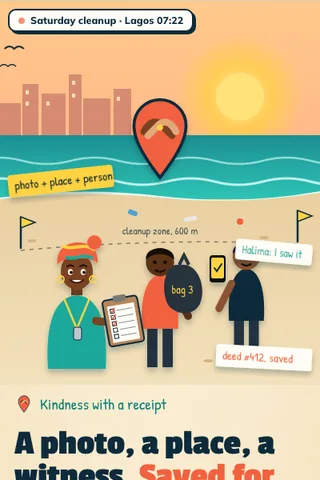
Real world good deeds, verified by a photo, a place, and a witness, saved forever.