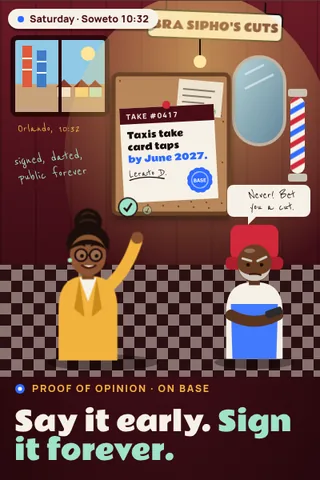
 LIVE DEMO
Proof of Opinion
Put your name on a take onchain, mint a shareable badge, others co-sign.
Ready now
$20Base
 Try it live
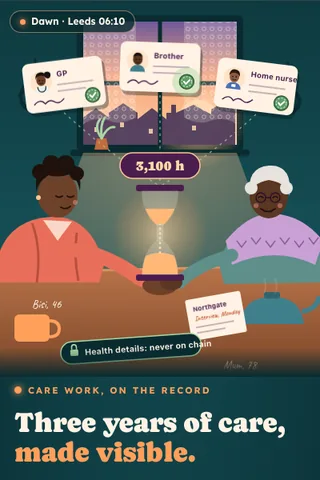
Caregivers and parents prove unpaid care work, privately, for loans and jobs.
Try it live, freeBisi spent three years caring for her mother. Care Hours turns doctor and family attestations into a private credential that explains her career gap to employers.
Attestation requests, private vault, selective share link.
Reshape it entirely: new features, your flows, your brand end to end, integrations you need. We scope it with you.
Only proposals and a government registry exist; a private verifiable care-hours credential is uncommon.
Chile's offchain caregiver registry issues QR credentials, and CareCredits and Wize propose tokenized care-hour records; no live private onchain care-hour credential found.
Checked with web searches in October 2026. A search is not proof that nothing similar exists, and the market moves fast, so we recheck before every build.
Public goods; open-source required generally.
The complete Care Hours app: carers turn unpaid care into a private, signed record of hours they can share with employers, with a paywall, owner console and helper agent built in.
Every buyer gets the same finished app. Basic branding and copy changes come through a quick form.
Your admin side: revenue, paywall editor, users, rules and the agent log.
Referral and growth mechanics, switched on when you are ready to grow.
Carers never pay to prove their own work. Families pay for the family tools, partner charities sponsor their members, and verifiers pay per check.
Verifiers pay $1 per verification. Gas (under $0.05 per record) can be sponsored by the owner.
Prices are yours to set. Illustrative, not a promise of income.
Verified care hours for people re-entering work, with health details never on chain.
Problem: Millions of people, mostly women, leave paid work to care for family. The years leave a blank CV and the only evidence is medical paperwork they should never have to share.
Solution: People who saw the care sign a narrow statement about who cared, when and roughly how much. Only salted commitments go on chain; the carer shares selected fields by expiring link.
Why now: Cheap attestations on Base and Celo, embedded email wallets, and small models that can chase signers make a private credential practical for non crypto users.
Market: Unpaid carers re-entering work, plus the charities, councils, returnship programmes, employers and lenders who need to read career gaps fairly.
The ask: Pilot partners: one carer charity and one returnship programme, and grant funding from public goods rounds such as Gitcoin.
Funding is never guaranteed. Check each program's rules.
Many hackathons require code written at the event. See the Regatta Boardfor each race's rule.
Custom work from $1,000: your own attester types and statements, integrations with a charity CRM or HR platform, extra languages, or a council branded deployment. Scoped on a call.
Millions of people, mostly women, leave paid work to care for a parent, partner or child. The years of real work leave a blank on a CV and in income history, and the only evidence they have is medical paperwork they should never have to share.
Chile runs an off-chain national caregiver registry that issues QR credentials, and projects like CareCredits and Wize have proposed tokenized care-hour records. We found no live product issuing a private, verifiable care-hours credential that a carer controls and shares selectively. The idea of recognizing care is not new; making it a portable, privacy-first credential is the uncommon part.
The carer's own estimate of months and weekly hours, short signed statements from attesters (a GP practice, a nurse, family members) about role, dates and approximate hours, and optional weekly logs. Health details, names of the cared-for person, addresses and documents are kept only in the carer's encrypted vault and are never written onchain.
Turn unseen care into recognized work, without ever making a family's health the price of being believed.
The gap gets a name A three year blank becomes 'primary carer, 2022 to 2025, signed by people who were there'. That relief before an interview is the moment people remember.
Dignity by design There is no field for a diagnosis. Carers trust it because it cannot leak what it never asks for.
A fairer family rota The one-tap weekly log and co-signing make hidden load visible inside families, which keeps people coming back long after the job search.
Login and wallet: Privy embedded wallets with email or phone login, so carers never handle seed phrases. Works on Base, with Celo as an option for mobile-first regions.
Private vault: Claims, notes and any documents are encrypted on the carer's device and in an encrypted backup. The carer can delete them at any time.
Attestations: Ethereum Attestation Service (EAS) on Base with a care-record schema. Each attester signs a statement whose onchain payload is only a salted hash commitment of role, month range and an hours bucket, plus the attester's role type.
Attester routing: Signing links by email or SMS. Clinicians can sign through a practice account where personal signing is not allowed, so the GP route works with real clinic policies.
Helper agent: A small model (for example Claude Haiku 4.5 class) drafts plain-language requests, sends reminders, flags implausible hour claims and suggests alternative routes when an attester is stuck. It never reads or stores health documents.
Selective share links: A link reveals only ticked fields (hours range, role, dates, attester roles) with the salts needed to verify them against the onchain commitments. Links expire and can be revoked.
Indexer: A lightweight indexer over EAS attestations so verifiers can check signatures without an account.
Per credential: around 3 attestations on Base, typically under $0.01 each in gas, so under $0.05 total, often sponsored by the app. Helper agent: about 20 short model calls per credential at Haiku 4.5 class pricing ($1 per million input, $5 per million output tokens), roughly $0.02. SMS reminders about $0.01 to $0.05 each depending on country. Example month for a charity running 500 credentials: about $25 gas, $10 model, $50 SMS, $30 hosting, roughly $115.
Every attestation request introduces a doctor, nurse or relative to the idea, and many of them know other carers. Carer support groups and charities onboard members in batches. Employers who accept the credential in hiring become visible advocates for returning carers.
Health privacy: The biggest risk. Mitigation: no health fields exist in the schema, only salted commitments go onchain, documents stay encrypted on device, and the app has no path to share medical records even if asked.
False claims: People may inflate hours. Ranges instead of exact counts, at least two attesters, plausibility checks, and attesters confirming the routine rather than a precise number.
Coercion by verifiers: Lenders or employers may demand more than they need. Share links have a fixed set of fields and the app explains to the carer that declining is fine.
Clinician liability: Doctors may be unwilling to sign. Statements are narrow (who cared, when), can be signed by a practice, and avoid any clinical judgement.
Permanence: Onchain data cannot be deleted. That is why only salted hashes are written, which reveal nothing without the carer's link.
Legal status: A credential does not create legal rights or guarantee a job, loan or benefit. Copy must say this plainly.
Costs and tools are estimates at the time of writing. General information only, not legal or financial advice.
Nine routes from one vessel. Tap a port to open its chart.
Millions of people step away from paid work to care for a parent or child, then face a blank space on their CV. Owning Care Hours means you run the place where that work becomes a private, verifiable credential, with your brand, your partners and your community. Care groups, clinics and recruiters need a trusted operator, and right now there is almost nobody doing it.
Care Hours keeps details private by design: the credential proves hours and who attested, not medical details. You never need to store diagnoses. Start with family attestations only and grow carefully.
They do not need to be. They sign in with email, and the wallet is created for them. The person sees a certificate and a share link, not a token.
Not all will, and we do not promise they will. Your first job is one partner who agrees to look at it, like a returnship programme or a local recruiter. One yes is enough to start.
The first move takes under an hour and the app runs itself once attesters are set. Most owners spend an hour a week.
Free for caregivers. Paid by organisations: care groups and clinics pay per verified attester seat, recruiters and returnship programmes pay to verify credentials.
Illustrative stages, not a forecast. Results depend on you and the market; nothing here is guaranteed.
LIVE DEMOPut your name on a take onchain, mint a shareable badge, others co-sign.
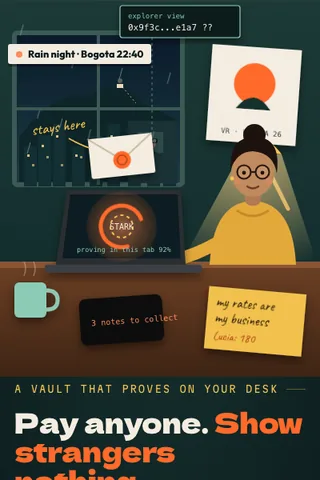 LIVE DEMO
Create an account and prove your transactions in your own browser. Client-side proving on Miden, nothing leaks.
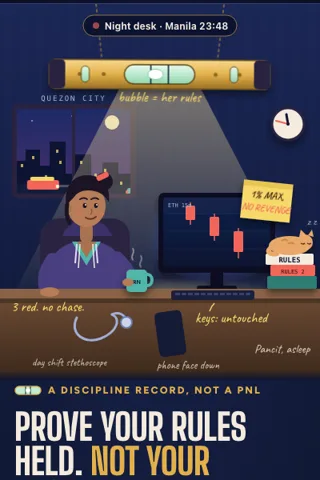 LIVE DEMO
Prove your trading discipline, not your profits: stops honored, sizing kept, tilt avoided.
 LIVE DEMO
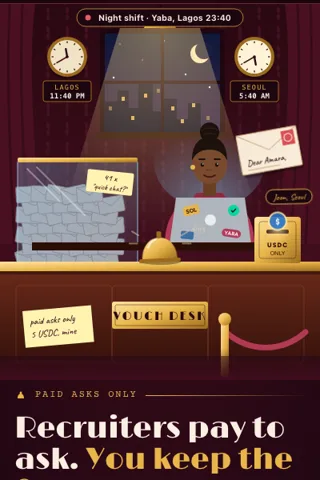
Recruiters pay a small USDC fee to request verified proofs from candidates, who get paid.
 LIVE DEMO
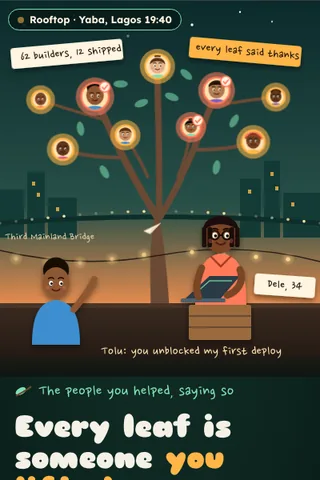
Mentees attest that you changed their path, building a lineage tree of who you lifted up.
 LIVE DEMO
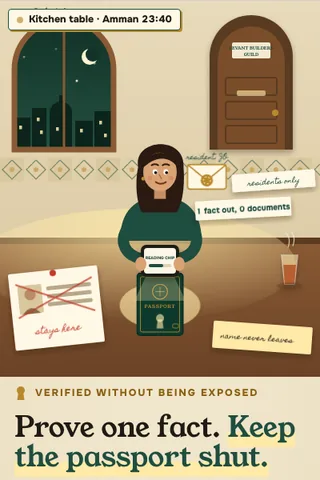
Prove you are over 18, a resident, or a degree holder without showing a single document.
 LIVE DEMO
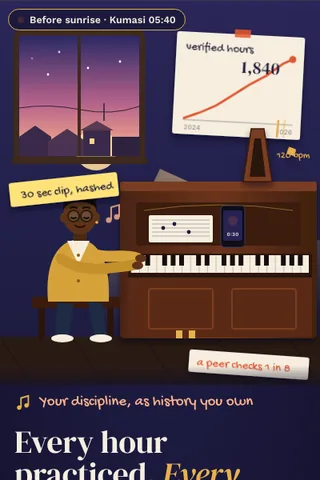
Timestamp every hour of deliberate practice and own the 10,000 hour proof.
 LIVE DEMO
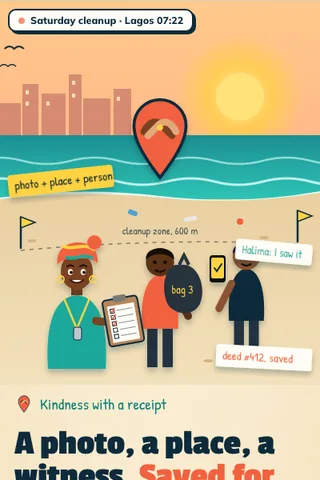
Real world good deeds, verified by a photo, a place, and a witness, saved forever.