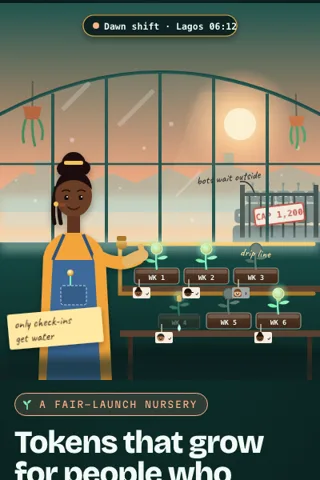
 LIVE DEMO
Slow Mint
A fair-launch token pad where supply unlocks only as real holders keep showing up, week after week.
Reserve · refundable deposit
$149Base · Solana +2
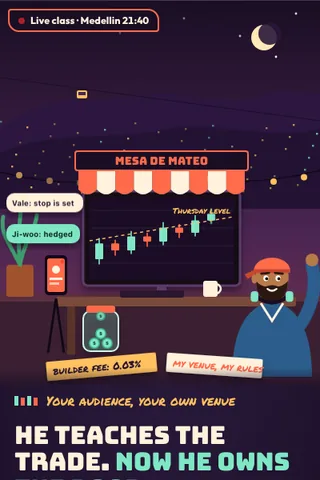 Try it live
Ship your own Hyperliquid front end with builder codes so your trades and fees are yours.
Try it live, freeA trading educator wants his community on his own front end. The kit deploys a branded interface earning builder fees.
Branded trade UI, builder code wiring, risk warnings.
Reshape it entirely: new features, your flows, your brand end to end, integrations you need. We scope it with you.
An ownable packaging of a front end type that already has open source templates.
Open source boilerplates like sovrun/create-builder-codes-dapp and Dwellir guides already provide Hyperliquid builder-code front ends, and many third-party front ends are live.
Checked with web searches in October 2026. A search is not proof that nothing similar exists, and the market moves fast, so we recheck before every build.
Eligibility unknown.
The complete Builder Code Kit app: a branded Hyperliquid front end for an educator's class, with the builder code attached, a one time fee approval, risk rails the owner sets and the fee printed on every ticket, plus a paywall, owner console and desk agent built in.
Every buyer gets the same finished app. Basic branding and copy changes come through a quick form.
Your admin side: revenue, paywall editor, users, rules and the agent log.
Referral and growth mechanics, switched on when you are ready to grow.
Students trade free apart from a small builder fee printed on every ticket, which settles to the owner's builder address. Class Pass adds replays, report cards and alerts, and sub rooms serve teaching assistants.
Builder fee set by the owner, up to the 0.1% Hyperliquid cap on perps. It is a share of volume, not of wins, and volume can fall to near zero.
Prices are yours to set. Illustrative, not a promise of income.
A trading educator's own Hyperliquid front end, with the builder code, the fee on every ticket and risk rails the class chooses.
Problem: Educators send students to other people's front ends, with no rails for beginners and nothing back for the teacher.
Solution: A branded front end delivered in days: one time capped fee approval, leverage caps, required stops and a cooling pause, with builder fees settling to the educator.
Why now: Hyperliquid builder codes are documented and widely used, so an owned front end is a packaging problem, not a research one.
Market: Trading educators, crypto communities and course creators with active student groups.
The ask: Pilot partners: three educators with active classes.
Funding is never guaranteed. Check each program's rules.
Many hackathons require code written at the event. See the Regatta Boardfor each race's rule.
Custom work from $1,500: more markets, your own rails and lessons, a multi educator setup or integrations. Scoped on a call.
Trading educators and community leads send thousands of people to trade on someone else's front end, with someone else's leverage defaults and fees. They want their own door with their own risk rails, without building an exchange.
This is not a new mechanic. Hyperliquid builder codes are documented and widely used, open source boilerplates such as sovrun/create-builder-codes-dapp and provider guides (for example Dwellir) already show how to build one, and many third party front ends are live. Research verdict: exists, low novelty. What the kit adds is packaging: a branded, owned front end delivered in days, with the approval flow, a visible fee on every ticket, and class level risk rails (leverage cap, required stops, a cooling pause after a loss) set by the owner.
Public Hyperliquid market data and the user's own orders and fills, the builder fee approval each user signs, the owner's settings (fee, leverage cap, stop rule), and an offchain class roster with opt in weekly cards. No custody of user funds.
Let anyone who teaches a community to trade give them a door with sane rails, and be paid fairly and visibly for running it.
Your name over the door Students see the class brand, not a generic app, and the same order book underneath.
Rails the class agreed to Leverage cap, stops first and a pause after a loss are part of the ticket, not a lecture.
Sunday card A weekly card with a stop streak and a vote on the replay topic brings the class back to learn, not to gamble.
Front end: A Next.js app on the owner's domain using Hyperliquid's public API and websocket for books, candles and positions.
Wallets: Users connect a wallet or sign in with an embedded wallet (for example Privy, which documents a Hyperliquid builder code recipe). An optional agent wallet signs routine orders; the builder fee approval must be signed by the user's main wallet.
Builder code: Each order carries builder {b, f}, with f in tenths of a basis point. Hyperliquid caps builder fees at 0.1% on perps and 1% on spot, and the builder address needs at least 100 USDC in perps account value.
Approval flow: Before a first trade the app checks maxBuilderFee for the user. If missing, it shows a one time approveBuilderFee card capped at the owner's fee, and always offers to trade without the code.
Risk rails: Client side checks before signing: leverage cap, required stop, a cooling pause after a recent realised loss, and plain language warnings. Blocked orders never reach the exchange.
Fees and reporting: Builder fees accrue to the builder address and are claimed from the rewards balance on Hyperliquid. A small indexer reads the owner's fills for the weekly fee report.
Weekly card: Opt in email or Telegram card with stop streak and replay vote. A small model tier (for example a Claude Haiku class model) writes plain summaries; no trade signals.
Per trade: no gas for the owner, Hyperliquid orders are signed actions with no per order gas. Hosting on a standard plan is about $20 a month, an RPC or data provider plan $0 to $50, and weekly card summaries with a small model about $0.001 per student per week. Example: 340 weekly traders and $2.1M weekly volume at 0.03% is about $630 in builder fees that week against roughly $70 a month in running costs, but volume varies widely and can fall to near zero.
Each class member's share card names the room and its rails, which recruits careful traders rather than gamblers. Educators share their front end in streams and courses, and a sub branded room for peers spreads the kit to other classes.
Regulation: Offering access to leveraged derivatives is regulated or restricted in many countries. Owners must geofence where required and get local legal advice. The kit gives no investment advice.
User losses: Most leveraged traders lose money. Rails reduce harm but cannot prevent it, and the owner earns fees on volume, a conflict the fee display and leverage cap are meant to keep honest.
Front end security: Phishing clones and dependency compromises are the main risk. Pin dependencies, use a strict content security policy and publish the official domain.
Platform dependency: Builder code rules, fee caps and minimums are set by Hyperliquid and can change; the kit must follow the current docs.
Agent wallet keys: If an agent wallet is used for convenience, its key lives in the user's browser and must be revocable; it never holds withdrawal rights.
Costs and tools are estimates at the time of writing. General information only, not legal or financial advice.
Nine routes from one vessel. Tap a port to open its chart.
Builder Code Kit gives you your own branded Hyperliquid front end with builder codes wired in, so when your community trades through it, the builder fee goes to your wallet instead of someone else's. Send your people to another front end and you hand over the fees, the brand and the relationship. Own it and every trade your community places builds your revenue and your onchain record.
You do not need to. The kit ships with a branded trade UI, builder code wiring and risk warnings. You set your name, logo, colors and fee level.
Builder fees only come from volume, so this works best if you already have a community that trades. If you do not, start with the productivity and portfolio paths, and grow an audience before expecting income.
You run an interface, not the exchange, and the kit includes risk warnings. Still, perps are risky and running a trading front end can be regulated in some countries. Check your local rules, keep warnings visible, block regions you must, and never promise returns.
It can. Builder fees are set by the protocol and can change. Treat them as one revenue line, and keep education or community memberships as a second.
Yes. Your domain, your brand, and the builder code points to your wallet.
You earn a builder fee on every trade placed through your front end, plus optional paid tiers for your community like premium tools or education. The ladder below is a target, not a promise.
Illustrative stages, not a forecast. Results depend on you and the market; nothing here is guaranteed.
LIVE DEMOA fair-launch token pad where supply unlocks only as real holders keep showing up, week after week.
 LIVE DEMO
Launch an NFT collection where each piece can only be minted by proving you can do the thing.
 LIVE DEMO
Founders publicly vow their own token lockups and get a shareable trust score that grows with time kept.
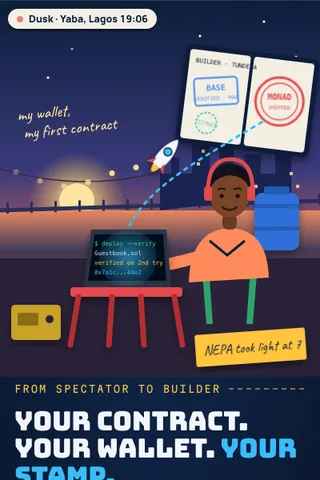 LIVE DEMO
Your own verified contract live on a new chain in ten minutes, with a public builder page to prove it.
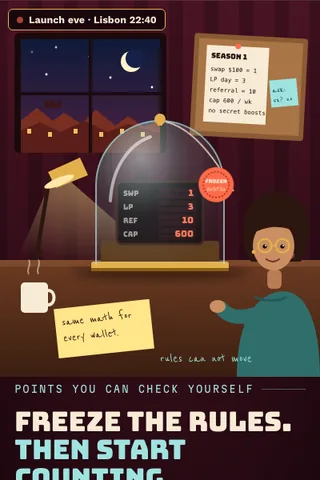 LIVE DEMO
A points program where the formula, caps and conversion odds are public and frozen before day one.
 LIVE DEMO
A DAO starter kit for small real groups: treasury, votes and roles in plain language.
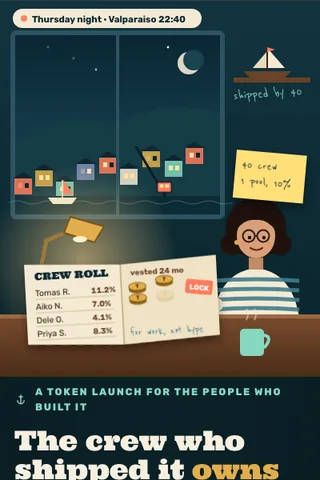 LIVE DEMO
Launch a token that only your verified contributors can receive, weighted by work they actually shipped.
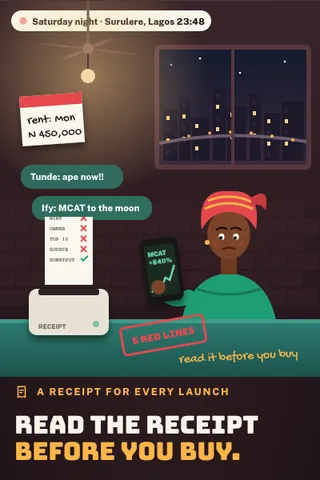 LIVE DEMO
Every launch gets a printable safety receipt: locks, caps, owner keys, all checked live.