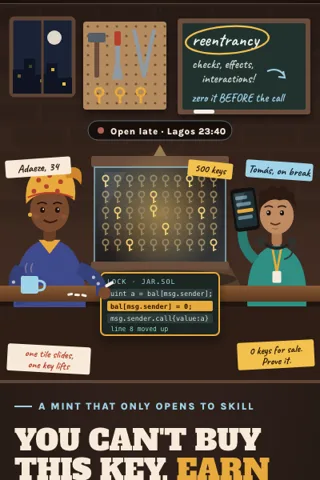
 LIVE DEMO
Skill Mint
Launch an NFT collection where each piece can only be minted by proving you can do the thing.
Reserve · refundable deposit
$129Base · Sui +1
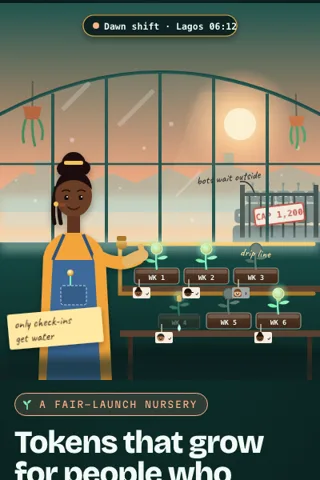 Try it live
A fair-launch token pad where supply unlocks only as real holders keep showing up, week after week.
Try it live, freeAda wants to launch a token for her design collective without whales sniping it. Slow Mint caps every wallet, locks liquidity for a year by contract, and releases each claim in weekly drips that only continue if the holder checks in, so the token ends up with people who actually stayed.
Token contract, per-wallet cap, 12 month LP lock, weekly drip claims with check-in, public safety card page.
Reshape it entirely: new features, your flows, your brand end to end, integrations you need. We scope it with you.
Retention-gated supply unlocks on a fair-launch pad were not found live, though weekly vesting schedules are common.
Weekly-unlock airdrops like Grand Base and standard vesting via Streamflow exist, and launchpads like pump.fun do instant launches. No launchpad found that gates continued supply unlocks on holder retention.
Checked with web searches in October 2026. A search is not proof that nothing similar exists, and the market moves fast, so we recheck before every build.
Retroactive for shipped apps on Base; existing projects OK.
Existing projects OK if positioned as public anti-rug tooling.
A complete fair-launch token pad you own: members join capped launches and check in weekly, founders pay you to plant theirs, and your console runs approvals, pricing, growth and the watcher agent.
Every buyer gets the same finished app. Basic branding and copy changes come through a quick form.
Your admin side: revenue, paywall editor, users, rules and the agent log.
Referral and growth mechanics, switched on when you are ready to grow.
Founders pay a one time launch fee or a monthly plan to plant launches on your pad, and a small pad fee is taken from each weekly drip in the launch's own token. Members always join and check in free.
Pad fee of 0 to 1 percent of each drip (default 0.5 percent), paid in the launch token to your treasury and shown on every claim receipt.
Prices are yours to set. Illustrative, not a promise of income.
A fair-launch token pad where supply unlocks only as real holders keep showing up, week after week.
Problem: Community tokens launch into bots and snipers. Members who do the work arrive minutes late and get crumbs, while one time claimers leave.
Solution: Per wallet caps, liquidity locked by contract and weekly drips that only release to holders who check in, plus a public safety card for every launch.
Why now: Cheap L2 gas, embedded wallets and paymasters make a weekly gasless check-in practical for people with no crypto experience.
Market: Creative collectives, clubs, DAOs and online communities that want a membership token without a sniper race; weekly vesting tools exist but none gate unlocks on retention.
The ask: Launch fees and plans from day one; seeking grant support (Base Builder Grants, Solana Foundation) to audit the contracts and ship proof of work check-ins.
Funding is never guaranteed. Check each program's rules.
Many hackathons require code written at the event. See the Regatta Boardfor each race's rule.
Your brand, token defaults, chain choice and extra integrations such as Discord roles, EAS proofs, custom check-in rules or a white label domain are scoped and priced together.
Community tokens keep launching into bots and snipers. Members who actually do the work show up minutes late and get crumbs, while one-time claimers dump on them. Founders want a launch where the token ends up with people who stay.
What exists: weekly-unlock airdrops like Grand Base, standard vesting and claim tooling like Streamflow and Tokenomist, and instant launchpads like pump.fun. What we did not find live: a fair-launch pad where continued supply unlocks are gated on holder retention, combined with a per-wallet cap and a fixed LP lock. Weekly vesting itself is common, so the new part is narrow: the check-in gate and the public safety card. Verdict from research: rare, medium novelty.
Onchain: token contract, per-wallet claim caps, drip schedule, signed weekly check-ins, LP lock state. Offchain: holder notification preferences, watcher clustering notes (timing and gas fingerprints), optional one-line check-in posts.
Reward patience and presence over speed, so community tokens end up with the community.
Streaks Every Monday check-in grows a visible streak. Losing a long streak feels worse than tapping once.
Bots get bored A sniper gets one small drip, then has to show up weekly for months. Most stop by week 2, which members can watch happen.
A feed worth opening The check-in asks one question, like what did you make this week, and the answers become the community's favourite feed.
Wallets: Privy embedded wallets with email or social login so members without crypto experience can claim. External wallets also work.
Contracts: An ERC-20 with mint authority renounced at deploy, a claim contract with per-wallet caps and a weekly drip, and an LP timelock with no admin key. Deployed on Base first; Solana port uses an SPL token with a Streamflow-style claim program.
Check-ins: Holders sign an EIP-712 message once per week inside the window. A relayer batches signatures into one transaction per hour, gas sponsored by a paymaster (Coinbase Developer Platform or Pimlico).
Indexer: Ponder or Goldsky subgraph indexes claims, check-ins and transfers to power the dashboard and the public safety card page.
Watcher agent: A small worker clusters suspicious wallets by block, gas tip and calldata patterns, and drafts notes for the founder. It uses a cheap model tier (for example Claude Haiku via OpenRouter) only to summarise clusters in plain words. It cannot freeze or move tokens.
Notifications: Push via web push, Telegram bot and email through Resend, sent only on channels each holder picked, at their local 9 AM.
Per check-in on Base: a batched relay costs well under one cent per holder at typical Base fees. Claim with sponsored gas: about 1 to 2 cents. Watcher summaries: a few thousand tokens a day on a small model, roughly 1 to 3 cents a day. Example month for a 1,500 holder community with weekly check-ins: about 6,000 check-ins plus notifications, roughly 40 to 120 USD in sponsored gas, under 5 USD in model calls, and about 20 USD for indexing and email. Gas varies with network load, so budgets should be set with a buffer.
Every holder's share card links back to the safety card page, which shows cap, lock and how many holders are still here. Founders who see another community's safety card ask how to get one, and each launch adds a public page that keeps working as proof for months.
Legal: Tokens may be treated as securities in some places. The app frames tokens as membership, never promises price or returns, and tells founders to get local legal advice before launch.
Sybil farms: Determined farmers can script weekly check-ins. Caps limit the damage per wallet and the watcher flags patterns, but the founder must decide; nothing is fully bot proof.
Exclusion: Strict rules punish people with patchy connectivity or life events. Defaults use a 3 day window and pausing, not forfeiting, missed drips.
Contract bugs: A bug in the claim or lock contract could strand funds. Use audited, minimal templates, testnet rehearsal and a public bug bounty before mainnet.
Privacy: Check-in times and posts reveal habits. Posts are optional, timestamps are shown at week level, and notification details stay offchain.
Costs and tools are estimates at the time of writing. General information only, not legal or financial advice.
Nine routes from one vessel. Tap a port to open its chart.
Every community that wants a fair token launch today rents someone else's launchpad, follows their rules and watches snipers take the first hour. Owning Slow Mint means the launch rules are yours: wallet caps, a year of locked liquidity and weekly drips that only keep flowing to people who keep showing up. You can run it for your own project, then rent it to every collective that asks how you did it.
You do not write contracts. The app ships deployed under your wallet with a guide, and the launch settings are a form: cap per wallet, lock length, drip schedule. If you can fill in a sign-up form, you can configure a launch.
Your first launch can be your own community or one friend's. One honest launch with a clean holder chart is the sales pitch for the next five. The playbook below starts with one group, not a marketplace.
Slow Mint is built against that: liquidity locks by contract and supply only unlocks for holders who stay. You also choose who can launch. Approve projects by hand until you trust the flow.
Token rules differ by country. Many owners use it for community and membership tokens with no promise of returns, and take local advice before any launch that sells tokens. We never promise prices, profits or airdrops.
A launch fee per project plus a small percentage of each weekly drip claim, and a white-label tier for collectives that want the pad on their own domain.
Illustrative stages, not a forecast. Results depend on you and the market; nothing here is guaranteed.
LIVE DEMOLaunch an NFT collection where each piece can only be minted by proving you can do the thing.
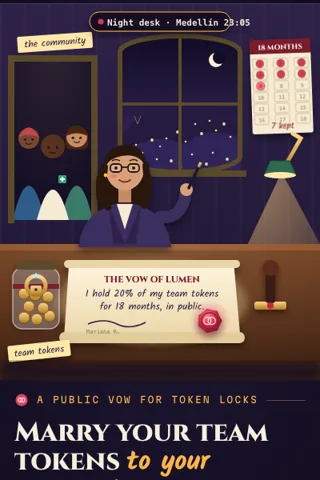 LIVE DEMO
Founders publicly vow their own token lockups and get a shareable trust score that grows with time kept.
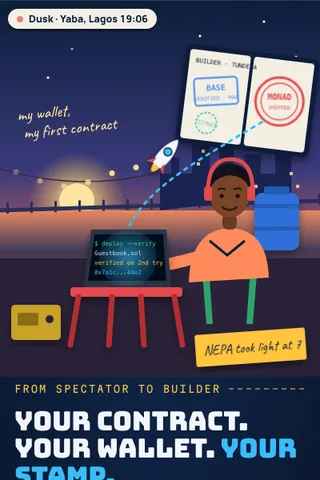 LIVE DEMO
Your own verified contract live on a new chain in ten minutes, with a public builder page to prove it.
 LIVE DEMO
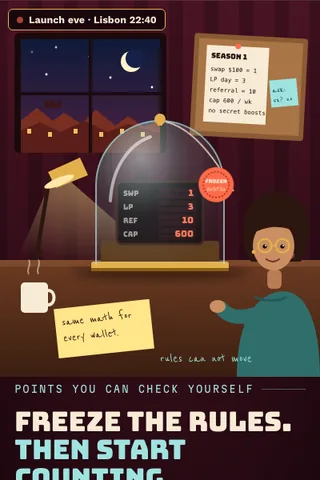
A points program where the formula, caps and conversion odds are public and frozen before day one.
 LIVE DEMO
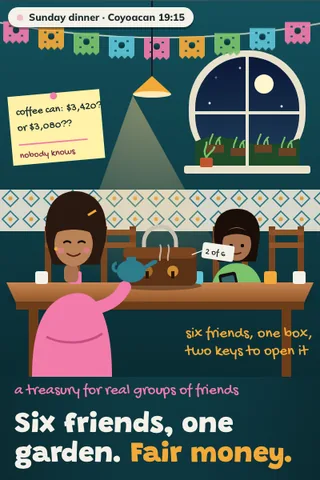
A DAO starter kit for small real groups: treasury, votes and roles in plain language.
 LIVE DEMO
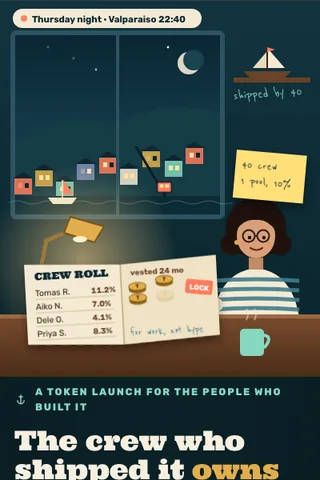
Launch a token that only your verified contributors can receive, weighted by work they actually shipped.
 LIVE DEMO
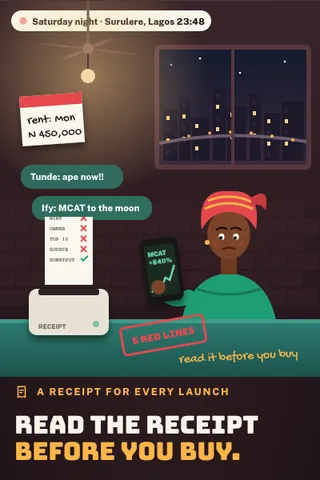
Every launch gets a printable safety receipt: locks, caps, owner keys, all checked live.
 LIVE DEMO
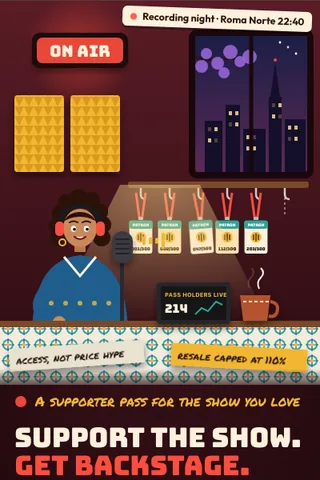
Launch a supporter pass where holders earn real access, not price promises.