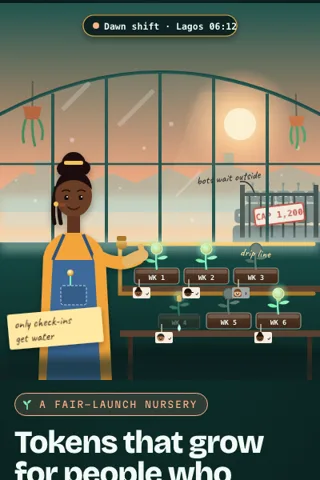
 LIVE DEMO
Slow Mint
A fair-launch token pad where supply unlocks only as real holders keep showing up, week after week.
Reserve · refundable deposit
$149Base · Solana +2
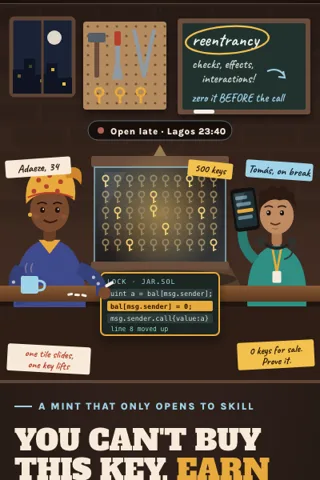 Try it live
Launch an NFT collection where each piece can only be minted by proving you can do the thing.
Try it live, freeA Solidity teacher drops a 500 piece collection, but each mint requires passing a short onchain challenge. The collection becomes a living roster of people who verifiably learned something.
Collection contract, challenge builder (quiz or onchain task), mint page, holder roster.
Reshape it entirely: new features, your flows, your brand end to end, integrations you need. We scope it with you.
Proof-of-skill minting exists in demos and quiz badges; the novelty is packaging it as an ownable creator launchpad.
Hackathon projects like MazeKing and Vitalik's Secret (ETHGlobal), ZK Panagram, and Remix Challenges already gate NFT mints on a ZK proof of solving a puzzle or quiz. None found packaged as a general creator launchpad with royalties.
Checked with web searches in October 2026. A search is not proof that nothing similar exists, and the market moves fast, so we recheck before every build.
Existing projects OK.
Eligibility unknown; prior editions accepted existing early teams.
The complete Skill Mint app: learners earn keys only by passing real challenges, failing privately, fixing a live bug on a Base fork and minting against an attestation, with a paywall and creator studio built in.
Every buyer gets the same finished app. Basic branding and copy changes come through a quick form.
Your admin side: revenue, paywall editor, users, rules and the agent log.
Referral and growth mechanics, switched on when you are ready to grow.
Learners take every public lock free. The owner earns from Pro and Creator subscriptions in USDC and an optional small fee per earned key.
Mint fee per earned key set by the owner (free, 1 or 2 USDC), plus up to 10% resale royalty for creators on tradable keys.
Prices are yours to set. Illustrative, not a promise of income.
A launchpad for collectibles you can only earn: pass a real challenge, mint the key.
Problem: Course certificates and attendance NFTs say someone showed up, not that they can do the thing, and static quizzes leak within hours.
Solution: Per wallet question variants, an onchain fix task graded deterministically on a fork, private misses with cooldowns, and a key that mints only against a pass attestation.
Why now: Embedded wallets and sponsored gas on Base make minting free for learners with no crypto, and EAS gives a portable record anyone can verify.
Market: Coding teachers, bootcamps, developer communities and grant programs that want a credential that means something.
The ask: Pilot with three teachers and one bootcamp, then open the creator studio.
Funding is never guaranteed. Check each program's rules.
Many hackathons require code written at the event. See the Regatta Boardfor each race's rule.
New task types and graders, your own brand, hiring integrations and white label setups are scoped and priced together.
Course certificates and attendance NFTs say someone showed up, not that they can do the thing. Teachers, bootcamps and communities want a credential that is earned by passing a real challenge, and learners want proof they can show an employer without anyone taking their word for it.
Proof of skill minting already exists as experiments: hackathon projects such as MazeKing and Vitalik's Secret (ETHGlobal), ZK Panagram and Remix Challenges gate an NFT mint on solving a puzzle or quiz. What we did not find is this packaged as a general, ownable creator launchpad with a challenge builder, per wallet question variants, an onchain task grader, royalties and a holder roster. The novelty is the packaging and the anti copy design, not the core idea.
The creator's challenge definition (question bank, onchain task and its exploit test), per wallet attempt logs kept offchain for 30 days, pass attestations on Base (wallet, collection, version, date), the collection contract and its mint events, and resale events for royalties.
Make a collectible mean something again: you can hold it only because you proved you can do what it says.
You can't buy it with answers Questions vary per wallet and the real gate is a working fix tested against an exploit, so a leaked answer key gets nobody a key.
Failing is part of the story Misses stay private and come with a cooldown and a hint. Only the pass is public, so people try again instead of hiding.
A key ring that grows weekly Each key unlocks the next week's lock. Learners come back on Sunday for a new challenge and a longer streak on their profile.
Wallets: Privy embedded wallets with email or social login, so a learner with no crypto can attempt and mint on Base. Gas for the mint can be sponsored by the creator with a paymaster.
Challenge builder: Creators write a question bank and, optionally, a Solidity task with an exploit test. Variants are drawn deterministically from the wallet address, so the same wallet always sees the same set.
Grader: A sandboxed worker compiles the submitted contract and runs the creator's exploit test on a local Base fork (Foundry anvil). Pass or fail is deterministic code, not an AI opinion.
AI helper: A small model (Claude Haiku 4.5 class) writes question variants for the creator to approve and explains a miss in plain language. A larger model (Claude Sonnet class) runs only weekly to summarise the most common mistakes for the creator's digest.
Attestations: On a pass, the app writes an EAS attestation on Base with wallet, collection, gate version and date. No answers or attempt counts are stored onchain.
Collection contract: An ERC-721 that mints only when a valid attestation exists from the collection's verifier. The verifier address can be swapped by the creator, so the gate can be tightened without redeploying. ERC-2981 royalties, or a soulbound mode.
Roster and notifications: An indexer (Ponder or a hosted subgraph) builds the public roster that separates who earned a key from who currently holds it. Email and push for cooldown ends and the weekly drop.
Per learner pass: about $0.005 to $0.02 in Base gas for the attestation plus the mint, under $0.002 of Haiku tokens for a miss explanation (around 1,000 tokens at about $1 per million input and $5 per million output), and fork test compute measured in seconds. Example month: 3,500 attempts and 300 passes costs roughly $6 in gas, $5 in model calls and $20 to $40 of hosting and grader compute, so about $35 to $50 total before any mint fees. Gas and model prices change; check current rates before launch.
Every earned key is a share card that says the learner passed a real challenge, often after failing once. Learners post it, friends try the challenge, and the creator's next weekly lock is only open to holders, so the roster grows and returns on the same rhythm. Creators recruit other creators because a roster is something you can point an employer to.
Answer leaks and sybils: Static quizzes leak within hours. Mitigate with per wallet variants, a code task with a real exploit test, cooldowns, and flagging clusters of wallets funded from one address. Do not auto ban; a fast honest learner looks similar to a cheater.
Grader security: Running untrusted Solidity requires an isolated sandbox with no network, strict time and memory limits, and a pinned compiler. A bug here could be abused to pass or to attack the worker.
Credential inflation: If tradable keys are bought later, holding is not proof. The roster must show minter versus holder, and creators can choose soulbound mode.
Privacy: Attempts and misses stay offchain and are deleted after 30 days. Learners can mint to a fresh wallet if they prefer not to link the key to their main one.
Legal and claims: A key is a record of passing one challenge, not an accredited qualification. Creators must not market it as a licence or a job guarantee, and paid keys are not an investment.
Costs and tools are estimates at the time of writing. General information only, not legal or financial advice.
Nine routes from one vessel. Tap a port to open its chart.
Skill Mint turns an NFT collection into a roster of people who proved they can do something, because each piece is minted only after passing your challenge. On someone else's platform, the roster, the mint fees and the reputation of 'the people who passed' belong to them. Own it, and the collection, the challenge, the holder list and every mint fee sit in your wallet under your name.
The challenge builder handles quizzes and simple onchain tasks without code. You write questions or pick a task like 'deploy a contract' or 'send a transaction on testnet'. Custom challenge logic later may need a developer.
Quizzes can be shared, so do not rely on them alone. Use onchain tasks where the proof is the learner's own wallet action, rotate question pools, and keep the collection honest about what it proves. No system is cheat proof; aim for 'hard enough to be meaningful'.
Only if the skill matters to them. Skill Mint works best attached to something people already want to learn: your course, your workshop, your community's onboarding. Start with your own students, not strangers.
In most places a collectible tied to a learning challenge is fine, but rules differ, especially if you promise returns. Never market it as an investment. If you are unsure, ask a local lawyer before charging.
Yes. The collection contract deploys from your wallet on the chain you choose, and mint fees go to the address you set. DEPLOYR keeps no admin key.
Teachers, bootcamps and protocols pay you to run proof-of-skill collections, or you earn mint fees on your own collections. A credential that verifiably means something can be priced higher than a plain certificate. This is a target, not a promise.
Illustrative stages, not a forecast. Results depend on you and the market; nothing here is guaranteed.
LIVE DEMOA fair-launch token pad where supply unlocks only as real holders keep showing up, week after week.
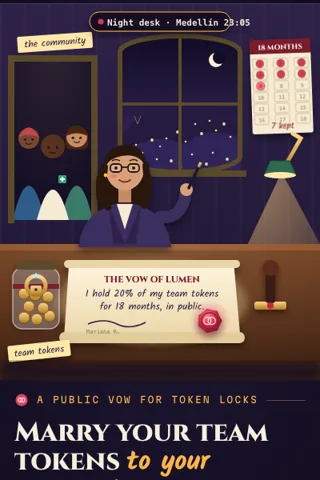 LIVE DEMO
Founders publicly vow their own token lockups and get a shareable trust score that grows with time kept.
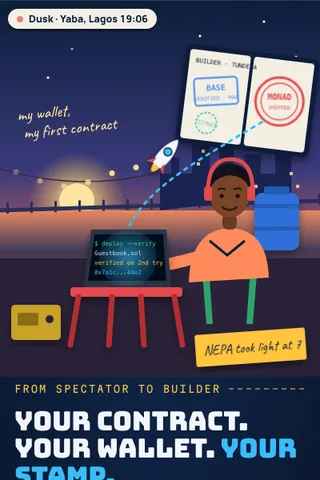 LIVE DEMO
Your own verified contract live on a new chain in ten minutes, with a public builder page to prove it.
 LIVE DEMO
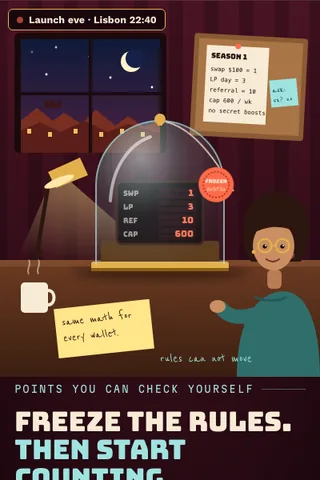
A points program where the formula, caps and conversion odds are public and frozen before day one.
 LIVE DEMO
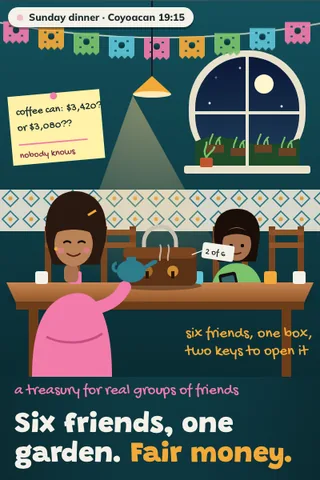
A DAO starter kit for small real groups: treasury, votes and roles in plain language.
 LIVE DEMO
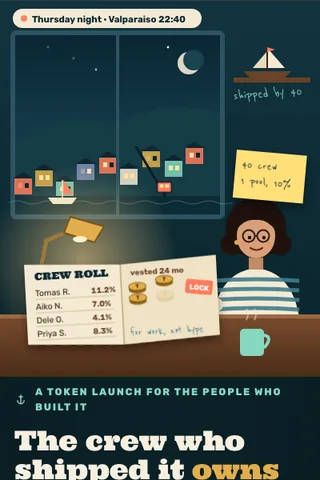
Launch a token that only your verified contributors can receive, weighted by work they actually shipped.
 LIVE DEMO
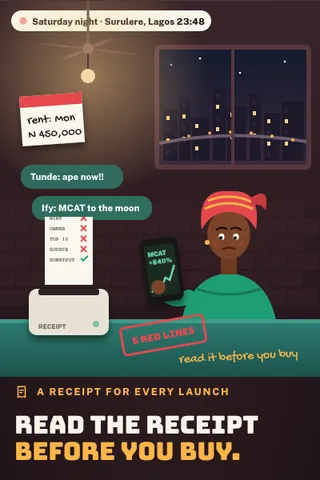
Every launch gets a printable safety receipt: locks, caps, owner keys, all checked live.
 LIVE DEMO
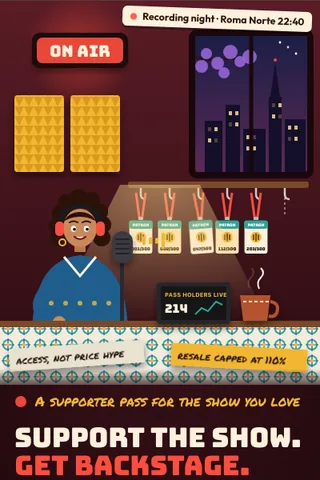
Launch a supporter pass where holders earn real access, not price promises.