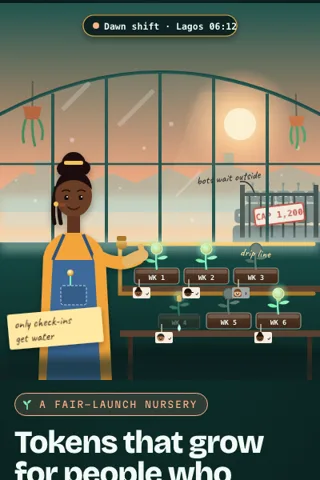
 LIVE DEMO
Slow Mint
A fair-launch token pad where supply unlocks only as real holders keep showing up, week after week.
Reserve · refundable deposit
$149Base · Solana +2
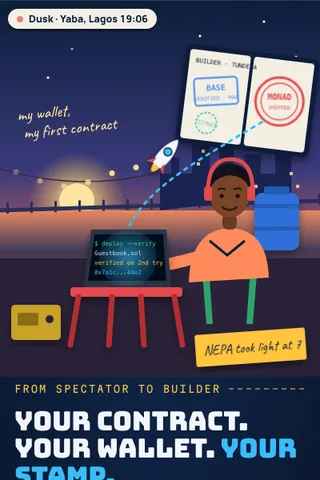 Try it live
Your own verified contract live on a new chain in ten minutes, with a public builder page to prove it.
Try it live, freeTunde hears Monad mainnet builders get early attention. First Deploy walks him through deploying his own verified contract from his own wallet, then gives him a shareable builder page listing every chain he has shipped on.
Guided deploy flow, contract verification, builder profile page across chains.
Reshape it entirely: new features, your flows, your brand end to end, integrations you need. We scope it with you.
The pieces are live separately; the bundle of guided deploy plus portable builder page is a packaging choice, not a new mechanic.
Base Learn guides first deploys and mints progress NFTs, Ronin's Builders Portal registers onchain builder profiles from deployed contracts, and thirdweb and Remix handle deploys.
Checked with web searches in October 2026. A search is not proof that nothing similar exists, and the market moves fast, so we recheck before every build.
Existing shipped projects OK.
Eligibility unknown.
The complete First Deploy app: a beginner picks a chain and a tiny template, deploys and verifies it from their own wallet, and collects a stamp per chain on a builder page, with a paywall and guide agent built in.
Every buyer gets the same finished app. Basic branding and copy changes come through a quick form.
Your admin side: revenue, paywall editor, users, rules and the agent log.
Referral and growth mechanics, switched on when you are ready to grow.
EVM deploys are free; builders subscribe for Move, domains and streak savers, and cohorts pay per class, in USDC.
Builders pay their own gas from their own wallet; the app never holds keys.
Prices are yours to set. Illustrative, not a promise of income.
Turn spectators into provable builders, one small verified contract at a time.
Problem: Beginners watch crypto from the sidelines because the first deploy is confusing and nobody can see what they built.
Solution: A guided deploy from the builder's own wallet with verification, and a builder page of stamps read from chain.
Why now: New chains launch monthly and each wants first builders; deploys cost cents.
Market: Students, bootcamps and hackathons, from free builders to $199 a month cohorts.
The ask: Run cohorts with three Lagos universities this term.
Funding is never guaranteed. Check each program's rules.
Many hackathons require code written at the event. See the Regatta Boardfor each race's rule.
New chains, custom templates, cohort branding and certificates, scoped on a call from $1,000.
Builder programs, grants and ecosystem teams increasingly ask one question first: what have you shipped? Many capable people never cross from reading threads to deploying anything, because the first deploy, the gas, the verification step and the proof of authorship are scattered across tutorials and explorers.
This largely exists in pieces. Base Learn guides first deploys and mints progress NFTs, Ronin's Builders Portal registers onchain builder profiles from deployed contracts, and thirdweb and Remix handle deploys and verification. First Deploy is a packaging choice, not a new mechanic: one guided flow that deploys from the user's own wallet and verifies the source, plus a portable builder page that lists every chain they shipped on, read straight from deployer addresses. Its value is getting a beginner to a verified first contract quickly and making that proof easy to share.
Public chain data only: contract addresses, deploy transactions and the deployer address, plus verification status from explorers or Sourcify. The user adds a display name, city and optional photo for their page. The app never holds keys and stores no private data beyond the page profile.
Turn spectators into provable builders, one small verified contract at a time, on any chain they choose.
The first stamp Watching a passport stamp land after the first verified deploy is a real moment of pride, and people screenshot it.
Proof that travels One link that lists every chain you shipped on, each one checkable onchain, is exactly what builder calls and applications ask for.
Ship Friday A weekly small idea and a streak of Fridays keeps people shipping after the first deploy, which is where most stop.
Wallet: The user connects their own wallet (any injected wallet, or a Privy embedded wallet for first timers). Every deploy is signed by the user, so the chain records them as deployer.
Templates and compile: Small audited-style templates (guestbook, tip jar, fixed supply token) compiled in the browser with solc for EVM chains, and a Move package path for Sui using the Sui CLI guide.
Chains: EVM chains such as Base, Monad, Berachain and HyperEVM through viem with each chain's public RPC, plus Arc testnet and Sui. Chain list is configurable by the owner.
Verification: Submits standard JSON input with exact compiler settings to the Etherscan V2 multichain API or Sourcify, falling back to the chain's own explorer API, and retries on settings mismatch.
Builder page: A public page per address that indexes contracts where that address is the deployer, using explorer APIs or a light indexer, and shows verified or unverified stamps.
Guide assistant: An optional assistant explains errors in plain words using a small model such as Claude Haiku 4.5. It reads errors and balances only and cannot sign.
Hosting: Next.js on Vercel with a small database (Convex or Postgres) for page profiles and the weekly reminder.
Gas is paid by the user from their own wallet: a small contract deploy on Base is typically a few cents or less, and similar on other low fee chains, but fees vary, so the app shows a live estimate. Verification APIs have free tiers. The guide assistant costs roughly $0.002 to $0.01 per explained error with a small model. Example month with 1,000 users: hosting about $20, database about $25, assistant about $15, so roughly $60.
Every builder page carries a 'ship your first' link, and pages get shared on builder calls, in applications and in class groups. Cohorts bring whole groups at once, and each new chain launch is a natural moment to invite people to add a stamp.
Scam tokens: A token template could be misused for scams. The token template has no sale function, the page labels it as a learning deploy, and the app never promotes tokens.
False expectations: Users may think a stamp guarantees grants, rewards or program entry. Copy says plainly it is proof of shipping only.
Key safety: Beginners can be phished. The app never asks for seed phrases, never signs for the user and warns about fake 'verify your wallet' sites.
Chain changes: New chains change RPCs, explorers and verification APIs. Keep chain configs in one file and check them monthly.
Verification failures: Settings mismatches are common. Always submit the full standard JSON input and show the exact settings used.
Costs and tools are estimates at the time of writing. General information only, not legal or financial advice.
Nine routes from one vessel. Tap a port to open its chart.
Thousands of people want to say 'I build on Monad' or 'I build on Base' and have nothing to point at. First Deploy turns that wish into a verified contract deployed from their own wallet and a builder page that lists every chain they have shipped on. If you own it, every new builder you onboard does it on your platform, under your brand, paying you, and your own builder page is the first one on it.
The guided deploy, verification and builder page are built. You run it, brand it and bring people to it. You will deploy your own contract first, so you understand the flow from the user's side.
Parts of it, yes. Your value is the bundle and the hand holding: one flow across several chains, a page that collects every deploy, and you as the friendly guide for your community. Compete on care and audience, not features.
Some will. Say clearly on every page that deploying does not guarantee any airdrop or reward. It builds a real, provable record; that is the honest promise.
Chains do upgrade. Test one deploy per chain monthly, keep a status note on the site, and remove a chain from the menu rather than leave it broken.
Many will not. Your buyers are people short on time, communities that want a branded onboarding flow, and hackathon organizers who want participants deploying in ten minutes.
Individual builders pay a small fee per guided deploy bundle and builder page, and communities, bootcamps and hackathon organizers pay for branded cohorts where every participant ships a verified contract.
Illustrative stages, not a forecast. Results depend on you and the market; nothing here is guaranteed.
LIVE DEMOA fair-launch token pad where supply unlocks only as real holders keep showing up, week after week.
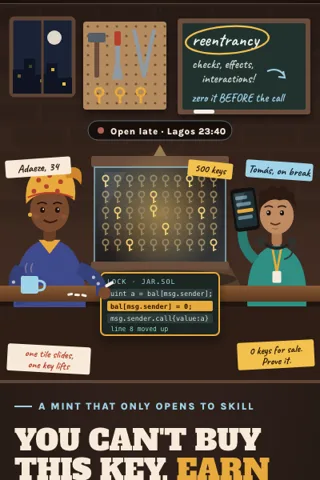 LIVE DEMO
Launch an NFT collection where each piece can only be minted by proving you can do the thing.
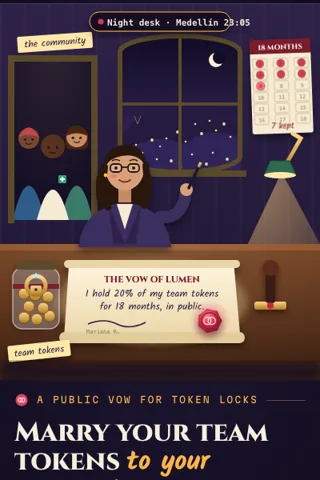 LIVE DEMO
Founders publicly vow their own token lockups and get a shareable trust score that grows with time kept.
 LIVE DEMO
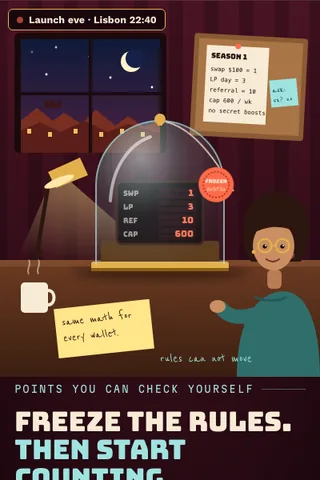
A points program where the formula, caps and conversion odds are public and frozen before day one.
 LIVE DEMO
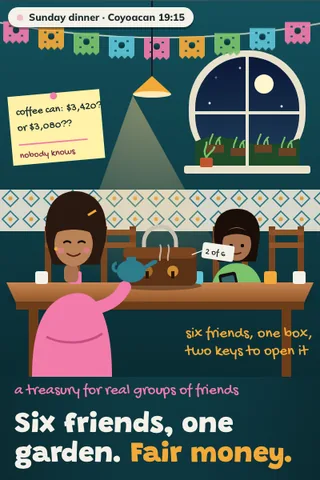
A DAO starter kit for small real groups: treasury, votes and roles in plain language.
 LIVE DEMO
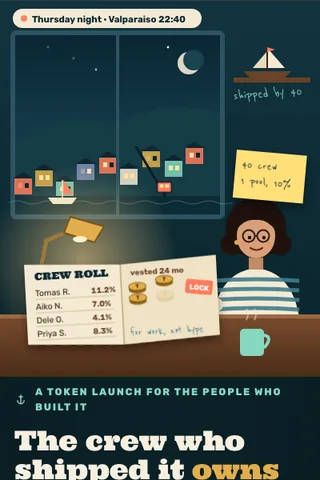
Launch a token that only your verified contributors can receive, weighted by work they actually shipped.
 LIVE DEMO
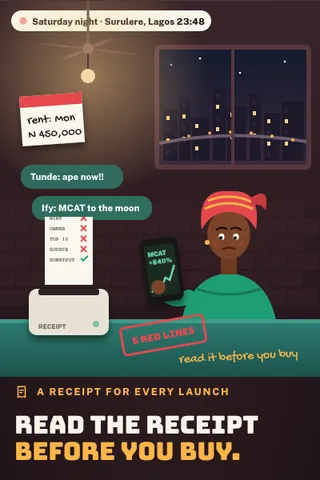
Every launch gets a printable safety receipt: locks, caps, owner keys, all checked live.
 LIVE DEMO
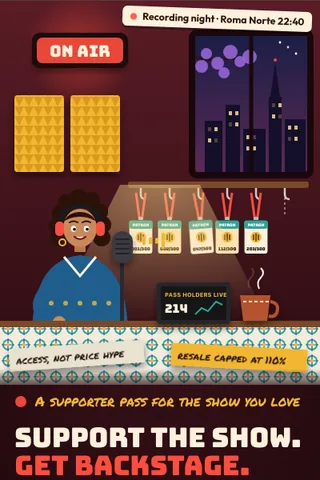
Launch a supporter pass where holders earn real access, not price promises.