 LIVE DEMO
Called It
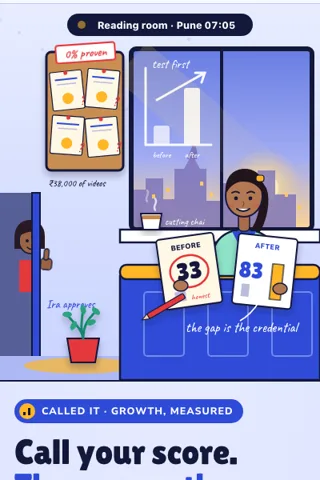
Log what you expect to learn before a course, then prove how much you actually grew.
Reserve · refundable deposit
$149Base · Optimism
 Try it live
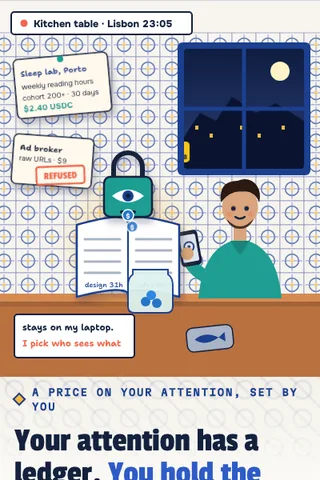
Keep a private log of what you read and watch, then sell anonymized slices only when you choose.
Try it live, freeLeo realizes brands profit from his browsing. Attention Ledger stores his history encrypted locally, and he opts in to sell aggregated topic slices to researchers for USDC, revoking anytime.
Local capture extension, encrypted vault, consent receipt contract, buyer request board
Reshape it entirely: new features, your flows, your brand end to end, integrations you need. We scope it with you.
Per-buyer consent data sales exist as a hackathon prototype; an individual-held attention log with revocation is uncommon.
Vana DataDAOs pool user data, Brave Rewards pays for ad attention, and Consent Protocol (HackFS) let users choose which data to sell and to whom.
Checked with web searches in October 2026. A search is not proof that nothing similar exists, and the market moves fast, so we recheck before every build.
User-owned data theme; eligibility unknown
The complete Attention Ledger app: members keep an encrypted log of what they read and watch on their own device, sell anonymized cohort averages only under their own rules, and revoke any licence, with a paywall and crypto checkout built in.
Every buyer gets the same finished app. Basic branding and copy changes come through a quick form.
Your admin side: revenue, paywall editor, users, rules and the agent log.
Referral and growth mechanics, switched on when you are ready to grow.
Keeping a ledger and saying no are free. Members can go Pro for deeper tools, research labs pay for buyer seats, and the owner takes a small fee on each slice sold.
The owner keeps a 10% fee on each slice (adjustable), halved for Pro members. Gas for receipts is under $0.01 and can be sponsored.
Prices are yours to set. Illustrative, not a promise of income.
A private ledger of your attention: sell anonymized averages to research you approve, and take back any yes.
Problem: Browsing and watching history is sold by ad networks and brokers without people's say or a share. Some people would gladly help research, but have no private way to keep the log, set rules and revoke.
Solution: A log kept encrypted on the person's device, a rules engine that answers buyer requests only with cohort averages above a minimum crowd, and consent receipts on chain that can be revoked.
Why now: Cheap receipts on Base, embedded wallets that pay out USDC without key handling, and small models that screen buyer requests for raw data asks make consented data practical for normal people.
Market: Academic researchers, media studies groups and market research firms who need consented panels, and the people tired of being tracked for free.
The ask: Two pilot research labs as first buyers, a privacy law review partner, and grant support from user owned data programs such as NEAR AI grants.
Funding is never guaranteed. Check each program's rules.
Many hackathons require code written at the event. See the Regatta Boardfor each race's rule.
Custom work from $3,000: your own topic taxonomy, a buyer agreement flow for your jurisdiction, integration with a lab's survey tool, extra languages or a white label panel for a university. Scoped on a call.
People's browsing and watching history is already sold by ad networks and data brokers, without their say or a share. Some people would gladly help research with anonymized averages, on their own terms, but have no private way to keep the log, set rules and revoke.
Vana DataDAOs pool user data for AI training, Brave Rewards pays users for viewing ads, and Consent Protocol, an ETHGlobal HackFS project, let users choose which data to sell and to whom. What we did not find is an individual-held attention log, kept encrypted on the person's device, that answers buyer requests with aggregated slices under personal rules and supports revocation. The consent selling idea exists as a prototype; the on-device ledger with revocable licences is the uncommon part.
Visited page topics, time spent and media type, captured by a local extension and stored encrypted on the user's device. Buyers receive only cohort aggregates. Onchain: licence grants, payments and revocations, with hashes. Raw URLs and history never leave the device.
Make a person's attention theirs to price, lend and take back, so research can learn from it without anyone being watched.
A mirror of your week Every Sunday the ledger shows where your hours went. Most people come for the mirror, not the money.
Saying no feels good Watching the agent refuse an ad broker on your behalf is a small, satisfying moment of control.
Revocation is real Taking back a yes with one tap, and seeing future deliveries stop, builds trust that keeps people opted in.
Local capture extension: A browser extension and optional mobile share sheet classify pages into topics on device and log time spent. Encrypted with a key kept on the device.
Rules engine: The user's rules (what to log, blocked buyer types, minimum cohort, floor price, licence length) run locally against each request.
Aggregation and privacy check: Requests are answered only as cohort averages through an aggregator using minimum cohort sizes and a uniqueness check; rare topics are dropped. Differential privacy noise can be added for larger studies.
Consent receipt contract: On Base (or NEAR, Arbitrum), each licence is a record: buyer, slice type, duration, price, and a revoked flag. Revocation stops future keys.
Buyer request board: Verified buyers post requests and fund them in USDC. Payment is released to users when a slice is delivered.
Wallets: Privy embedded wallets so users receive USDC without handling keys.
Request screening agent: A small model such as Claude Haiku 4.5 reads buyer requests and flags ones that ask for raw data or come from blocked categories.
Per licence on Base: gas usually under $0.01. Screening a request with a small model: about 2,000 tokens, under $0.01. Example month with 1,000 users and 200 slices: under $10 in gas and model costs, plus about $50 for hosting the request board and aggregator.
Users share their weekly mirror and refusals. Researchers who get useful slices post more requests, which draws more users who want to be part of studies they care about.
Re-identification: Small cohorts or rare topics can identify people. Enforce minimum cohorts and uniqueness checks, and drop rare topics.
Privacy law: Selling personal data is regulated (GDPR, CCPA). Use explicit consent, purpose-limited licences, and legal review per market.
Revocation limits: Data already delivered cannot be recalled. Say so plainly and keep licences short.
Bad buyers: A buyer may misuse data. Verify buyers, ban breaches, and keep a public record of licences.
Small income: Payments are small. Never promise earnings.
Costs and tools are estimates at the time of writing. General information only, not legal or financial advice.
Nine routes from one vessel. Tap a port to open its chart.
Every ad network already sells a slice of what you read and watch; you just never see the money or the buyer. Attention Ledger keeps a member's history encrypted on their own device and lets them sell anonymized topic slices to researchers only when they say yes, with a consent receipt onchain and revocation any time. Owning it means you run the consent marketplace: your brand on the extension, your buyer relationships, and your platform fee on every consented sale.
The capture extension, encrypted vault, consent receipt contract and buyer request board are built. You brand it, deploy from your wallet with the guide and publish the extension under your name. Expect a few extra steps for the browser store listing.
Consent based sales of anonymized, aggregated data can be lawful, but privacy law varies (GDPR, state laws and others). Before your first paid sale, get a privacy lawyer to review your terms and buyer agreements. Never sell raw histories.
Many will not, and that is reasonable. Publish exactly what is captured, keep data encrypted on device, open source the extension if you can, and start with people who already know you.
Academic researchers, market research firms and media studies groups who need consented panels. Start with one researcher you can reach personally.
Small amounts at first, often a few dollars a month. Be honest: it is about control and fair pay, not income replacement.
Buyers pay per consented data slice; members receive most of it and you keep a clearly disclosed platform fee. Researchers can also pay a monthly subscription for panel access.
Illustrative stages, not a forecast. Results depend on you and the market; nothing here is guaranteed.
LIVE DEMOLog what you expect to learn before a course, then prove how much you actually grew.
 LIVE DEMO
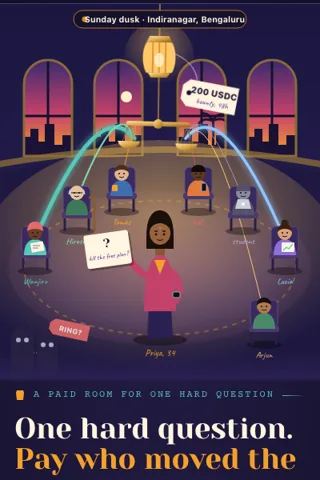
Pose a hard question, stake a bounty, and pay the crowd by how much each answer moved the final consensus.
 LIVE DEMO
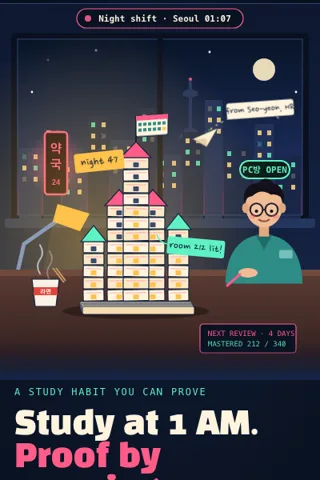
Turn what you are learning into spaced repetition decks that prove your streak and mastery onchain.
 LIVE DEMO
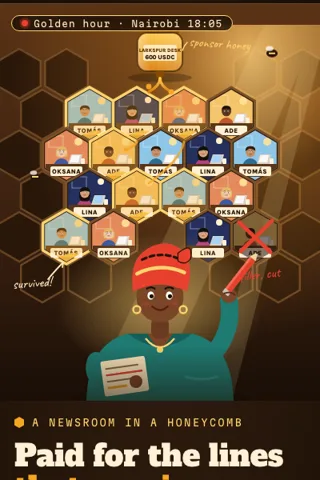
A group writes one living briefing together and everyone is paid by the lines that survive edits.
 LIVE DEMO
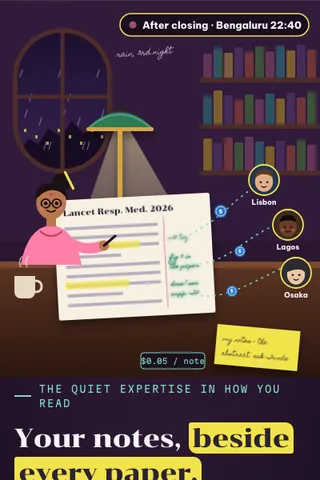
Your highlights and annotations on any article become a collectible, tippable layer others can subscribe to.
 LIVE DEMO
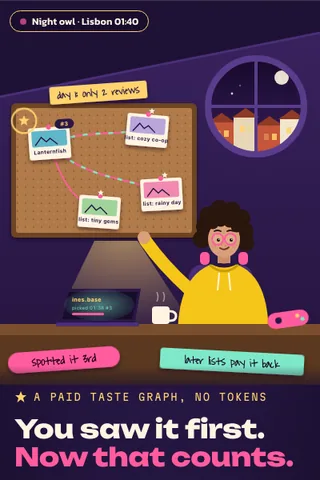
Curate a list early, and earn a share when the things you picked go on to be loved.
 LIVE DEMO
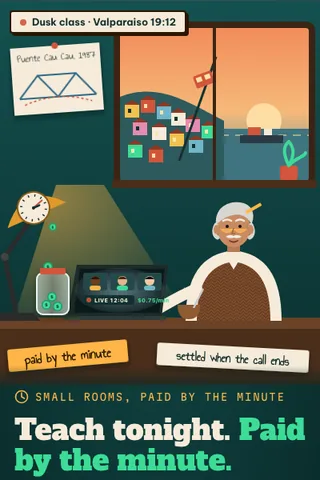
Teach live in small rooms where students pay per minute and you get paid the second the call ends.
 LIVE DEMO
Write letters to the future that unlock for named people at a date or when you stop checking in.