 LIVE DEMO
Sealed Take
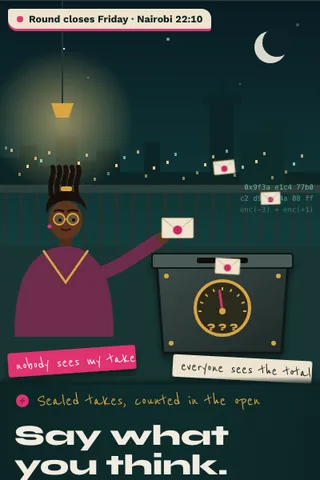
Everyone stakes a conviction, encrypted. The chain tallies it without ever seeing a single take. FHE on Base.
Ready now
$20Fhenix
 Try it live
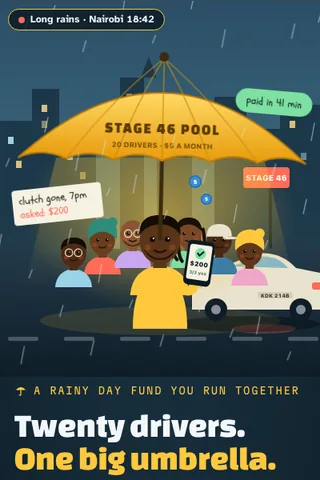
A small group pools a rainy-day fund and votes fast on emergency payouts to members.
Try it live, freeTwenty ride-share drivers in Nairobi chip in $5 a month. When Otieno's car breaks down he requests $200, three members approve within an hour, and USDC lands. No insurer, no promised returns, just each other.
Pool contract, monthly contributions, request flow, tiered approval thresholds, transparent ledger.
Reshape it entirely: new features, your flows, your brand end to end, integrations you need. We scope it with you.
The mechanic exists in prototypes; a maintained small-group product was not found.
ChipIn (hackathon), help a fren (open source) and aidDAO prototype group emergency funds with voted payouts; none confirmed live.
Checked with web searches in October 2026. A search is not proof that nothing similar exists, and the market moves fast, so we recheck before every build.
USDC mutual aid; eligibility unknown
Existing projects OK
The complete Mutual Umbrella member app: a small group chips in monthly, asks with a photo, votes with their wallets and gets USDC the same hour, with a paywall and a steward agent built in.
Every buyer gets the same finished app. Basic branding and copy changes come through a quick form.
Your admin side: revenue, paywall editor, users, rules and the agent log.
Referral and growth mechanics, switched on when you are ready to grow.
Running a pool is free. Chairs pay for Pool Plus per pool, associations pay monthly for many pools, and the owner can set a small service fee on payouts shown on every receipt. Plan money never passes through the pool.
Optional service fee on payouts (0%, 0.5% or 1%) set by the owner. Gas on Celo is under one cent and can be sponsored.
Prices are yours to set. Illustrative, not a promise of income.
A rainy day fund a small group runs itself: chip in monthly, vote fast, USDC lands the same hour.
Problem: Gig drivers, traders and small crews live one breakdown or hospital bill from losing a week of income. Insurance rarely covers them and group funds run on a treasurer's notebook and trust.
Solution: A shared pool contract with a cap, tiered approvals, a waiting period and photo fingerprints. Members ask, friends approve with their wallets, and a steward agent reminds and tallies but never moves money.
Why now: Phone number wallets, near zero gas on Celo and Base, and USDC to mobile money off ramps make a group fund practical for people who never touch crypto.
Market: Ride share and boda drivers, market traders, church and savings groups, and the associations that organise them across East and West Africa and beyond.
The ask: Pilot partners: one drivers association and one off ramp partner, plus grant funding from public goods and financial inclusion rounds.
Funding is never guaranteed. Check each program's rules.
Many hackathons require code written at the event. See the Regatta Boardfor each race's rule.
Custom work from $1,000: your own ask categories and rules, an off ramp in your country, SACCO or chama integrations, extra languages, or an association branded deployment. Scoped on a call.
Gig drivers, market traders and small crews live one breakdown or hospital bill away from losing a week of income. Formal insurance rarely covers them, chamas and merry go rounds run on trust and a treasurer's notebook, and when money is short it is the treasurer who carries the stress and the suspicion.
The mechanic exists in prototypes, not as a maintained product. ChipIn (a hackathon project), help a fren (open source) and the aidDAO prototype all show group emergency funds with voted payouts, and none was confirmed live. Research verdict: rare, medium novelty. What this app adds is the everyday packaging for one small group: tiered approval thresholds, a cap per request, a waiting period for new members, a voluntary top up circle when an ask is over the cap, proof photo hashing against repeat claims, and a steward agent that reminds and tallies but never decides.
Monthly contributions and payouts in USDC on the chosen chain, member wallets and the membership snapshot taken when each request opens, approval signatures, request amounts and the cap rule used, hashes of proof photos. Reasons, photos and phone numbers stay in group storage visible to members only.
Give any small group a rainy day fund it can run itself, quickly and fairly, without an insurer or a single treasurer holding the bag.
Paid within the hour A real ask approved by friends lands as USDC the same evening and cashes out to mobile money. People tell that story at the stage.
Umbrella Friday A one glance weekly check: pool balance, who is covered, your on time streak, and who the pool helped this month.
Rules you chose together Cap, thresholds and waiting period are voted in by the group, so a held request feels like the group's rule, not someone's judgement.
Wallets: Members sign in with an embedded wallet (for example Privy) tied to a phone number, so nobody needs a seed phrase. Celo is the default for low fees and mobile money off ramps, with Base or Polygon as options.
Pool contract: A small audited Safe based pool with a module that enforces the cap per request, approval thresholds by amount, the new member waiting period and a membership snapshot per request. Payouts need the configured number of member signatures.
Requests and votes: A request stores amount, reason category and a proof photo hash onchain. Votes are wallet signatures collected offchain and submitted in one transaction when the threshold is met.
Steward agent: A scheduled agent on a small model tier (for example Claude Haiku) sends reminders, tallies votes, flags repeat proof hashes and drafts the Friday digest. It holds no keys that can move funds.
Notifications: WhatsApp or SMS through a messaging API for reminders, requests and payout receipts, with times the group chooses.
Cash out: USDC to local currency through a licensed off ramp partner in each country, for example to M-Pesa in Kenya. The app does not hold customer funds itself.
Indexer: A light indexer reads pool events to build the ledger, the balance chart and the yearly report.
On Celo a contribution or payout costs well under one cent in gas. The steward agent uses roughly 2,000 tokens per digest or tally on a small model tier, about $0.002 to $0.01 each. Messaging is the main cost at about $0.005 to $0.05 per message depending on country and channel. A 20 member pool with weekly digests runs about $3 to $6 a month all in, before off ramp fees which the member pays at cash out.
Every payout is a story people repeat at the stage, and the share card names the group, not the app. New members join existing pools by invite, and drivers who move routes start new pools with the same rules. Associations of drivers, traders and churches run pools for their members.
Not insurance: In many countries pooling against risk can fall under insurance or savings group rules. Keep pools small and member run, never promise payouts, and get local legal advice before marketing to the public.
Join, ask, leave: Waiting periods, caps and membership snapshots limit it. Overrides need a larger vote.
False claims: Proof photo hashes catch reuse. The group still has to trust each other; the app makes it visible, not impossible.
Pool runs dry: The app warns when the cap is large compared with monthly inflow and shows months of runway before every vote.
Privacy: Medical and family reasons stay offchain and visible only to members, deleted after 90 days by default.
Key loss: Embedded wallets with phone recovery, and the pool contract lets the group vote a lost member's replacement wallet in.
Costs and tools are estimates at the time of writing. General information only, not legal or financial advice.
Nine routes from one vessel. Tap a port to open its chart.
Mutual Umbrella lets a small group pool a rainy day fund and vote quickly on emergency payouts to members. Owning it means the groups you serve trust your deployment, not an unknown app, and every contribution and vote is visible onchain. It is not insurance and promises no returns, it is people looking after each other with better tools.
DEPLOYR deploys it from your wallet. You help groups set up: members, monthly amount, how many approvals a payout needs.
It is a mutual aid pool, not insurance, and you must say so plainly. Rules on pooled funds differ by country. Keep groups small and member run, never promise payouts or returns, and get local advice before running it at scale.
Groups set their own approval rules, like three members must approve. Payouts and votes are public to members. Start with groups who already know each other.
The app deployment is yours and fees route to your wallet. Each group's pool belongs to its members, not to you. That separation is the point.
It can. Groups should set a payout cap and a waiting period for new members. Be honest that the fund only holds what members put in.
Groups use the app to run their own pools; the owner earns a small monthly fee per group for the tools, never a share of the pooled money. About $1M a year is a target, not a promise.
Illustrative stages, not a forecast. Results depend on you and the market; nothing here is guaranteed.
LIVE DEMOEveryone stakes a conviction, encrypted. The chain tallies it without ever seeing a single take. FHE on Base.
 LIVE DEMO
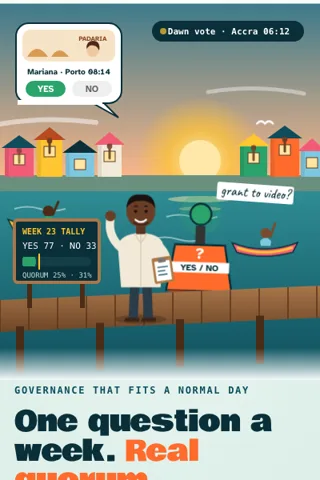
Governance by text-sized questions: one decision a week, answered in ten seconds, with real quorum.
 LIVE DEMO
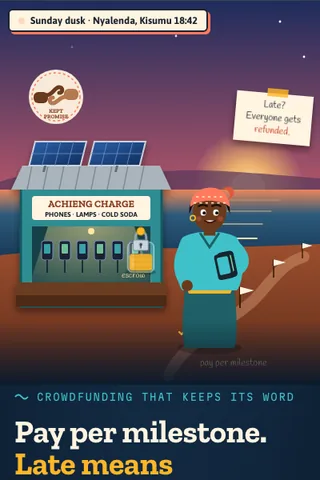
Crowdfunding where backers get refunded by contract if the goal or the milestones are missed.
 LIVE DEMO
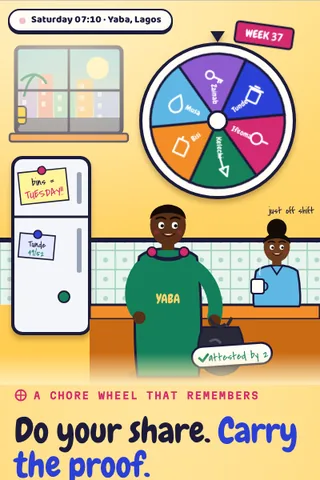
A shared house or club tracks who did the work, and the record becomes everyone's portable reliability score.
 LIVE DEMO
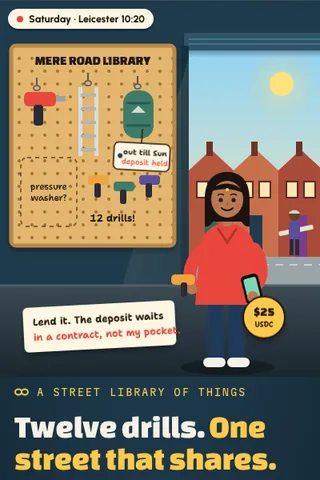
Lend the ladder, the drill, the tent: a street library of things with deposits held by contract.
 LIVE DEMO
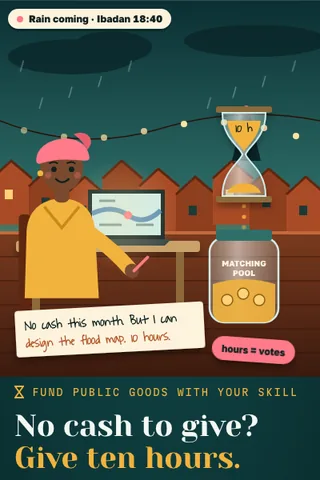
Fund a public good with hours of your skill, not just money, and get matched like a donation.
 LIVE DEMO
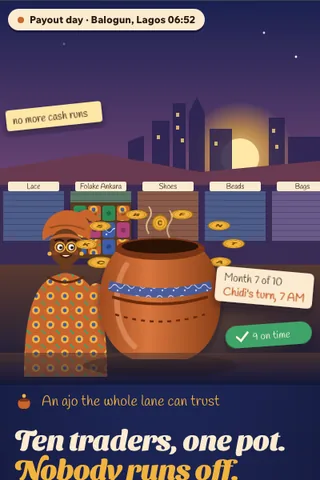
A rotating savings circle (ajo, susu, chama) with payouts enforced by contract and trust scores for members.
 LIVE DEMO
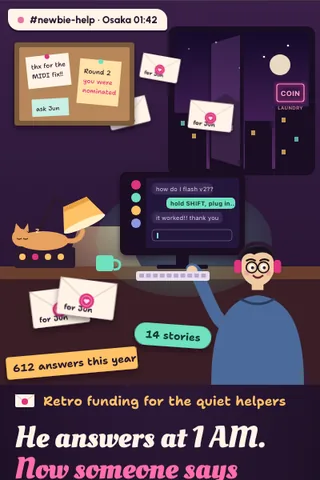
Retro funding for the quiet helpers: the community nominates who mattered, a pot pays them.