 LIVE DEMO
Sealed Take
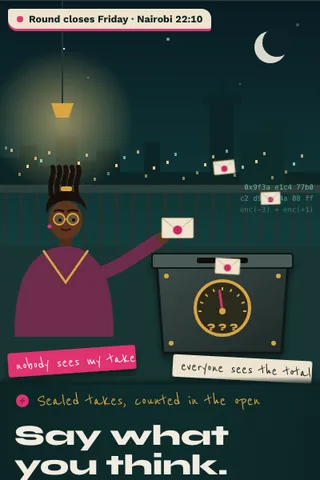
Everyone stakes a conviction, encrypted. The chain tallies it without ever seeing a single take. FHE on Base.
Ready now
$20Fhenix
 Try it live
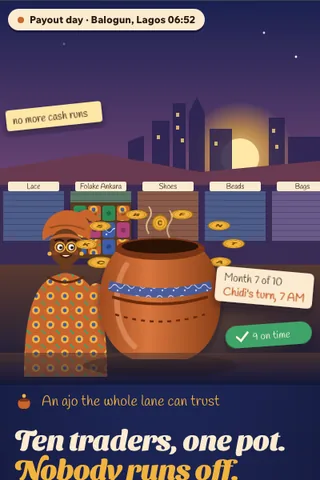
A rotating savings circle (ajo, susu, chama) with payouts enforced by contract and trust scores for members.
Try it live, freeFolake's market traders run a monthly ajo, but last year a member vanished after collecting. Pot Luck locks each month's contributions, pays the turn automatically, and requires late joiners to post a small bond, while on-time payers build a savings record.
Circle creation, USDC contributions, turn order, automatic payout, member bond, on-time record badges.
Reshape it entirely: new features, your flows, your brand end to end, integrations you need. We scope it with you.
Onchain ROSCAs with reputation already exist; differentiation would be UX and distribution, not mechanic.
AjoAI claims to be live on Celo mainnet with per-circle escrow and onchain reputation, and AjoDAO, Ajo on Base and Venn esusu-chain are hackathon builds of the same mechanic.
Checked with web searches in October 2026. A search is not proof that nothing similar exists, and the market moves fast, so we recheck before every build.
Stablecoin savings app; eligibility unknown
Payments apps; existing projects OK
The complete Pot Luck app: a rotating savings circle where the pot is held by contract, each turn pays itself, a bond covers missed payments and every member builds an on time record, with a paywall built in.
Every buyer gets the same finished app. Basic branding and copy changes come through a quick form.
Your admin side: revenue, paywall editor, users, rules and the agent log.
Referral and growth mechanics, switched on when you are ready to grow.
Running one lane's circle is free. Organisers who run more circles pay monthly, and trader associations pay for many organisers and one shared rulebook. The app never takes a cut of contributions.
No fee on contributions or payouts. Gas, under $0.10 a cycle per circle, can be sponsored by the owner. Members pay their own onramp fees.
Prices are yours to set. Illustrative, not a promise of income.
A rotating savings circle where the pot pays itself and nobody can run off with it.
Problem: Millions of traders save through ajo, susu and chama circles that run on trust and a cash bag. When a member collects early and disappears, the rest carry the loss and the organiser's name is damaged.
Solution: Contributions go into a small contract that pays each turn on time, holds a bond from members who have already collected, and builds an on time record that members own and can carry to the next circle.
Why now: Phone number wallets, cheap stablecoin transfers on Celo and Base, local onramps and small models that write voice note reminders in local languages make it usable for traders who have never touched crypto.
Market: Market traders, cooperatives and diaspora groups who already save in rotating circles, plus the trader associations that oversee dozens of them.
The ask: Pilot partners: two real circles in one market and one trader association, plus grant support from stablecoin and payments programmes.
Funding is never guaranteed. Check each program's rules.
Many hackathons require code written at the event. See the Regatta Boardfor each race's rule.
Custom work from $1,400: your own circle types and rules, a mobile money partner in your country, extra languages for reminders, or an association branded deployment. Scoped on a call.
Rotating savings circles (ajo, esusu, susu, chama, tanda) are how millions of traders save and get a lump sum without a bank loan. They run on trust and a cash bag. When a member collects early and disappears, the rest of the circle carries the loss and the organiser's name is damaged.
This mechanic already exists. AjoAI says it is live on Celo mainnet with per-circle escrow and onchain reputation, and AjoDAO, Ajo on Base and Venn esusu-chain are hackathon builds of the same idea. Research verdict: exists, low novelty. What this version focuses on is the organiser's day to day: voice note reminders in local languages, a grace window before anything counts as late, a bond held only from members who have already collected, late joiners posting a bond, and an on time record that travels to the next circle. The difference is UX and distribution, not the contract.
Circle rules (size, amount, cycle, order, bond, grace), member wallets, contribution and payout transactions, bond balances, and an on time record per member. Names, stall locations, phone numbers and the reasons a payment was missed stay in the app, never onchain.
Let any group of people who already trust each other save together without one person carrying the risk, the cash or the blame.
The pot pays itself On payout morning the person whose turn it is gets paid automatically. Nobody walks across the market with a bag of cash.
A record you keep Every on time payment adds to a savings record you can show the next circle, so a lane that does not know you can still let you in.
The Sunday check A two minute weekly check: did I pay, whose turn is next, leave a voice note. Streaks keep the whole circle on time.
Wallets: Privy embedded wallets with phone number login on Celo (default), Base or Polygon. Members never see a seed phrase. Organisers can add members who only have a phone.
Pot contract: A small circle contract holds USDC contributions per cycle, pays the turn holder at the set time, holds a bond from members who have collected, and pays bonds back at the end. Rules are fixed when the circle starts and hashed onchain.
On time record: Each payment updates a per member record; at the end of a circle an EAS attestation summarises it (cycles, on time count, misses covered by bond). Members choose whether to share it.
Pot keeper agent: A low cost model tier (for example Claude Haiku or a comparable small model via OpenRouter) writes reminders and summaries and flags missing payments after the grace window. It can only remind and trigger the bond rule; it cannot move a member's funds.
Reminders: WhatsApp Business messages and voice notes in the members' languages, sent at a time the circle picks. SMS fallback for basic phones.
Money in and out: Local onramps and offramps (bank transfer or mobile money partners where available) so members see naira, cedi or shillings, while the pot settles in USDC.
Per cycle for a 10 person circle: about 12 onchain transactions (10 contributions, 1 payout, 1 bond update). On Celo these typically cost well under one US cent each, so under $0.10 a cycle. Reminder writing with a small model is roughly 20 short messages a cycle, a fraction of a cent. WhatsApp business messages are the main cost, a few cents each depending on country. Example: 50 circles of 10 people, monthly, comes to roughly $40 to $80 a month in messaging and gas, before onramp fees which members pay.
Every circle has an organiser who already runs one in cash. When a member's sister hears about it in another market, she can join with her record instead of a personal vouch. Each finished circle produces records that make the next one easier to fill.
Regulation: Holding pooled savings can count as deposit taking or money transmission in some countries. Launch with legal advice per market, keep the contract non custodial and keep amounts in the range circles already use.
Not an investment: A savings circle returns what you put in. It must never be marketed as earning interest, yield or profit.
Default after collecting: A bond reduces but does not remove the loss if someone leaves early. Circles choose the bond size knowing this, and the app shows the exposure plainly.
Privacy and shame: Misses are visible to the circle, which can be harsh. Reasons stay private, and members control whether their record is shared outside the circle.
Phone and wallet loss: Phone number recovery through the embedded wallet provider, and an organiser cannot redirect a member's payout.
Stablecoin and onramp risk: USDC and local onramps can fail or pause. Show the naira value at each step and keep a manual fallback for a cycle.
Costs and tools are estimates at the time of writing. General information only, not legal or financial advice.
Nine routes from one vessel. Tap a port to open its chart.
When your ajo, susu or chama runs on someone else's app, they hold the members, the records and the trust. When you own Pot Luck, the circle runs from your wallet under your group's name, payouts follow a contract nobody can walk away with, and every on-time payment builds a savings record your members keep. You become the trusted organizer, with proof.
Many will not at first. Start with the two or three who already hold USDC, or help members get a simple wallet on a phone. Keep a cash circle running beside it until the onchain one proves itself. Do not push anyone.
That is what the member bond is for: late joiners post a small bond, and missed payments come from it. It reduces the risk; it does not remove it. Choose members you know, and put newer members later in the turn order.
Yes. It deploys from your wallet, with your group's name. DEPLOYR builds and hands it over.
Informal rotating savings is legal in most places, but taking deposits from the public or charging interest can be regulated. Keep circles to people you know, take no interest, and check local rules before you charge an organizer fee or run circles for strangers.
Funds sit in the contract between turns, so a bug or a stablecoin problem is a real risk. Keep circles small, cycles short and contributions an amount members can afford to lose access to for a while.
A small organizer fee per circle per cycle, paid circles for cooperatives and market associations, and partner fees from fintechs who want members with proven savings records.
Illustrative stages, not a forecast. Results depend on you and the market; nothing here is guaranteed.
LIVE DEMOEveryone stakes a conviction, encrypted. The chain tallies it without ever seeing a single take. FHE on Base.
 LIVE DEMO
Governance by text-sized questions: one decision a week, answered in ten seconds, with real quorum.
 LIVE DEMO
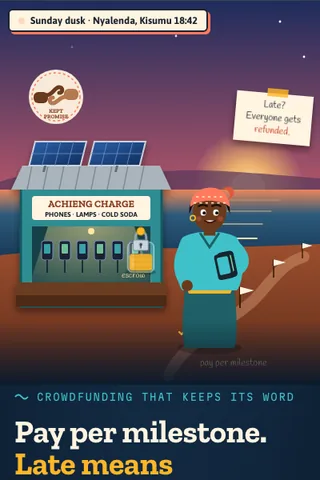
Crowdfunding where backers get refunded by contract if the goal or the milestones are missed.
 LIVE DEMO
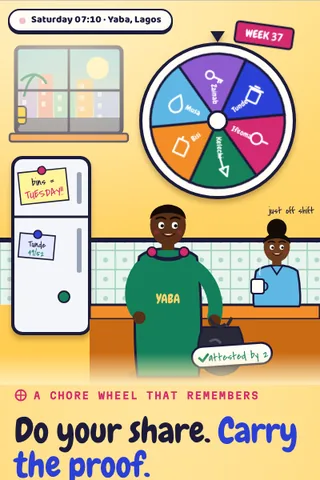
A shared house or club tracks who did the work, and the record becomes everyone's portable reliability score.
 LIVE DEMO
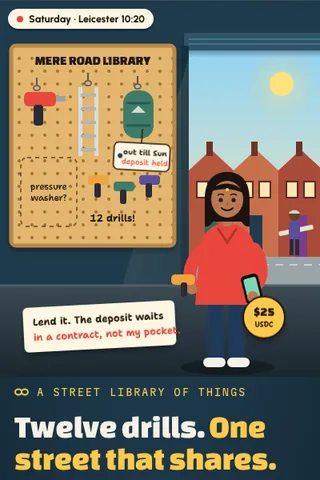
Lend the ladder, the drill, the tent: a street library of things with deposits held by contract.
 LIVE DEMO
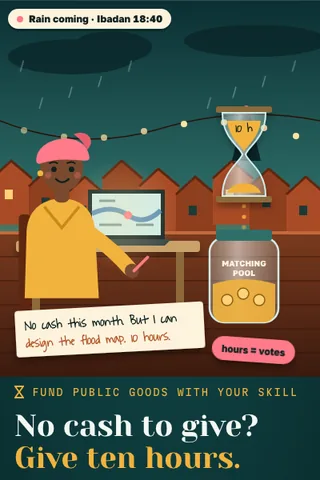
Fund a public good with hours of your skill, not just money, and get matched like a donation.
 LIVE DEMO
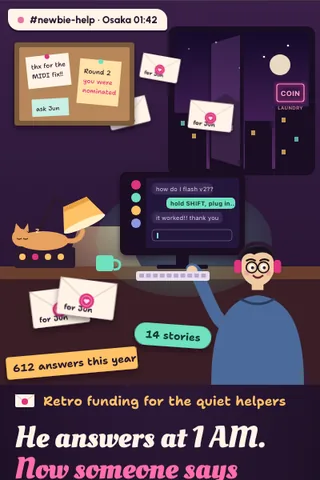
Retro funding for the quiet helpers: the community nominates who mattered, a pot pays them.
 LIVE DEMO
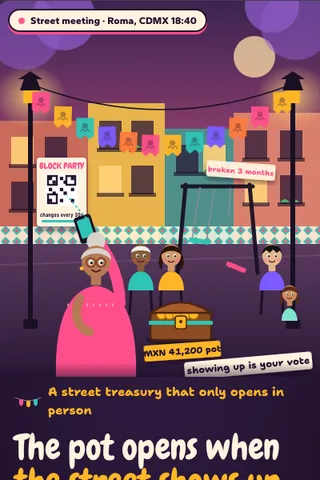
A neighbourhood treasury where proposals unlock only after enough real neighbours physically show up.