 LIVE DEMO
Fix Proof
Tradespeople log each repair with photos and a customer signature, sealed onchain as a warranty.
Reserve · refundable deposit
$159Base · Polygon +1
 Try it live
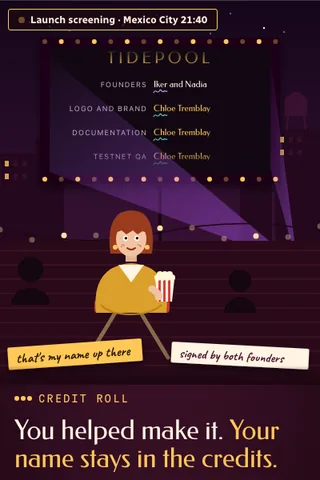
Every contributor to a project gets a signed credit, like movie credits, owned by them forever.
Try it live, freeChloe designed the logo, wrote docs, and tested a protocol that later took off. The founders issue Credit Roll entries; her role is permanently on record and linked from her portfolio.
Project credits page, role attestations, contributor claim flow, embeddable credits widget.
Reshape it entirely: new features, your flows, your brand end to end, integrations you need. We scope it with you.
Contributor attestations exist; a movie-style credits roll is a presentation twist.
Optimist Profiles, Lighthouse and CodeCred issue onchain contribution attestations, but not as a simple credits page.
Checked with web searches in October 2026. A search is not proof that nothing similar exists, and the market moves fast, so we recheck before every build.
Contribution attribution tooling; needs measurable impact.
Open-source projects OK.
The complete Credit Roll app: every contributor to a project gets a signed credit, like movie credits, claimed and owned by them forever, with a paywall, owner console and usher agent built in.
Every buyer gets the same finished app. Basic branding and copy changes come through a quick form.
Your admin side: revenue, paywall editor, users, rules and the agent log.
Referral and growth mechanics, switched on when you are ready to grow.
Contributors claim credits free. Projects pay a monthly plan for unlimited rolls, hackathons and DAOs buy event or season packs, and contributors can pay for Portfolio Pro.
Event and season packs from $490. Attestation gas on Base, Optimism or Arbitrum is a few dollars a month.
Prices are yours to set. Illustrative, not a promise of income.
Every contributor to a project gets a signed credit, like movie credits, owned by them forever.
Problem: Designers, writers and testers who make projects possible are invisible in commit histories, and anyone can claim they worked on something.
Solution: An usher drafts credits from repos, design files, docs and bug trackers; founders sign each role at release; contributors claim them as attestations they can link from any portfolio.
Why now: Cheap attestations on Base, Optimism and Arbitrum and ecosystems that want honest contribution data for grants and hiring.
Market: Open source and crypto projects, hackathons, DAOs and the designers, writers and testers who work with them.
The ask: Pilot partners: three projects, one hackathon and one DAO season, plus Optimism retro funding style grants.
Funding is never guaranteed. Check each program's rules.
Many hackathons require code written at the event. See the Regatta Boardfor each race's rule.
Custom work from $700: your own role taxonomy, integrations with your design and docs tools, branded portfolio pages or an ecosystem deployment. Scoped on a call.
Designers, writers, testers, translators and community leads help projects launch, then disappear from the story. Repos only remember commits, and a portfolio claim like 'I did their brand' is easy to doubt and easy to fake.
Contributor attestations already exist. Optimist Profiles on Optimism, Lighthouse and CodeCred issue onchain contribution attestations, and research rates this concept as medium novelty. What Credit Roll adds is presentation and workflow: a movie-style credits page per release, roles signed by founders, a claim flow for non-code contributors, pseudonymous credits and an embeddable widget for portfolios. It is a friendlier layer on known attestation tools, not a new primitive.
Project releases, roles, contributor wallets or pseudonyms, founder signatures, evidence fingerprints (hashes of files, links or invoices kept by the project), claim status and dispute notes. Evidence itself stays private with the project.
Make sure everyone who helped build something keeps their name on it, with proof they own.
Your name rolls Each release ends with a credits screening. Seeing your name roll past is a small, real joy, and people share it.
Proof in ten seconds Anyone viewing a portfolio can check the founders' signatures behind a role in one click.
Release night ritual Founders sign the new credits before each release goes out, so contributors know to look for their name.
Wallets and login: Privy embedded wallets with email login so non-crypto contributors can claim. Founders sign with their existing wallets or a Safe.
Credit attestations: Ethereum Attestation Service schema credit-roll v1 on Base, Optimism or Arbitrum: project, release, role, contributor, evidence hash, signers. Signed credits are never overwritten; corrections are new attestations that reference the old one.
Credits agent: A small model tier (for example a Claude Haiku class model via an API router) reads repo history, design file activity, docs history and issue trackers to draft roles. A larger model summarises disputes. It drafts only, never signs.
Claim flow: Each contributor gets an email link to claim into their wallet, choose a legal name or pseudonym, and hide or show the credit.
Credits page and widget: An indexer turns attestations into a scrolling credits page per release and an embeddable widget for portfolios and READMEs.
Disputes: Competing claims are shown side by side with dated evidence. Founders resolve them by signing a new, narrower credit or declining.
Each credit is one attestation; on Base or Optimism that is usually well under one US cent in gas, sponsored by the app. Drafting a release's credits uses a few tens of thousands of tokens on a small model, a few cents. A project with 40 credits a release costs well under $1 per release to run. 500 projects a month: roughly $200 to $400 including hosting.
Every credit sends a claim email to someone new, and every claimed credit ends up as a widget on a portfolio, which shows other builders the tool. Ecosystems that care about contribution data bring their projects in bulk.
False credit: Founders can credit friends or omit people. Mitigation: two signer option, public dispute flow, evidence hashes. It shows who vouched; it cannot prove the work was good.
Privacy and safety: Some contributors cannot be publicly named. Pseudonymous credits and hidden credits are first-class options, and legal names are never required.
Permanence: Attestations are lasting. Contributors can hide a credit from their page, and projects can issue a correction, but the history remains.
Overclaiming value: A credit is a record, not a guarantee of jobs, grants or rewards. The app must say so.
Agent errors: The drafting agent can miss people or inflate titles. It never signs, and drafts are labelled as drafts until humans approve.
Costs and tools are estimates at the time of writing. General information only, not legal or financial advice.
Nine routes from one vessel. Tap a port to open its chart.
Credit Roll turns the invisible work behind a project into credits people own forever, and whoever runs the credits page becomes the place a community goes to say thank you. Own it and every roll carries your brand, your wallet issues the attestations, and your onchain record shows you as the builder who made contributors visible. Use someone else's and you are just a name in their list.
Busy founders rarely start on their own, so you start for them. Draft the roll from their public repo, docs and Discord, then ask them to approve it. Approving a ready list takes five minutes; writing one from scratch never happens.
Credits are issued and signed by the project, not self-claimed. A contributor can only claim a credit the project created. If a mistake happens, the project can issue a correction, and the history stays visible.
Yes. Issuing a roll is a form: project name, roles, contributors. DEPLOYR deploys and hands it over. Your real job is talking to projects and contributors.
Modest money from single projects, better money from hackathons, DAOs and agencies that issue many rolls a year, and from contributors who want a polished profile. It is a small, steady product, not a jackpot. Treat the revenue ladder below as a target.
The attestation contract deploys from your wallet, payouts go to your wallet, and the brand and domain are yours.
Projects pay per credits roll or a yearly plan for unlimited rolls; hackathons and DAOs buy event or season packs; contributors can pay for a premium portfolio page that aggregates all their credits. This is a target, not a promise.
Illustrative stages, not a forecast. Results depend on you and the market; nothing here is guaranteed.
LIVE DEMOTradespeople log each repair with photos and a customer signature, sealed onchain as a warranty.
 LIVE DEMO
Leave clear onchain instructions so the people you trust can reach your crypto if you cannot.
 LIVE DEMO
A weekly ritual that finds risky token approvals and lets you revoke them in one tidy pass.
 LIVE DEMO
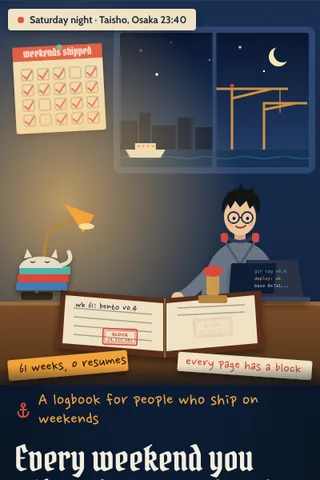
Every commit, deploy, and demo you ship becomes a signed, timestamped builder diary.
 LIVE DEMO
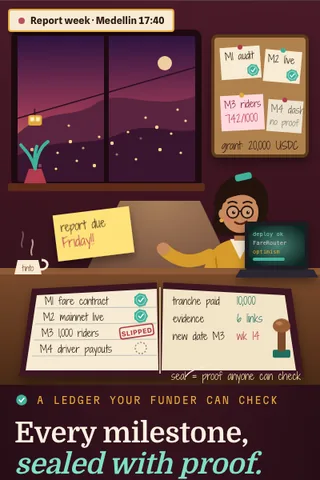
Show funders exactly what their grant built, milestone by milestone, with proof attached.
 LIVE DEMO
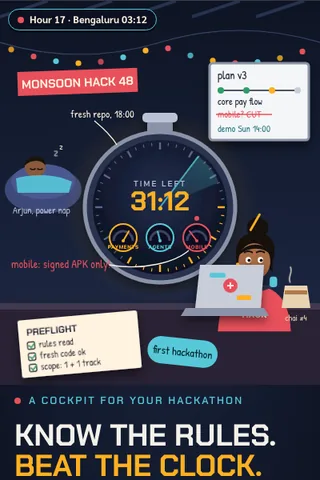
A hackathon cockpit that plans your scope, tracks bounties, and drafts a judge-ready submission.
 LIVE DEMO
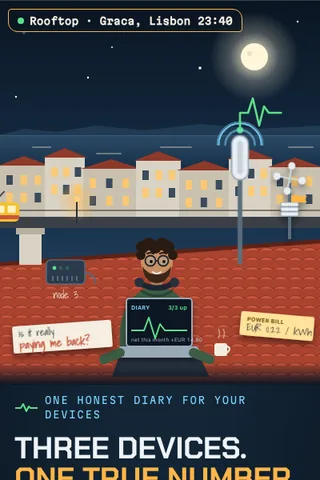
Your DePIN devices report uptime and earnings in one honest dashboard with tax-ready exports.
 LIVE DEMO
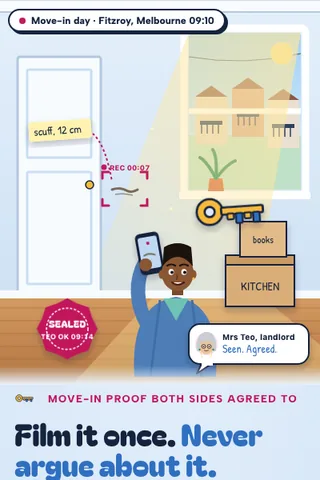
Tenants and landlords seal move-in photos and rent receipts so deposit disputes end fast.