 LIVE DEMO
Fix Proof
Tradespeople log each repair with photos and a customer signature, sealed onchain as a warranty.
Reserve · refundable deposit
$159Base · Polygon +1
 Try it live
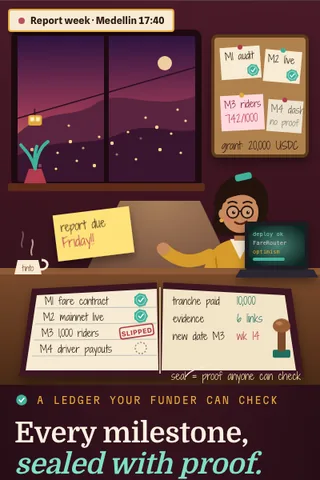
Show funders exactly what their grant built, milestone by milestone, with proof attached.
Try it live, freeA two-person team got 20k from a foundation and dreads the report. Grant Ledger links each milestone to a commit, deploy, or metric, then publishes a living report page the program manager can verify in a minute.
Milestone board, evidence linking, attestations, public report page, export for applications.
Reshape it entirely: new features, your flows, your brand end to end, integrations you need. We scope it with you.
Milestone proof for funders is live in Karma GAP; this would be a white-label variant.
Karma GAP lets grantees post milestones with proof as EAS attestations and gives funders review dashboards, integrated with Gitcoin and Octant.
Checked with web searches in October 2026. A search is not proof that nothing similar exists, and the market moves fast, so we recheck before every build.
Tooling for impact measurement; needs deployed measurable impact.
Public goods tooling; existing open-source projects OK.
Existing projects OK.
The complete Grant Ledger app: a grant team links each milestone to a commit, deploy or contract metric, seals it onchain or marks it honestly slipped, and sends the funder one living report, with a paywall and evidence agent built in.
Every buyer gets the same finished app. Basic branding and copy changes come through a quick form.
Your admin side: revenue, paywall editor, users, rules and the agent log.
Referral and growth mechanics, switched on when you are ready to grow.
Teams start free; Team Pro and funder Program plans are paid monthly in USDC.
Seals cost well under $0.05 each on an L2.
Prices are yours to set. Illustrative, not a promise of income.
Make grant follow through visible, so small teams build a record and funders spend minutes on reports.
Problem: Grant reports are PDFs of screenshots that funders cannot check and teams dread writing.
Solution: Milestones linked to checkable evidence, sealed onchain or honestly slipped, in one living report.
Why now: Ecosystem grant programs fund thousands of small teams and need accountability without overhead.
Market: Grant funded teams and the programs that fund them, from free to $500 a month.
The ask: Pilot with two ecosystem grant programs this quarter.
Funding is never guaranteed. Check each program's rules.
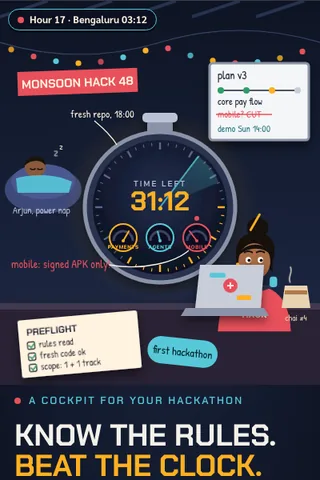
Many hackathons require code written at the event. See the Regatta Boardfor each race's rule.
Custom evidence readers, program dashboards, new chains and branded reports, scoped on a call from $1,000.
Small teams that win grants spend days on reports, and program managers with dozens of grantees still check every link by hand. Slides round numbers up, screenshots cannot be checked, and slips get buried until trust breaks at the next round.
This largely exists. Karma GAP already lets grantees post milestones with proof as EAS attestations and gives funders review dashboards, integrated with Gitcoin and Octant. Research verdict: exists, low novelty. What this app offers is a white label variant an ecosystem or a single foundation can run under its own name: evidence read straight from commits, deploys and contract events, honest slip lines with new dates, a weekly close habit, and an export for the next application. It is a packaging and UX layer, not a new mechanic.
The grant agreement (milestones, dates, tranche splits), public repo commits and reviews, contract deploys and event logs on Optimism, Arbitrum, Base or Polygon, team wallet lists used to exclude self activity, and funder replies. Evidence files stay with the team; only hashes and statuses are attested.
Make follow through visible, so honest small teams build a checkable track record and funders spend minutes, not days, on reports.
The seal A milestone that holds up gets a green seal anyone can check. It is a small, satisfying moment that rewards linking proof as you go.
The honest slip Missed targets are shown with the real number and a new date. Funders learn to trust teams that show slips, and teams feel safe being honest.
The Friday close Ten minutes a week to accept or reject what the agent found. A streak calendar makes report season disappear.
Sign in: Privy email or wallet login for grantees and funders, with team roles. No custody of funds.
Grant import: The agreement is parsed into milestones, dates and tranche percentages by a small model (for example Claude Haiku tier), then confirmed by the team.
Evidence readers: GitHub API for commits and reviews, an indexer (for example a hosted subgraph or Envio) for contract deploys and events, with team funded wallets excluded from metrics.
Attestations: Each verified milestone is an EAS attestation on the chosen chain with status, evidence hash and signer. Slips are attested too.
Report page: A public, living page per grant plus a funder dashboard across all grantees, with one click link checks.
Notifications: Friday reminders and funder alerts by email or Telegram bot.
Export: Sealed history exported as JSON and a readable summary for future applications.
Per milestone seal: one EAS attestation on an L2 such as Optimism or Base is usually well under $0.05 in gas. Evidence parsing with a small model is a few thousand tokens, roughly $0.01 or less. A team with 4 milestones and 12 weekly closes a quarter costs well under $2 to run. A funder program with 40 grantees is roughly $20 to $60 a month including indexer and hosting.
Every report link a funder opens shows a small made with Grant Ledger mark. Program managers who like it invite their whole cohort, and teams carry their sealed history into the next application.
Gaming metrics: Teams could fund wallets to inflate usage. Exclude wallets funded by the team within two hops and show the method on the page.
Overstated trust: A seal proves evidence exists and matches, not that the work is good. Say so on every page.
Privacy: Some milestones involve private user data. Only hashes go onchain; files stay with the team and can be shared privately.
Duplication with Karma GAP: An existing tool covers much of this. Offer import and export to avoid locking teams in.
No funding promises: The app never promises grants or tranche releases. Funders release money on their own terms.
Costs and tools are estimates at the time of writing. General information only, not legal or financial advice.
Nine routes from one vessel. Tap a port to open its chart.
Grant Ledger turns a dreaded grant report into a living page where each milestone links to a commit, a deploy or a metric anyone can check. Owning it means the reports your customers publish live on your domain and your contracts, so every program manager who verifies one meets your brand. Grantees pay for credibility, and you hold the onchain record of every team you helped prove their follow through.
The app is deployed to your wallet with setup steps. Connecting a GitHub repo or a contract address is a form, not a coding task. Your real job is talking to grantees and program managers.
Program managers spend hours chasing reports. A page they can verify in a minute saves them time. Not every program will adopt it, so start with the teams, who feel the pain first.
Yes. The contracts deploy from your wallet, the domain and brand are yours, and the customer list is yours. DEPLOYR does not take a cut of what you charge.
Grant Ledger links to evidence, it does not judge it. Make that clear on every page. The value is that fake claims become easy to spot when the proof link is right there.
Ledger entries are stored onchain and on public links, so the record survives a broken page. Setup issues are covered by the get-it-shipped promise.
Grantee teams pay per ledger or per month, and grant programs pay a higher monthly plan to give every grantee a ledger with a program dashboard. Reaching $1M a year is a target, not a promise, and depends on landing programs, not just individual teams.
Illustrative stages, not a forecast. Results depend on you and the market; nothing here is guaranteed.
LIVE DEMOTradespeople log each repair with photos and a customer signature, sealed onchain as a warranty.
 LIVE DEMO
Leave clear onchain instructions so the people you trust can reach your crypto if you cannot.
 LIVE DEMO
A weekly ritual that finds risky token approvals and lets you revoke them in one tidy pass.
 LIVE DEMO
Every commit, deploy, and demo you ship becomes a signed, timestamped builder diary.
 LIVE DEMO
A hackathon cockpit that plans your scope, tracks bounties, and drafts a judge-ready submission.
 LIVE DEMO
Your DePIN devices report uptime and earnings in one honest dashboard with tax-ready exports.
 LIVE DEMO
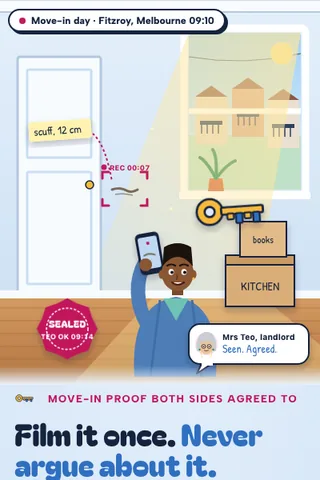
Tenants and landlords seal move-in photos and rent receipts so deposit disputes end fast.
 LIVE DEMO
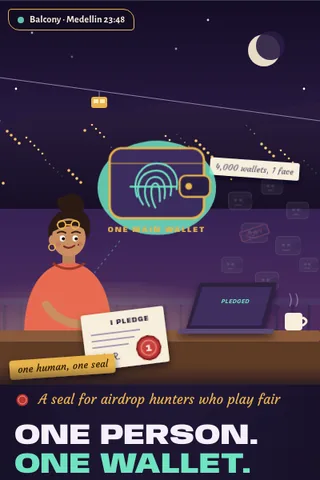
Airdrop hunters prove they are one real person with one main wallet and get ranked fairly.