 LIVE DEMO
Fix Proof
Tradespeople log each repair with photos and a customer signature, sealed onchain as a warranty.
Reserve · refundable deposit
$159Base · Polygon +1
 Try it live
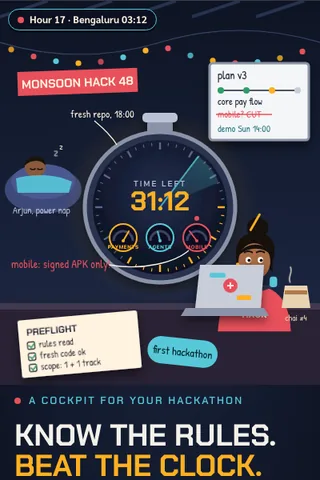
A hackathon cockpit that plans your scope, tracks bounties, and drafts a judge-ready submission.
Try it live, freePriya registers for a 48 hour event with three sponsor tracks. Hack Week Pilot reads the rules, flags eligibility traps like fresh-code requirements, builds a timeline, and on Sunday morning drafts the README and demo script.
Rules parser, eligibility checklist, team board, submission and demo-script drafts, onchain team commit timestamp.
Reshape it entirely: new features, your flows, your brand end to end, integrations you need. We scope it with you.
Hackathon AI copilots already exist; this would compete on web3 bounty depth.
HackPilot plans scope, generates Devpost copy and scores submission readiness, and HackaRag maps ideas to bounties.
Checked with web searches in October 2026. A search is not proof that nothing similar exists, and the market moves fast, so we recheck before every build.
Builder tooling for hackers; varies per event.
Many DoraHacks events accept existing BUIDLs.
The complete Hack Week Pilot app: a first time hacker gets every rule and linked document read, traps flagged, a plan checked against the clock, a timestamped kickoff commit and Sunday drafts of the README and demo, with a paywall and pilot agent built in.
Every buyer gets the same finished app. Basic branding and copy changes come through a quick form.
Your admin side: revenue, paywall editor, users, rules and the agent log.
Referral and growth mechanics, switched on when you are ready to grow.
Rules and traps are free; hackers pay monthly for Pilot and clubs or organizers buy licences, in USDC.
Timestamps cost a few cents per team per event.
Prices are yours to set. Illustrative, not a promise of income.
The veteran's hackathon playbook in a first timer's pocket.
Problem: First time hackers lose to fine print and overscoped plans, not to weak ideas.
Solution: Every rule read and checked, a plan against the clock, a timestamped fresh repo and honest Sunday drafts.
Why now: Web3 and AI hackathons run every week with sponsor tracks full of fine print.
Market: Student and early career hackers, plus the clubs and organizers who host them.
The ask: License to five university clubs and two event organizers this quarter.
Funding is never guaranteed. Check each program's rules.
Many hackathons require code written at the event. See the Regatta Boardfor each race's rule.
Custom event integrations, organizer dashboards, new chains and branded pilots, scoped on a call from $1,000.
First time hackers lose weekends to things veterans avoid: rules buried in linked PDFs, fresh code requirements, chasing too many sponsor tracks, and no demo video ten minutes before judging. The playbook lives in veterans' heads.
Hackathon AI copilots already exist. HackPilot plans scope, generates Devpost copy and scores submission readiness, and HackaRag maps ideas to bounties. Research verdict: exists, low novelty. This version would compete on web3 bounty depth: reading every linked rules document and diffing changes, flagging chain specific track requirements, an onchain commit timestamp at kickoff for fresh code rules, and a weekly practice loop between events. It is a focused variant, not a new category.
Public event pages, track pages and linked documents (PDF FAQs), the team's repo commits, the team's chosen tracks, hours and skills, and public bounty boards for weekly sprints. Drafts and notes stay private to the team.
Give every first time hacker the playbook veterans keep in their heads, so they ship something that works and learn faster.
The trap alert A red ticket that says this rule would have disqualified you, found in a PDF you never opened. People share that moment.
The runway A live gauge of build hours left versus scope. Seeing OVER BY 12H at hour 17 makes cutting scope feel obvious, not painful.
Sunday sprints A 45 minute weekly task matched to the next event that fits your stack, with a streak.
Sign in: Privy email or GitHub login, optional embedded wallet on Base for timestamps. Team invites by link.
Rules reader: Fetches the event page, track pages and every linked document, extracts rules with a mid tier model (for example Claude Sonnet tier) and rechecks on a schedule, diffing changes.
Planner: Scope estimates per track from rules and past public repos, against team hours with a 55% real build factor. Small model tier for routine nudges.
Repo watcher: GitHub webhooks track progress against the plan and feed the readiness score.
Commit timestamps: Kickoff and final commit hashes written to Base (or Solana or Arbitrum) as a tiny transaction or an EAS attestation, so fresh code is checkable.
Drafts: README, track answers and a 2 minute demo script drafted on Sunday morning, each claim linked to a commit, edited by the team.
Notifications: Telegram or Discord bot for rule changes, runway warnings and Sunday sprints.
Per event per team: reading and rechecking rules is roughly 200k to 400k tokens on a mid tier model, a few dollars at most; planner nudges and drafts on smaller models add well under $1. Two onchain timestamps on Base cost a few cents in gas. A club running 30 teams through an event is roughly $50 to $120 in model costs.
Share cards after each event, club licences that bring whole cohorts, and the weekly sprint list that brings people back between events.
Wrong rule reading: A missed or misread rule can cost a team. Always link the source line, mark confidence, and tell teams to confirm with organisers.
Rule breaking help: Some events ban AI generated code or copy. Read that rule first and switch drafting off when required.
Overpromising: The app never predicts or promises prizes. It helps teams ship; judges decide.
Privacy: Repos and drafts may be private. Only commit hashes go onchain, and only when the team opts in.
Competition: Existing copilots cover planning and copy. Stay focused on web3 track depth and honest scoping.
Costs and tools are estimates at the time of writing. General information only, not legal or financial advice.
Nine routes from one vessel. Tap a port to open its chart.
First time hackers lose weekends to the same traps: scope too big, a sponsor rule missed, a README written at 3am. Hack Week Pilot reads the rules, flags eligibility traps like fresh code requirements, plans the timeline, tracks bounties and drafts the submission and demo script. Owning it makes you the cockpit your community uses every hackathon: your brand, your team board, and revenue from every hacker and every organizer who wants better submissions.
Yes. The rules parser, eligibility checklist, team board, submission and demo script drafts and onchain team commit timestamp are built. You set the default chain, name and colors, add your AI key and deploy with the guide.
Check each event's rules. The tool drafts; the team edits and owns every word. Encourage hackers to disclose AI help where events ask, and never fake what was built.
No. It removes avoidable mistakes and saves hours. Judges still reward the idea and the build. Say this plainly.
It can. Show the source rule text beside every flag and tell users to confirm with organizers. Collect misses and fix the parser prompts.
Hackers who do many events, university clubs that send teams, and organizers who want fewer broken submissions.
Hackers pay per event or monthly; clubs and bootcamps pay per team; organizers pay to offer it to every participant.
Illustrative stages, not a forecast. Results depend on you and the market; nothing here is guaranteed.
LIVE DEMOTradespeople log each repair with photos and a customer signature, sealed onchain as a warranty.
 LIVE DEMO
Leave clear onchain instructions so the people you trust can reach your crypto if you cannot.
 LIVE DEMO
A weekly ritual that finds risky token approvals and lets you revoke them in one tidy pass.
 LIVE DEMO
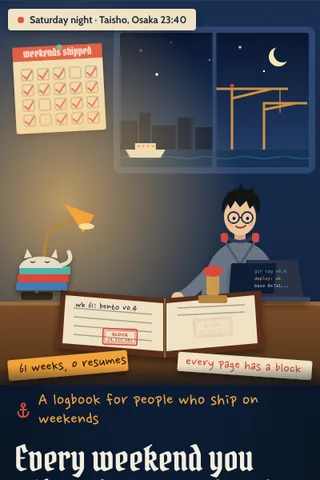
Every commit, deploy, and demo you ship becomes a signed, timestamped builder diary.
 LIVE DEMO
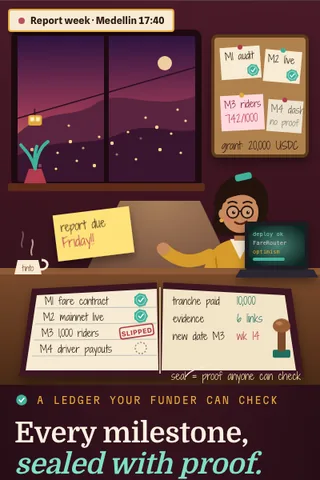
Show funders exactly what their grant built, milestone by milestone, with proof attached.
 LIVE DEMO
Your DePIN devices report uptime and earnings in one honest dashboard with tax-ready exports.
 LIVE DEMO
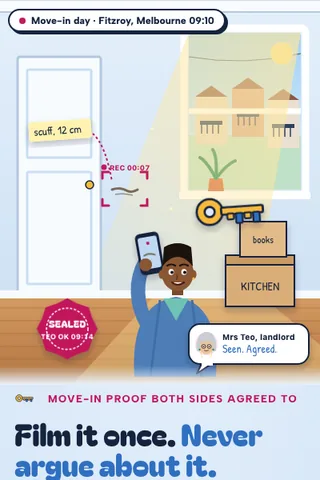
Tenants and landlords seal move-in photos and rent receipts so deposit disputes end fast.
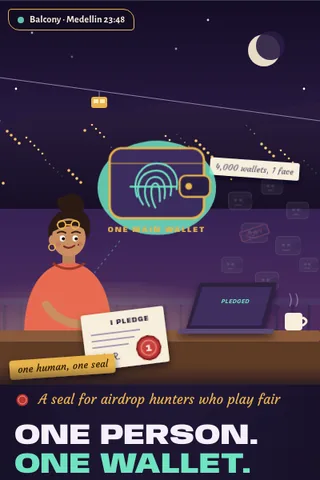 LIVE DEMO
Airdrop hunters prove they are one real person with one main wallet and get ranked fairly.