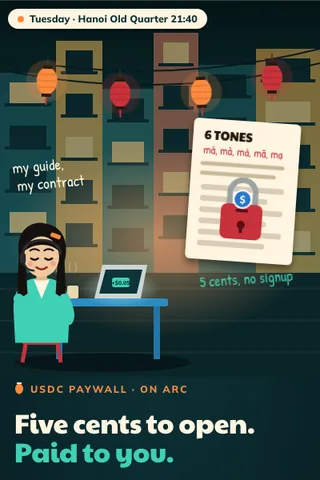
 LIVE DEMO
USDC Paywall
Lock content behind a fraction-of-a-cent USDC payment, on your own Arc contract. Deploy it, become the onchain creator.
Ready now
$20Arc
 Try it live
A tilt brake that delays your trades after losses until you answer one honest question.
Try it live, freeAfter three red trades, Dami reaches for 20x. Cooling Off holds his order for ten minutes, asks why, and logs the answer onchain to his own journal; he reviews the pattern each Sunday.
Order proxy with loss triggered delay, prompt journal, weekly tilt report
Reshape it entirely: new features, your flows, your brand end to end, integrations you need. We scope it with you.
The tilt-brake mechanic is live in Osias; the onchain wrapper and journaling prompt are the only differences.
Osias, a browser extension, blocks buys after loss-driven patterns with a configurable cooldown, and Wealthsimple enforces loss-limit cooldowns. These are not onchain, but the core tilt-brake mechanic is live.
Checked with web searches in October 2026. A search is not proof that nothing similar exists, and the market moves fast, so we recheck before every build.
Consumer trading safety; existing projects allowed if new progress disclosed
The complete Cooling Off app: when a trader's losing streak meets a leverage jump, new orders wait ten minutes and ask one honest question, while exits always pass, with a private journal, a paywall and a brake agent built in.
Every buyer gets the same finished app. Basic branding and copy changes come through a quick form.
Your admin side: revenue, paywall editor, users, rules and the agent log.
Referral and growth mechanics, switched on when you are ready to grow.
The brake is free; traders subscribe in USDC for reports and buddies, coaches and trading groups pay more.
No trading fees. A daily Base anchor costs a few cents a month per user.
Prices are yours to set. Illustrative, not a promise of income.
Ten minutes and one honest question at the moment a trader is most likely to hurt themselves.
Problem: Revenge trading after a losing streak blows up small accounts, and nothing stands between the impulse and the order.
Solution: An order proxy that holds new risk after a streak plus a jump, asks one question, journals the answer and never delays an exit.
Why now: Agent wallets on perps venues make a safe proxy possible without custody.
Market: Retail perps traders and the communities they trade in, from free to $29 a month.
The ask: Pilot with two trading Telegram groups.
Funding is never guaranteed. Check each program's rules.
Many hackathons require code written at the event. See the Regatta Boardfor each race's rule.
Custom triggers, more exchanges, coach dashboards and group plans, scoped on a call from $1,000.
Tilt, the urge to win back losses with a bigger bet, is one of the most common ways retail traders lose money fast. In the moment, willpower is weakest exactly when stakes jump.
The core mechanic already exists. Osias, a browser extension, blocks buys after loss-driven patterns with a configurable cooldown, and Wealthsimple enforces loss-limit cooldowns for its users. Neither is onchain. What is different here is small: the brake sits on an onchain order route (a Hyperliquid agent wallet), it asks one question and keeps the answer as a tamper-evident journal anchored on Base, and a Sunday review reads the pattern back. Research verdict: exists, low novelty.
Loss streaks and leverage or size versus the trader's own 7 day average, held orders and their outcome (cancelled or sent), the trader's answers (encrypted with their key), and one hash per journal entry on Base.
Give people ten minutes and one honest question at the moment they are most likely to hurt themselves.
Set by calm you You choose the trigger, the wait and the question on a calm Sunday. Loosening the brake waits too.
It never forbids After the wait you can still send. People trust a brake they control, and most still cancel.
Your words, read back The Sunday review shows why you wanted each trade, in your own words. That is what changes habits.
Order proxy: Orders go through a Hyperliquid agent wallet the trader approves. It can place and cancel, never withdraw. A proxy service decides send now or hold.
Trigger: Loss streak from the account's fills plus a jump in leverage or size versus the 7 day average. Reduce-only and close orders always pass.
Hold and ask: Held orders wait for the chosen delay; a push notification asks the question. Answers are encrypted client side.
Journal anchor: Each entry's hash and outcome are written to Base, batched daily to keep gas tiny, so the journal cannot be quietly rewritten.
Sunday review: A small model (for example a Haiku or Gemini Flash tier) summarizes decrypted answers on device or with the user's consent, and suggests a tighter trigger.
Other chains: The same proxy pattern fits Solana perps venues that support delegated trading keys.
Per user per month: one batched Base transaction a day is a few cents a month in gas at recent fee levels; the weekly review with a small model is under a cent; the proxy and notifications run on a small server, about $20 to $40 a month for a few hundred users. Example: 300 users is roughly $30 to $60 a month.
Share cards of nights someone went to sleep instead, brake templates passed around trading groups, and sisters, partners and friends who set it up for someone they worry about.
Not advice: The app never suggests trades and must not imply that waiting makes money.
Delaying exits: Holding a close can make a loss bigger. Reduce-only orders are never held.
Easy to bypass: Anyone can trade from another app or wallet. The brake is a commitment the trader makes, and the app says so plainly.
Sensitive words: Answers can reveal stress or gambling harm. They stay encrypted, and the app points to support lines when patterns look severe.
Key risk: A leaked agent key can place orders but not withdraw. Keys are scoped and revocable in one tap.
Costs and tools are estimates at the time of writing. General information only, not legal or financial advice.
Nine routes from one vessel. Tap a port to open its chart.
Cooling Off sits between a trader and their worst ten minutes, so whoever owns it owns a very personal kind of trust. When the brake runs on your contract, under your name, every saved account and every honest journal entry builds your brand and your onchain record instead of a browser extension company's. Traders tell their friends about the tool that stopped them from blowing up, and you want that story to end with your link.
The order proxy, the loss trigger, the journal prompt and the weekly tilt report ship ready. Your job is setting the delay length, picking the chain and inviting traders. If you want a custom trigger later, that is a paid change, not something you have to build.
Osias is a browser extension for centralized habits. Yours wraps onchain orders on Hyperliquid, Base or Solana and writes the journal to the trader's own wallet. That is a narrow difference, so win on community: a brake that your trading group set up together beats a generic tool nobody talks about.
It can. A held order may fill worse ten minutes later. Make the delay opt in, show it clearly before every session, and let the trader set their own length and an override phrase. You are offering a brake they chose, not financial advice, and your copy should say exactly that.
The contract deploys from your wallet, the brand and domain are yours, and the payout wallet for subscriptions is yours. DEPLOYR builds the vessel; your name goes on the bow.
Some will not. The ones who pay are traders who already lost a month to one bad night. Start with ten of them, free, and charge only after one of them tells you it saved a trade.
Traders pay a monthly subscription for the brake and the weekly tilt report. Trading groups and prop style communities pay a group plan to run it for all members, and the journal data (shared only with consent) makes a premium coaching tier possible. The ladder below is a target, not a promise.
Illustrative stages, not a forecast. Results depend on you and the market; nothing here is guaranteed.
LIVE DEMOLock content behind a fraction-of-a-cent USDC payment, on your own Arc contract. Deploy it, become the onchain creator.
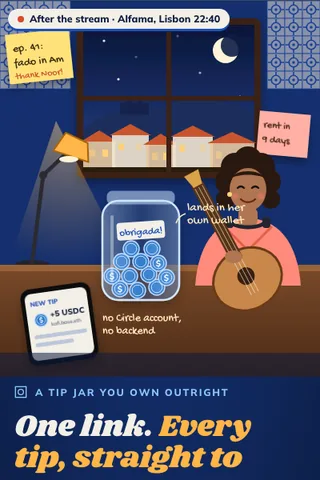 LIVE DEMO
Take pay-what-you-want USDC tips on Base, with a live supporters feed read straight from chain. No Circle account, no backend.
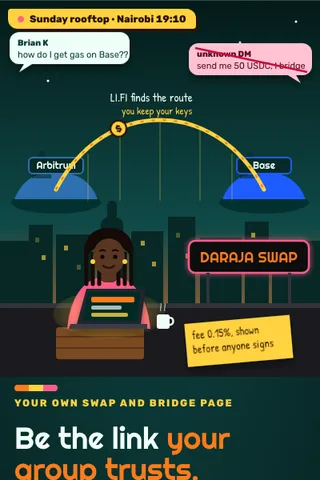 LIVE DEMO
Your own swap/bridge front-end. Integrator fee optional and disclosed.
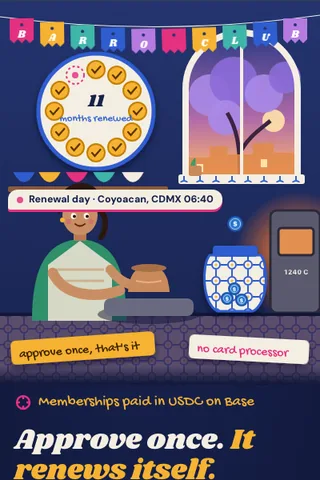 LIVE DEMO
Recurring USDC on Base. Members approve once, it renews itself. No card processor, no contract.
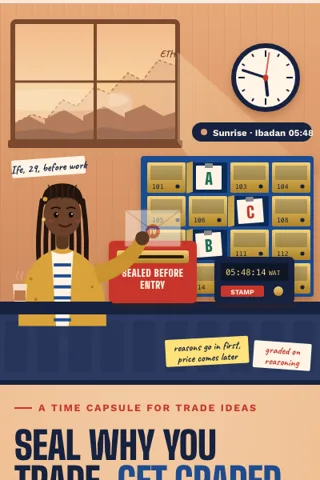 LIVE DEMO
Write why you entered a trade, seal it with the timestamp, and get graded on reasoning, not luck.
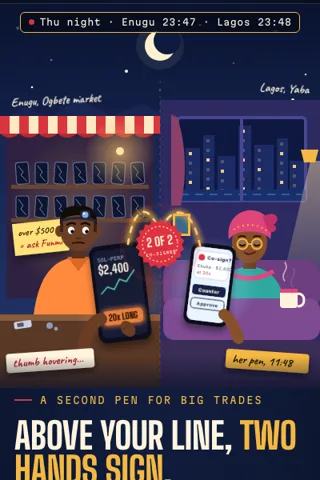 LIVE DEMO
Let a trusted mentor co sign your risky trades above a size you choose.
 LIVE DEMO
Your perp bot follows your rules, and every rule you kept becomes a public, provable track record.
 LIVE DEMO
Your prediction market history, turned into a calibration score you can carry anywhere.