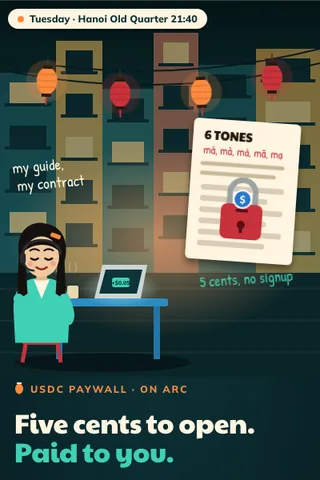
 LIVE DEMO
USDC Paywall
Lock content behind a fraction-of-a-cent USDC payment, on your own Arc contract. Deploy it, become the onchain creator.
Ready now
$20Arc
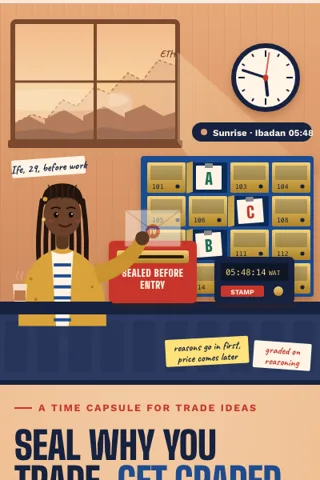 Try it live
Write why you entered a trade, seal it with the timestamp, and get graded on reasoning, not luck.
Try it live, freeIfe enters an ETH long with a written thesis and an invalidation level. When the position closes, the app scores whether the thesis played out and builds a reasoning record she can share with a fund.
Thesis form linked to wallet positions, onchain hash commit, auto grading at close, shareable profile
Reshape it entirely: new features, your flows, your brand end to end, integrations you need. We scope it with you.
Commit-before-outcome trade journaling exists in an early open source project; grading reasoning on top is uncommon.
BausBank vtr-core seals salted hashes of trading decisions onchain before outcomes, but it does not grade reasoning, and offchain journals like Tradervue are unverifiable.
Checked with web searches in October 2026. A search is not proof that nothing similar exists, and the market moves fast, so we recheck before every build.
Existing shipped projects OK
Superchain app; existing projects OK
The complete Thesis Vault app: traders write why they enter a trade, seal it onchain before entry, and are graded at close on whether their reasoning played out, building a verifiable record of judgment, with plans and checkout built in.
Every buyer gets the same finished app. Basic branding and copy changes come through a quick form.
Your admin side: revenue, paywall editor, users, rules and the agent log.
Referral and growth mechanics, switched on when you are ready to grow.
A free journal with a monthly call limit, a Pro record for traders who want a public verified profile, and desk plans for groups graded on one rubric.
No trading fees. Each call costs a cent or two of gas plus a few cents of model work at close.
Prices are yours to set. Illustrative, not a promise of income.
Write why you entered a trade, seal it with a timestamp, and get graded on reasoning, not luck.
Problem: Trading records only show PnL, which mixes skill with luck, and anyone can edit a journal after the fact.
Solution: A sealed thesis committed before entry, automatic checks of each stated reason at close, discipline and calibration scores, and attested grades that build a shareable record.
Why now: Cheap commits on Base, positions readable from wallets, and small models that can turn free text reasons into checkable claims.
Market: Self directed traders who want to improve or be hired, plus trading communities and funds screening talent.
The ask: Pilot with two trading communities and three small funds that will accept records.
Funding is never guaranteed. Check each program's rules.
Many hackathons require code written at the event. See the Regatta Boardfor each race's rule.
Custom work from $900: your own grading rubric, exchange or broker imports, a desk branded deployment, or fund review integrations. Scoped on a call.
Traders who want to be taken seriously by a fund, a community or themselves have no way to prove what they thought before a trade. PnL screenshots mix skill with luck, and journals can be edited after the fact.
Commit before outcome trade journaling exists: BausBank's open source vtr-core seals salted hashes of trading decisions onchain before outcomes. Offchain journals such as Tradervue are useful but unverifiable. What vtr-core does not do, as far as we found, is grade the reasoning itself at close, claim by claim, separately from profit. That grading layer and the shareable reasoning record are what is new here; the sealing idea is not.
The written thesis (reasons, invalidation, target, horizon, confidence), a salted hash committed on Base, the linked position's entry and exit from the user's wallet or exchange export, public market data for each named reason (price, funding, ETF flow reports, event calendars), and the grade attestation.
Make good judgment provable, so traders are trusted for how they think and not for one lucky screenshot.
Your worst trade can be your best grade Exiting where you said you would scores well even when it loses. That flips the usual shame of a loss into proof of discipline.
Nobody can be right in hindsight The hash is on Base before the entry. Once sealed, not even the author can quietly edit the reasons.
A Sunday review that teaches you A weekly digest shows which of your reasons actually hold and whether your 70% calls land about 70% of the time.
Wallets and positions: Privy login with an embedded or connected wallet. Positions are read from the user's onchain trades on Base, Arbitrum or Solana, or from a read only exchange CSV import. No trading permissions are ever requested.
Commit: The thesis is hashed with a private salt on the device and committed to a minimal contract on Base, storing only hash and block time. A reveal later checks the text against the hash.
Ordering check: The indexer compares the commit block with the position's entry. A thesis sealed after entry is labelled a journal note, not a call.
Grader: At close, each stated reason is mapped to its data source and window and checked by deterministic rules where possible (price levels, funding, flows). A model (Claude Haiku 4.5 class) parses free text reasons into checkable claims; a larger model (Claude Sonnet class) writes the plain language review. PnL is displayed but excluded from the score by design.
Attestations: The grade, rubric version and commit reference are written as an EAS attestation on Base, so a record can be verified without trusting the app's database.
Profile and digest: A public profile lists sealed calls, plan followed rate and calibration, with text revealed only for calls the user chooses. Sunday digest by email or push.
Per call: two small Base transactions (commit and grade attestation, the reveal can be batched) at roughly $0.002 to $0.01 each, plus about 3,000 tokens of model work at close, around $0.01 to $0.05 depending on the model tier. Example month for 1,000 active traders sealing 4 calls each: about $40 to $80 in gas, $40 to $200 in model calls, plus $50 to $100 for hosting, indexing and market data. Prices move; verify current gas and model rates before launch.
The share card leads with the counterintuitive line (my worst trade got my best grade), which spreads further than another PnL screenshot. Funds and trading communities ask applicants for a Thesis Vault record, which pulls new traders in, and every new member of a desk invites the next.
Financial promotion: Public theses can look like signals. Keep it a record, not a feed: no copy trading, no alerts on open calls by default, clear not advice wording, and no ranking by returns.
Grading errors: A model can misread a reason or pick the wrong data window. Publish the rubric, show the evidence for each claim, version every grade, and let users appeal a grade with a human review.
Gaming: People may seal many vague theses and reveal only the good ones. Count unrevealed commits against the record and penalise vague reasons that cannot be checked.
Privacy: Linking a wallet exposes position sizes. Sizes stay offchain, profiles can use a separate wallet, and revealed text never includes balances.
Data dependence: Reasons like ETF flows depend on third party data that can be late or revised. Grade on the data as of the horizon end and record the snapshot used.
Costs and tools are estimates at the time of writing. General information only, not legal or financial advice.
Nine routes from one vessel. Tap a port to open its chart.
Anyone can screenshot a winning trade. Very few can prove they wrote down why before the market moved. When Thesis Vault is yours, the sealed reasoning records, the grading rules and the trader community all sit under your name and your wallet, so you own the most credible track record format in your circle instead of renting space on someone else's leaderboard.
Yes. The thesis form, onchain hash commit and grading are built. You choose the chain, name and colors, deploy from your wallet with the guide, and your job is getting traders to write theses. If something breaks, the support thread is there.
They cannot change it after the fact. The thesis is hashed and timestamped onchain before the outcome, so a record of past calls is fixed. People can still write vague theses, which is why grading rewards a clear invalidation level and penalizes fuzz.
Make privacy the default. Theses stay sealed until the trader chooses to reveal. Many traders reveal only to a fund or mentor at first. Public profiles come later, once they see their reasoning score is something to be proud of.
No, and keep it that way. It records and grades the user's own reasoning. Do not publish calls as recommendations, do not charge for copying trades, and say so clearly on your site.
Publish the grading rules in plain words and let users dispute a grade with a note. Treat early disputes as product research; the first twenty will tell you exactly how to make the scoring fairer.
Traders pay a monthly subscription for sealed theses, grading and a shareable reasoning profile. Later, trading communities, mentors and small funds pay for team plans to review applicants or members by verified reasoning rather than screenshots.
Illustrative stages, not a forecast. Results depend on you and the market; nothing here is guaranteed.
LIVE DEMOLock content behind a fraction-of-a-cent USDC payment, on your own Arc contract. Deploy it, become the onchain creator.
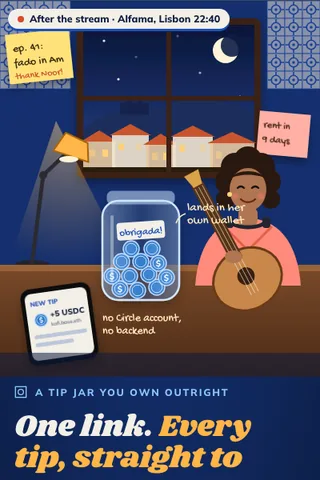 LIVE DEMO
Take pay-what-you-want USDC tips on Base, with a live supporters feed read straight from chain. No Circle account, no backend.
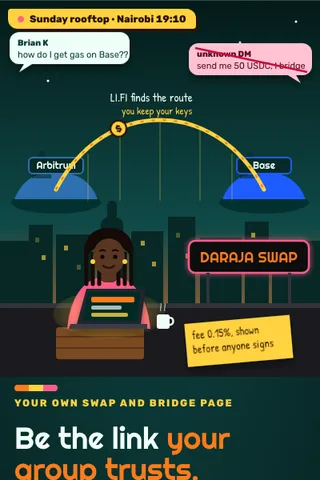 LIVE DEMO
Your own swap/bridge front-end. Integrator fee optional and disclosed.
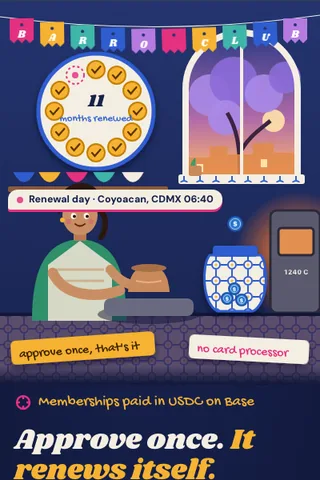 LIVE DEMO
Recurring USDC on Base. Members approve once, it renews itself. No card processor, no contract.
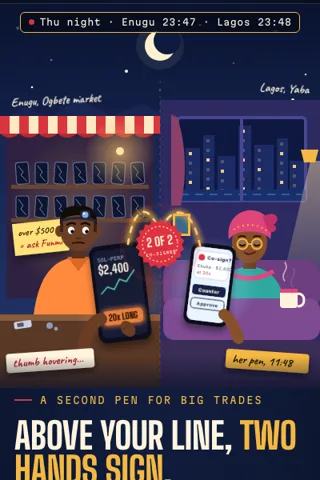 LIVE DEMO
Let a trusted mentor co sign your risky trades above a size you choose.
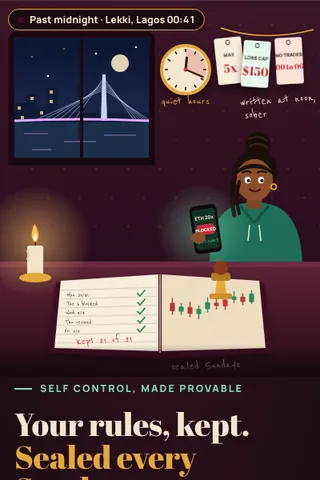 LIVE DEMO
Your perp bot follows your rules, and every rule you kept becomes a public, provable track record.
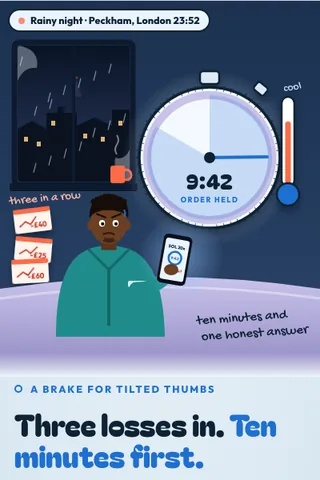 LIVE DEMO
A tilt brake that delays your trades after losses until you answer one honest question.
 LIVE DEMO
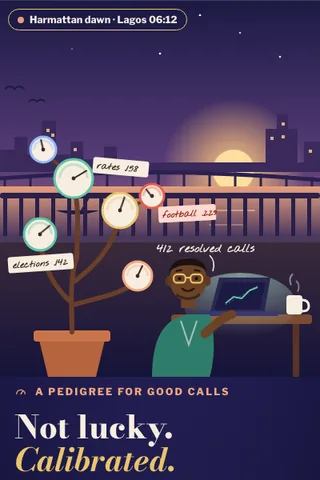
Your prediction market history, turned into a calibration score you can carry anywhere.