 LIVE DEMO
USDC Tip Jar
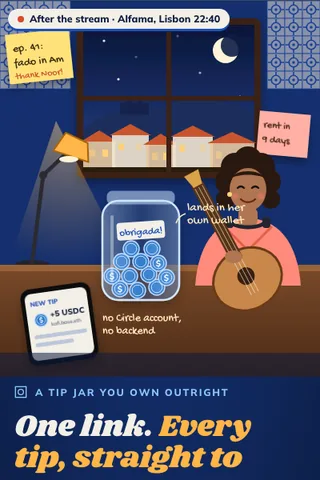
Take pay-what-you-want USDC tips on Base, with a live supporters feed read straight from chain. No Circle account, no backend.
Ready now
$20Circle
 Try it live
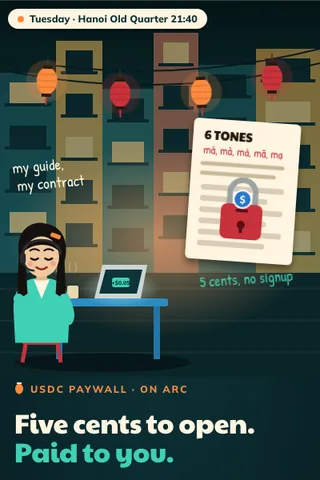
Lock content behind a fraction-of-a-cent USDC payment, on your own Arc contract. Deploy it, become the onchain creator.
Try it live, freeThe working app on your own wallet and git, one-click deploy, and the step-by-step guide that makes you the verifiable developer.
Reshape it entirely: new features, your flows, your brand end to end, integrations you need. We scope it with you.
The complete USDC Paywall app: creators lock a guide behind a few cents of USDC on their own Arc contract, readers unlock with no account, and unlocks settle in batches, with a paywall and helper agent built in.
Every buyer gets the same finished app. Basic branding and copy changes come through a quick form.
Your admin side: revenue, paywall editor, users, rules and the agent log.
Referral and growth mechanics, switched on when you are ready to grow.
Creators subscribe monthly in USDC; the free plan pays a small fee on unlocks.
A 3% fee on unlocks for free plan creators, set by the owner.
Prices are yours to set. Illustrative, not a promise of income.
A paywall for anyone who knows something useful: a few cents of USDC, no platform in the middle.
Problem: Small creators cannot charge a fair tiny price because card fees and platforms eat it.
Solution: Each creator gets their own contract; readers sign a USDC unlock and batches settle for a fraction of a cent.
Why now: Signed USDC authorizations and cheap new chains make five cent payments practical.
Market: Tutors, coaches and niche writers, from a free stall to $29 a month plans.
The ask: Become the default paywall for online language tutors first.
Funding is never guaranteed. Check each program's rules.
Many hackathons require code written at the event. See the Regatta Boardfor each race's rule.
Custom domains, niche shelves, new chains and branded unlock pages, scoped on a call from $1,000.
Tutors, writers and small creators have one or two things people keep asking for, but a monthly subscription is too much to ask for one page, and card checkouts make tiny payments impossible because fixed card fees eat them.
Paid content tools already exist: Substack, Patreon and Gumroad sell subscriptions and downloads by card, and onchain options such as Paragraph and Zora mints, plus HTTP 402 payment flows like Coinbase's x402, already let people pay small amounts in USDC. What is different here is the packaging, not the primitive: a creator owned paywall contract on Arc (where USDC is the fee token), per piece sub-cent pricing, built-in co-author splits, batched settlement and a card top-up fallback for readers with no USDC. Modest novelty; the value is a simple, owned setup.
Per piece price and split settings, signed payment authorizations from readers, batch settlement transactions, unlock counts, and the creator's content stored in their own storage. No reader emails or accounts are required.
Let anyone who knows something useful get paid a fair, tiny amount for it, directly, with no platform in the middle.
Cheaper than a thought At five cents there is no decision to make, so readers who would never subscribe will unlock.
Yours, not a platform's The contract deploys from the creator's wallet and pays to their address; nobody can freeze it.
Public counter A live unlock count is proof that sells the next creator on running their own paywall.
Wallets: Privy embedded wallets so readers can pay with a passkey, with an optional card onramp to buy a few dollars of USDC.
Paywall contract on Arc: A small contract on Arc, Circle's stablecoin-focused chain where fees are paid in USDC, stores prices, payout address and split percentages per piece.
Signed payments, batched: Readers sign an EIP-3009 style USDC transfer authorization (the same pattern x402 uses). Access is granted on a valid signature, and a relayer settles many at once to keep gas below the price.
Content gate: Files stay in the creator's storage (for example Cloudflare R2 or IPFS with encryption); a Next.js route serves them only against a valid paid signature and issues short lived links.
Helper agent: A small model (for example a Claude Haiku class model via OpenRouter) summarises weekly asks and suggests price tests; settlement and rate limits are plain code.
Indexer and notes: Convex indexes settlements for the dashboard, the public counter and the Monday note.
Arc is young and its fee levels may change, so check current network status and fees before launch. Batching keeps cost per unlock to a fraction of the batch fee: if one settlement costs about one cent and carries 200 unlocks, gas is well under a hundredth of a cent each. The helper agent costs well under a cent a week per creator. Example: 10,000 unlocks a month is roughly $1 to $5 in settlement gas plus about $25 for hosting and storage. Card onramp fees are charged by the provider to the reader.
Each unlock page shows 'Run your own paywall'. Creators who post their weekly counts pull in peers in the same niche. Start with one niche, such as language tutors, and become the default there before widening.
Young chain: Arc may change or upgrade. Keep content off the contract and keep a plain list of what is behind each lock so the paywall can be redeployed elsewhere.
Tax and rules: USDC income is usually taxable like other income and rules differ by country. Nothing here is tax or legal advice; keep the onchain ledger and ask a local accountant.
Content leaks: A paying reader can copy a page. Short lived links and watermarks reduce it; it cannot be fully stopped, so price for that.
Unsettled signatures: Access is granted before settlement, so a reader could move funds first. Settle often and cap unsettled value per wallet.
Onramp friction: Readers with no USDC face a card top-up with its own fee. Always offer the free preview instead of a hard wall.
Costs and tools are estimates at the time of writing. General information only, not legal or financial advice.
Nine routes from one vessel. Tap a port to open its chart.
Every paywall you rent takes a cut, holds your money for weeks and owns the list of who paid you. USDC Paywall runs on your own Arc contract, so each fraction-of-a-cent unlock lands in your wallet in seconds and the payment record is yours. You are also the deployer of record on Arc, which a hosted Substack or Patreon page can never give you.
You do not have to. The guide walks you through connecting your wallet, pressing deploy and pasting your content links. If a step breaks, the copy-paste fixes are in the guide, and the get-it-shipped promise means DEPLOYR helps you finish.
Maybe not at first. Sub-cent pricing removes the biggest objection (signing up and committing to a monthly fee), but you still need something worth unlocking. Start with one piece you know people already ask you for, and measure unlocks before you build more.
Yes. The contract deploys from your wallet, the code lives in your git, and payments settle to an address you control. DEPLOYR cannot freeze your paywall or redirect your USDC.
Arc is a young chain, so expect upgrades. Your code and content are yours, so you can redeploy or move. Keep your content stored off the contract, and keep a plain list of what is behind each lock.
Probably, depending on where you live. Payments in USDC are usually treated as income like any other. Keep the onchain record (it is a clean ledger) and ask a local accountant once you earn more than pocket money. Nothing here is legal or tax advice.
You earn two ways. First, unlocks on your own content pay you directly. Second, and bigger, you run the paywall for other creators: they pay you a flat monthly fee for a branded paywall on your Arc deployment, and you can add a small percentage on unlocks. The $1M path is the second one.
Illustrative stages, not a forecast. Results depend on you and the market; nothing here is guaranteed.
LIVE DEMOTake pay-what-you-want USDC tips on Base, with a live supporters feed read straight from chain. No Circle account, no backend.
 LIVE DEMO
Your own swap/bridge front-end. Integrator fee optional and disclosed.
 LIVE DEMO
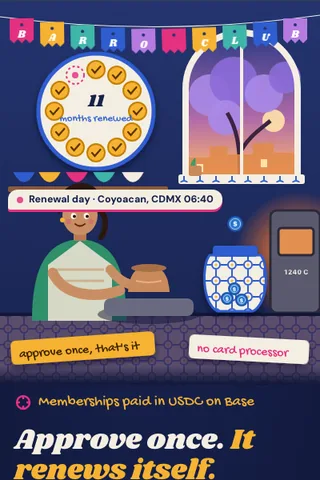
Recurring USDC on Base. Members approve once, it renews itself. No card processor, no contract.
 LIVE DEMO
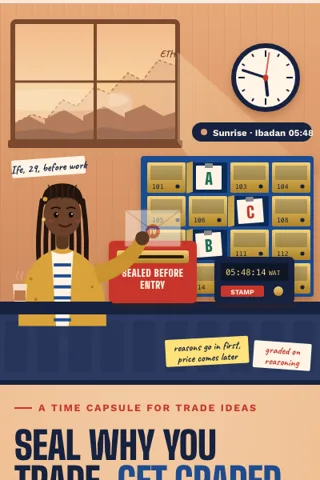
Write why you entered a trade, seal it with the timestamp, and get graded on reasoning, not luck.
 LIVE DEMO
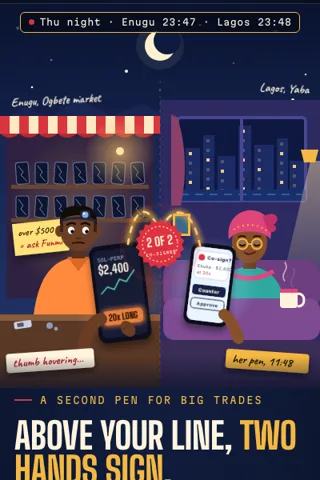
Let a trusted mentor co sign your risky trades above a size you choose.
 LIVE DEMO
Your perp bot follows your rules, and every rule you kept becomes a public, provable track record.
 LIVE DEMO
A tilt brake that delays your trades after losses until you answer one honest question.
 LIVE DEMO
Your prediction market history, turned into a calibration score you can carry anywhere.