 LIVE DEMO
Proof of Opinion
Put your name on a take onchain, mint a shareable badge, others co-sign.
Ready now
$20Base
 Try it live
Prove a skill live: timed challenge, peer judged, result minted to your profile.
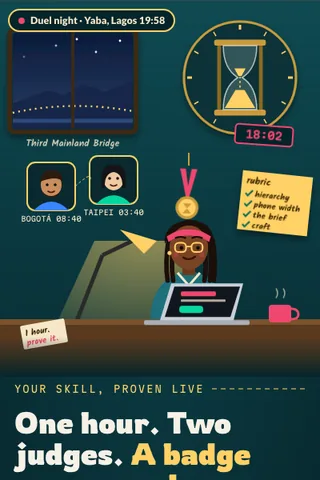
Try it live, freeAda claims she can design a landing page in an hour. She takes a Skill Duel, two peers judge, and the badge proves it beyond a portfolio.
Challenge templates, timer, submission, peer judging, badge mint.
Reshape it entirely: new features, your flows, your brand end to end, integrations you need. We scope it with you.
Peer-judged onchain skill proofs exist only as pitches and research, none clearly live.
SkillForge and SkillDAO (hackathon projects) describe live challenges with peer validation and minted skill tokens, and the Zlto research platform stores peer-evaluated skills onchain.
Checked with web searches in October 2026. A search is not proof that nothing similar exists, and the market moves fast, so we recheck before every build.
Existing projects OK.
The complete Skill Duel app: anyone proves a skill in one timed hour on a sealed brief, scored blind by drawn peer judges, with a badge on Base, a judge roster and a built in paywall. The owner console and growth tools are available as add-ons.
Every buyer gets the same finished app. Basic branding and copy changes come through a quick form.
Your admin side: revenue, paywall editor, users, rules and the agent log.
Referral and growth mechanics, switched on when you are ready to grow.
Entrants pay a small entry fee per duel that mostly pays the judges, with the first duel free. Pro members pay monthly for senior panels and reviews, and companies pay monthly for hiring partner seats.
Judges receive a fee per duel (default 4 USDC) from the escrowed entry fee. Gas, model and storage run well under a cent to a few cents per duel.
Prices are yours to set. Illustrative, not a promise of income.
Prove a skill live: a sealed brief, a one hour clock, blind peer judges and a badge on Base.
Problem: Freelancers and self taught makers are asked whether their portfolio is really theirs. Portfolios can be borrowed, AI assisted or made by a team, and clients have no cheap way to check.
Solution: A sealed brief opens when the clock starts. Drawn judges in other cities score blind against a rubric with written reasons, the median decides, and a pass becomes an attestation while the file stays with the maker.
Why now: Cheap attestations on Base, embedded email wallets and small models that can summarise canvas history make a fair, fast skill check practical for people outside crypto.
Market: Freelance designers, developers and writers, plus agencies and startups that hire them and want a better signal than a portfolio or a take home test.
The ask: Pilot partners: two agencies to post sealed briefs, a first panel of 20 judges, and grant support from ecosystem programs such as Arbitrum grants.
Funding is never guaranteed. Check each program's rules.
Many hackathons require code written at the event. See the Regatta Boardfor each race's rule.
Custom work from $1,400: your own tracks and rubrics, integrations with an ATS or job board, private company duels, extra languages or a branded deployment. Scoped on a call.
Freelancers and self taught makers are asked to prove their portfolio is really theirs. Portfolios can be borrowed, AI assisted or made by a team, and clients have no cheap way to check. People need a proof of skill that was produced in front of witnesses.
Peer judged onchain skill proofs exist mostly as pitches and research. SkillForge and SkillDAO are hackathon projects that describe live challenges with peer validation and minted skill tokens, and the Zlto research platform stores peer evaluated skills onchain. None is clearly live as a product today (research verdict: rare, medium novelty). What this app adds is a working loop: sealed brief, timed session, blind scoring by drawn judges with written reasons, median scoring, a copy check on layout structure and canvas history, and an attestation only when the bar is met.
Challenge briefs and their hashes, timer events, submission files and canvas history (kept in the entrant's storage), judge wallets and their badges, rubric scores with one line of reasoning each, copy check results, and the final attestation on Base or Arbitrum.
Let anyone prove what they can do in one honest hour, judged by peers, and carry that proof everywhere.
The clock A sealed brief and a visible timer turn a claim into a moment people want to watch and share.
Strangers agree Two drawn judges in other cities scoring blind is more believable than any testimonial.
Judge next week Every badge holder can judge and earn the judge fee, so winners come back as referees.
Sign in: Privy embedded wallet or an existing wallet, with email login for non crypto users. Entry fee paid in USDC on Base or Arbitrum.
Sealed brief: Briefs are written per track and their hash is posted in an EAS attestation before the clock starts, so nobody can say the brief leaked or changed.
Timed session: A web timer records start and submit times server side. Entrants upload the file plus an exported canvas history or a short screen recording.
Copy check: A referee job compares layout structure against known templates and reads canvas history for large pastes. A small model such as Claude Haiku 4.5 summarises the evidence for judges. Flags go to a human, never auto reject alone.
Judge draw: Two or three judges are drawn from badge holders in the same track, excluding follows and same city. They score each rubric row blind and write one line per row. The median decides; a spread over 3 points draws a third judge.
Badge: On a pass, an EAS attestation is issued to the entrant with track, score, rubric hash, judge wallets and brief hash. The file itself stays off chain.
Payouts: Judge fees are paid from the escrowed entry fee in USDC after scores land.
Per duel: an EAS attestation on Base usually costs well under one cent in gas; the referee summary on a small model is a few thousand tokens, roughly one cent or less; storage of a submission is pennies. Judges are the main cost, about $4 each. Example month: 400 duels with 2 judges is about $3,200 in judge fees covered by entry fees, plus under $50 in gas, model and hosting.
Every passing entrant shares a badge card with the score and the cities of the judges. Badge holders become judges, which grows judge supply with demand. Companies that post briefs bring their own candidates.
Collusion: Judges and entrants could coordinate. Judges are drawn, exclude social links, score blind, and judges far from the median too often stop being drawn.
AI and copying: Entrants may use AI or templates. Tracks state what tools are allowed, and canvas history plus structure checks catch the worst cases. It is a strong signal, not proof of innocence.
Unfair scores: Taste varies. Rubrics with written reasons and median scoring reduce one harsh or generous judge. Entrants can appeal once to a fresh panel.
Privacy: Failed attempts are not published. Only passes become attestations, and entrants can revoke display of a badge on their profile.
Legal: Judge fees are payment for a service, and the app does not promise jobs or income. Check local rules for paying judges across borders.
Costs and tools are estimates at the time of writing. General information only, not legal or financial advice.
Nine routes from one vessel. Tap a port to open its chart.
Portfolios can be faked and certificates can be bought. Own Skill Duel and you run the live, peer judged test that proves someone can actually do it, from your wallet and brand. The challenges, the judges and the hiring partners are yours.
Use two or three judges, blind scoring where possible, and publish the rubric before the timer starts. Ban judges who score far off the others.
Some will, if the badge gets them work. Start free, then charge once a hiring partner is looking at results.
You do not need to. Skill Duel arrives working, deployed from your own wallet with a written guide for every step. You will click, paste and fill in names. If you ever want a change you cannot make, the custom option or a freelancer can handle it, but the first launch needs no code.
Yes. The contract is deployed from your wallet on Base, the code sits in your own git repo, and the name and brand are yours. DEPLOYR does not hold your keys or take a cut of what Skill Duel earns. If you stop paying anyone tomorrow, the app keeps running on your wallet.
That is the most likely early outcome, and it is fixable. The paths below start with you as the first user, then ten real designers, developers and freelancers who want to prove a skill you can name today. If ten people you message do not care after you have shown it to them, you have learned something useful in a week instead of a year.
Entry fee per duel (part goes to judges), plus paid hiring plans for teams that recruit from duel results. This ladder is a target, not a promise.
Illustrative stages, not a forecast. Results depend on you and the market; nothing here is guaranteed.
LIVE DEMOPut your name on a take onchain, mint a shareable badge, others co-sign.
 LIVE DEMO
Create an account and prove your transactions in your own browser. Client-side proving on Miden, nothing leaks.
 LIVE DEMO
Prove your trading discipline, not your profits: stops honored, sizing kept, tilt avoided.
 LIVE DEMO
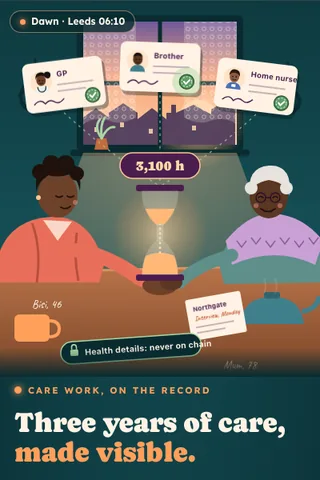
Caregivers and parents prove unpaid care work, privately, for loans and jobs.
 LIVE DEMO
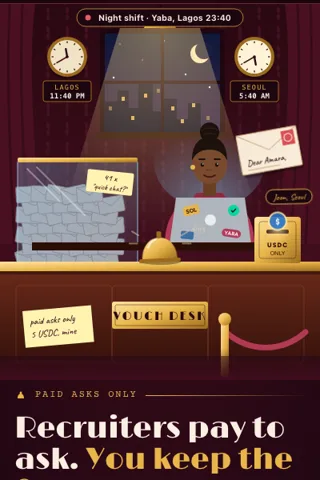
Recruiters pay a small USDC fee to request verified proofs from candidates, who get paid.
 LIVE DEMO
Mentees attest that you changed their path, building a lineage tree of who you lifted up.
 LIVE DEMO
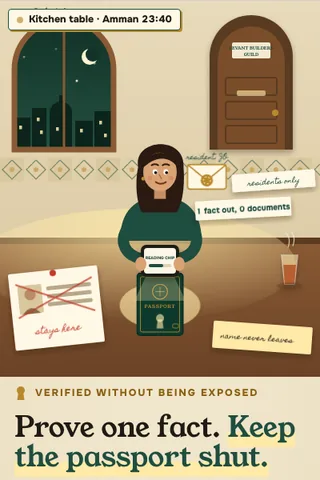
Prove you are over 18, a resident, or a degree holder without showing a single document.
 LIVE DEMO
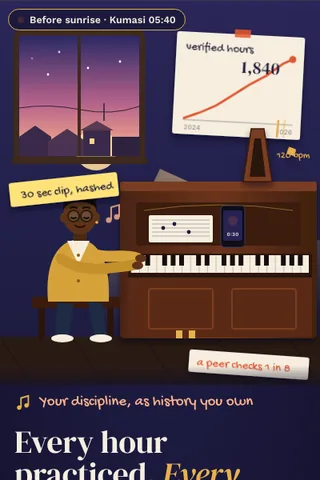
Timestamp every hour of deliberate practice and own the 10,000 hour proof.