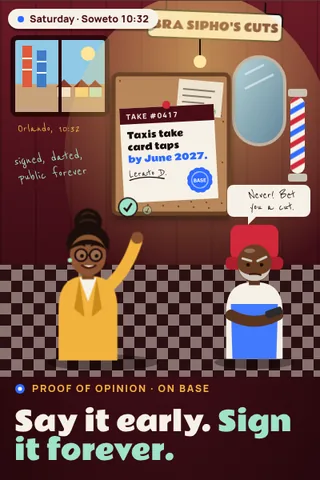
 LIVE DEMO
Proof of Opinion
Put your name on a take onchain, mint a shareable badge, others co-sign.
Ready now
$20Base
 Try it live
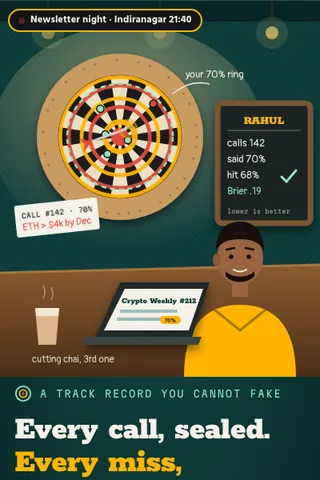
A public score of how often your predictions and calls actually came true.
Try it live, freeRahul writes a weekly crypto newsletter full of calls. Calibrated stores each call with a date and resolves it later, so readers see he is right 68 percent of the time at stated confidence, and he grows on honesty instead of hype.
Call creation with confidence, timed resolution by owner plus reader dispute, Brier score profile, embeddable widget.
Reshape it entirely: new features, your flows, your brand end to end, integrations you need. We scope it with you.
Onchain Brier scoring exists for agents; an owned calibration profile for any human expert is the uncommon angle.
Pantheon (Casper hackathon) and Foresight Arena score AI forecasters onchain with Brier scores; Metaculus and Good Judgment score humans on their own platforms.
Checked with web searches in October 2026. A search is not proof that nothing similar exists, and the market moves fast, so we recheck before every build.
Retroactive for shipped Base apps.
The complete Calibrated app: writers seal every call with a confidence, a source and a date, readers see one honest score, with a paywall, reader disputes and a resolver agent built in.
Every buyer gets the same finished app. Basic branding and copy changes come through a quick form.
Your admin side: revenue, paywall editor, users, rules and the agent log.
Referral and growth mechanics, switched on when you are ready to grow.
Writers seal, resolve and show their Brier score for free. Serious writers pay for Pro tools, and publications pay for many writers under one masthead.
Gas is under 2 cents per sealed and resolved call and can be sponsored by the owner. Payments settle in USDC on Base by default.
Prices are yours to set. Illustrative, not a promise of income.
A public score of how often your predictions actually came true, sealed before the answer.
Problem: Writers and analysts make public calls every week, but nobody keeps an honest score. Misses get deleted, hits get repeated, and readers cannot tell a careful thinker from a loud one.
Solution: Each call is sealed as an attestation with a confidence, a source and a date. It resolves on the date, readers can dispute, and the writer gets a Brier score and calibration curve they cannot quietly edit.
Why now: Attestations on Base cost under a cent, embedded email wallets remove crypto friction, and small models can check wording before a call is sealed.
Market: Newsletter writers, research analysts, podcasters and the publications behind them, starting with crypto writers and growing into sports, elections and tech.
The ask: Ten launch writers with real audiences, a Base Builder Grant, and one publication willing to put calibration next to every byline.
Funding is never guaranteed. Check each program's rules.
Many hackathons require code written at the event. See the Regatta Boardfor each race's rule.
Custom work from $1,500: your own resolution source adapters, a branded publication deployment, CMS integrations beyond Substack and Ghost, or extra languages. Scoped on a call.
Newsletter writers, analysts and creators make public predictions every week, but nobody keeps an honest score. Misses get deleted or forgotten and hits get repeated. Readers cannot tell a careful thinker from a loud one, and honest writers have no way to prove they are careful.
Scoring forecasts is not new. Metaculus and Good Judgment score human forecasters with Brier scores, but only on their own platforms and questions. Pantheon (a Casper hackathon project) and Foresight Arena score AI forecasters onchain with Brier scores. Research verdict: rare, medium novelty. What this app adds is an owned calibration profile for any human expert, on their own calls in their own newsletter, with calls sealed onchain before the answer, reader disputes, and an embeddable widget. It applies known scoring to a new audience rather than inventing the scoring.
The text of each call, its stated confidence, resolution date and resolution rule, chosen by the writer. Public resolution sources such as price feeds and official notices. Reader disputes and reviewer votes. Only hashes of calls and their resolutions go onchain; newsletter content and reader identities stay offchain.
Let anyone who makes predictions build a track record they cannot quietly edit, and let readers trust people for being right rather than loud.
One honest number When I say 70%, I am right 68% of the time. A single, checkable line that careful writers love to share.
Friday resolution day Every Friday the due calls resolve. Readers come back to see who was right, and can score their own guesses against the writer.
Misses that stay Wrong calls stay on the page, struck in red. It sounds like a downside; it is exactly why readers believe the hits.
Accounts: Privy email or social login with an embedded wallet on Base or Arbitrum for the writer. Readers can follow and dispute with an email login.
Sealing a call: The call text, confidence, date and resolution rule are hashed and recorded as an Ethereum Attestation Service (EAS) attestation on Base. After sealing, the call cannot be edited, only voided with a public note.
Rule checks: Before sealing, a small model (for example Claude Haiku via OpenRouter) checks that the call has a number, a source and a date, and suggests tighter wording. It never chooses the confidence.
Resolution: On the date, a worker reads the named source: a median of several price feeds or oracles such as Chainlink for prices, or a link to an official notice for events. The writer confirms and the resolution is attested.
Disputes: Any reader can dispute within 7 days. Two reviewers with resolved track records vote; the score is held until they agree. The writer cannot resolve their own disputed call.
Scoring and widget: Brier scores and a calibration curve by confidence bucket are computed from attestations and shown on a profile page and an embeddable newsletter widget.
An EAS attestation on Base usually costs well under one cent in gas, so sealing and resolving a call is roughly one to two cents at most. A rule check on a small model is a fraction of a cent per call. Example month for a writer with 20 calls and 5,000 readers viewing the widget: under $1 gas, under $0.20 model, and about $20 hosting shared across writers.
Writers share their calibration line and embed the widget in every issue. Readers who score their own guesses on Friday become writers themselves. A good score is a reason to send traffic; a public profile is a quiet challenge to rivals.
Not financial advice: Calls about prices can be read as advice. Show clear notices, never link calls to trading, and never present a good score as a promise of future accuracy.
Gaming with easy calls: Writers can pad scores with obvious calls. Show the confidence mix, highlight bold calls, and compare against a 50% baseline.
Bad resolution sources: A single feed can be wrong or manipulated. Use medians across sources, show the spread, and allow disputes.
Vague wording: Vague calls cannot be scored fairly. Block sealing without a number, source and date, and void unresolvable calls in public.
Harassment over misses: Public misses can attract abuse. Moderate replies, and keep disputes to the facts of the rule.
Costs and tools are estimates at the time of writing. General information only, not legal or financial advice.
Nine routes from one vessel. Tap a port to open its chart.
Calibrated turns every call you make into a dated, resolved record that lives at your own address, under your own name. On someone else's platform your track record belongs to them and disappears when you leave; on yours, your hit rate is a public asset that follows you to every newsletter, podcast and job. Readers stop asking whether you are loud and start seeing whether you are right.
Then you learn it before your readers do. Run it privately for four weeks, look at your Brier score, and only publish the widget once you are comfortable. A 60 percent hit rate shown honestly beats a 90 percent claim nobody can check, and the score rewards stating lower confidence when you are unsure.
You do not need to. You create a call in a form, pick a confidence, set a resolution date, and resolve it when the date arrives. The embeddable widget is one line you paste into Substack, Ghost or your site builder, and DEPLOYR ships it set up.
You resolve it, and readers can dispute. Every resolution and dispute is recorded, so cheating on your own calls is visible to everyone. Pick a clear resolution source when you write the call (a price feed, a public announcement, a named date) and disputes stay rare.
Yes. The contract deploys from your wallet and the calls are signed by you. If DEPLOYR vanished tomorrow, your record would still be readable onchain and you could point any frontend at it.
Calibrated records predictions, it does not give advice or take money for trades. Still, if your calls are about assets, add a plain not financial advice line and check your local rules on paid signals before you charge for them. Many owners avoid this entirely by calling events, launches and metrics instead of prices.
Calibrated earns in three ways: a paid tier for your readers who want early access to calls before they go public, a hosted version you rent to other writers and analysts who want their own score, and sponsorship from tools that want to sit next to a verified track record. This is a target to aim at, not a promise.
Illustrative stages, not a forecast. Results depend on you and the market; nothing here is guaranteed.
LIVE DEMOPut your name on a take onchain, mint a shareable badge, others co-sign.
 LIVE DEMO
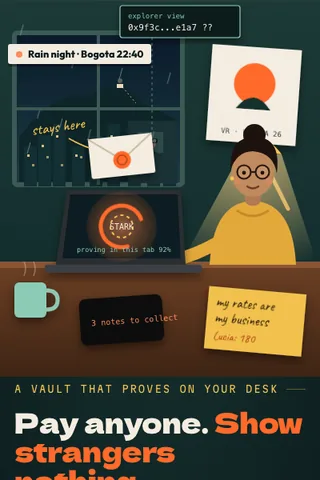
Create an account and prove your transactions in your own browser. Client-side proving on Miden, nothing leaks.
 LIVE DEMO
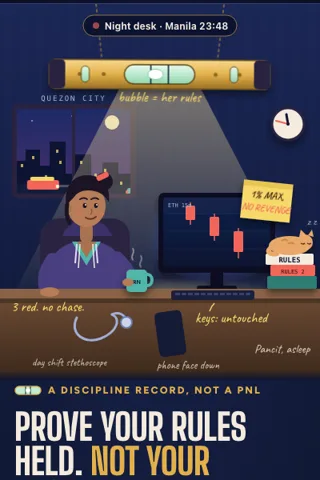
Prove your trading discipline, not your profits: stops honored, sizing kept, tilt avoided.
 LIVE DEMO
Caregivers and parents prove unpaid care work, privately, for loans and jobs.
 LIVE DEMO
Recruiters pay a small USDC fee to request verified proofs from candidates, who get paid.
 LIVE DEMO
Mentees attest that you changed their path, building a lineage tree of who you lifted up.
 LIVE DEMO
Prove you are over 18, a resident, or a degree holder without showing a single document.
 LIVE DEMO
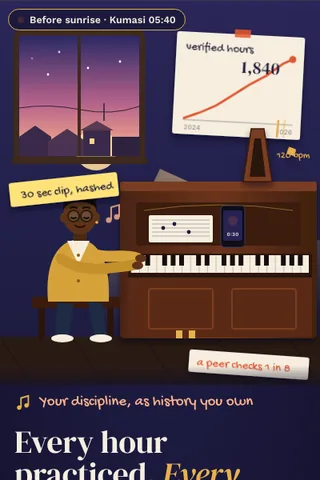
Timestamp every hour of deliberate practice and own the 10,000 hour proof.