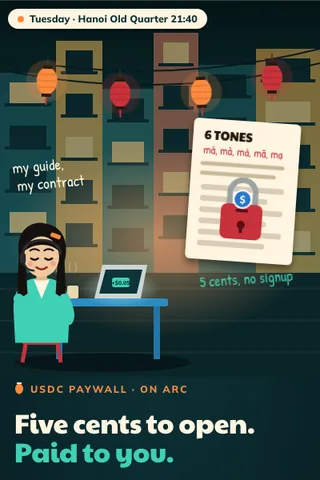
 LIVE DEMO
USDC Paywall
Lock content behind a fraction-of-a-cent USDC payment, on your own Arc contract. Deploy it, become the onchain creator.
Ready now
$20Arc
 Try it live
Tracks every prediction market you hold and explains resolution rules before they bite you.
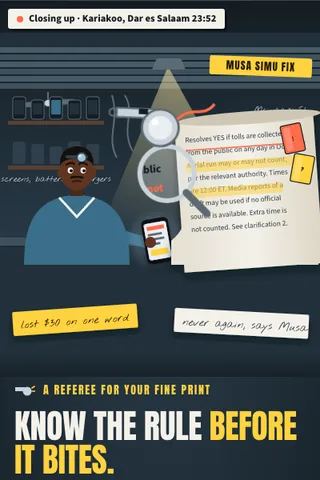
Try it live, freeMusa lost a bet on a technicality. Resolve Watch reads resolution criteria for his positions, flags ambiguity, and alerts him on disputes.
Position import, AI rule summaries, dispute alerts
Reshape it entirely: new features, your flows, your brand end to end, integrations you need. We scope it with you.
AI resolution-rule analysis for Polymarket already exists; per-held-position tracking is a small extension.
BetAudit uses AI to flag tricky clauses in Polymarket resolution rules before trading, PolymarketScan offers AI rules analysis with alerts, and Orrery tracks UMA dispute states as resolution risk.
Checked with web searches in October 2026. A search is not proof that nothing similar exists, and the market moves fast, so we recheck before every build.
The complete Resolve Watch app: prediction market traders import positions read only, get every resolution rule in plain words with times on their own clock, and hear about disputes with both arguments, with a paywall, owner console and clause reader built in.
Every buyer gets the same finished app. Basic branding and copy changes come through a quick form.
Your admin side: revenue, paywall editor, users, rules and the agent log.
Referral and growth mechanics, switched on when you are ready to grow.
Reading five positions is free. Active traders pay for Watcher to cover everything they hold in their language and chat app, and small funds and groups pay for Desk.
No fees on positions. The app never trades, signs or moves funds.
Prices are yours to set. Illustrative, not a promise of income.
Every prediction market rule you hold, in plain words on your clock, with a whistle when a dispute opens.
Problem: Traders lose calls they got right on technicalities: extra time not counted, a deadline in another time zone, a draft that may or may not count. Rules are long and nobody rereads them or notices disputes.
Solution: A read only importer pulls positions; a cheap model extracts conditions and times, a stronger one checks flagged clauses against an archive of disputed wording; an indexer watches oracle disputes and sends both arguments by chat.
Why now: Prediction markets have grown into everyday use worldwide, and cheap models make reading every rule affordable.
Market: Prediction market traders, trading groups and small funds, plus the creators who write the rules.
The ask: Partnerships with two market venues for creator embeds, and a pilot with East African trading groups.
Funding is never guaranteed. Check each program's rules.
Many hackathons require code written at the event. See the Regatta Boardfor each race's rule.
Custom work from $600: more venues, group features, local languages or a creator branded version. Scoped on a call.
Prediction market traders lose money on technicalities: extra time not counted, a deadline in another time zone, a draft report that may or may not count. Rules are public but long, and nobody rereads them for every position, or notices when a dispute opens.
This largely exists. BetAudit uses AI to flag tricky clauses in Polymarket resolution rules before trading, PolymarketScan offers AI rules analysis with alerts, and Orrery tracks UMA dispute states as resolution risk. Resolve Watch is a modest extension: it starts from the positions you already hold, flags only wording that caused trouble in past markets, converts every deadline to your clock, and alerts on disputes in your language and channel. Research verdict: exists, low novelty. Its value is focus and delivery, not a new capability.
Public wallet positions on Polygon, each market's rules, clarifications and resolution source, UMA optimistic oracle proposals, disputes and votes, and an archive of past resolved and disputed markets used to judge which wording is risky. The user's alert settings stay offchain.
Nobody should lose a call they got right because of a sentence they never read.
Red card in minutes A new dispute on a market you hold reaches you fast, with both arguments in plain words.
Your clock, not theirs Every deadline shown in your time zone, with a one tap reminder.
Friday spot the trap A five minute quiz built from real disputed wording. A streak that makes you a better rule reader.
Read only wallet import: Paste addresses or connect with Privy in read mode. Positions are read from public Polygon data and market APIs. No signing, no trading permissions.
Rule and dispute indexer: An indexer pulls each market's rules and clarifications and watches UMA optimistic oracle proposal, dispute and vote events on Polygon.
Clause risk model: A cheap model tier (for example Claude Haiku or a comparable OpenRouter model) extracts conditions, sources and times; a mid tier (for example Claude Sonnet) runs only on flagged clauses, compared against an archive of past disputed wording.
Time normalizer: Every time and date in a rule is parsed and converted to the user's zone, with daylight saving handled.
Alerts: WhatsApp Business, Telegram bot or SMS, with quiet hours that red card disputes can override.
Optional proof of the read: A fingerprint of each summary can be attested with EAS on Base so the app cannot quietly rewrite what it told you.
Per new position: Haiku tier extraction of a few thousand tokens is under 1 cent; a Sonnet tier pass on the roughly 1 in 8 flagged rules is 2 to 4 cents. Dispute watching is indexer reads, a fraction of a cent. WhatsApp or SMS alerts cost 1 to 5 cents each depending on country. Example month for 500 users holding 10 new positions each: about $70 model, $40 indexer, $60 messaging, $30 hosting, roughly $200.
Share cards from near misses travel in trading group chats. The Friday quiz is shareable. Market creators can embed a plain words rule summary that links back, and a public archive of disputed wording earns search traffic.
Wrong or missing flags: The model can miss a trap or misread one. Always show the original rule, say it is an aid, not advice, and never claim certainty about outcomes.
Seen as betting advice: It explains rules and shows both sides of disputes; it never says which side to take or predicts votes.
Legal access: Prediction markets are restricted in some countries. Resolve Watch reads public data and does not provide market access.
Alert fatigue: Too many flags make users stop reading, as week 1 showed. Flag only wording that caused trouble before, and measure read rates.
Wallet privacy: Watched addresses link a person to positions. Store minimal data, allow deletion, and never publish who watches what.
Costs and tools are estimates at the time of writing. General information only, not legal or financial advice.
Nine routes from one vessel. Tap a port to open its chart.
Prediction market traders lose real money on fine print they never read. Resolve Watch imports a trader's positions, summarizes each market's resolution rules in plain words, flags ambiguity and alerts them when a dispute opens. Owning it means the alert list, the subscribers and the reputation as the person who reads the fine print are yours, not a dashboard you rent.
Yes. Position import, AI rule summaries and dispute alerts are built. You set the chain, name and colors, deploy with the guide, and add your AI key. Your job is finding traders who need it.
It can be. Show the original rule text next to every summary, label summaries as aids not advice, and invite users to flag errors. Never tell anyone how a market will resolve.
It varies a lot by country and by state. Resolve Watch only reads public rules and positions, but your users must follow their own local rules. Do not market to places where using these markets is restricted, and check with a lawyer before charging at scale.
Some do parts of it. Your edge is focus on positions people actually hold, alerts that arrive in their chat app, and you as a trusted reader in your community.
Start free for a few power traders and watch whether alerts save them money. If they do, they will pay; if they do not, the alerts need to be sharper.
Traders pay a monthly subscription for rule summaries and dispute alerts on their held positions. Later, trading groups pay for a shared alert channel, and analysts pay for a pro tier with history of disputed markets.
Illustrative stages, not a forecast. Results depend on you and the market; nothing here is guaranteed.
LIVE DEMOLock content behind a fraction-of-a-cent USDC payment, on your own Arc contract. Deploy it, become the onchain creator.
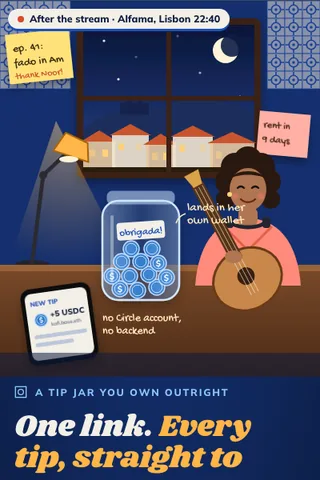 LIVE DEMO
Take pay-what-you-want USDC tips on Base, with a live supporters feed read straight from chain. No Circle account, no backend.
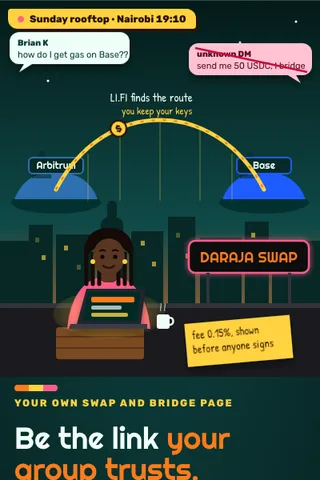 LIVE DEMO
Your own swap/bridge front-end. Integrator fee optional and disclosed.
 LIVE DEMO
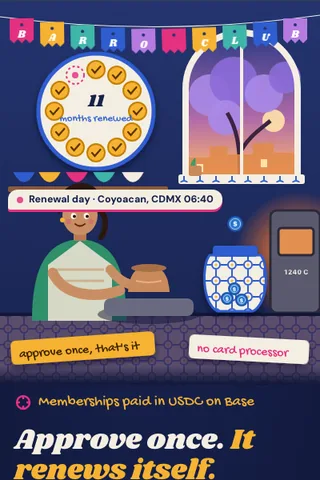
Recurring USDC on Base. Members approve once, it renews itself. No card processor, no contract.
 LIVE DEMO
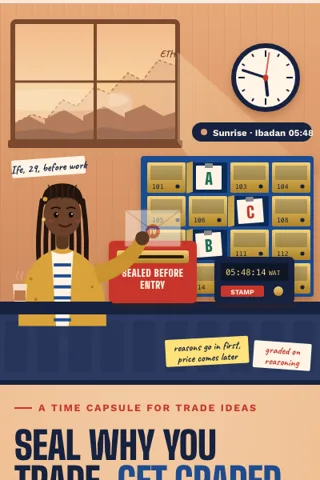
Write why you entered a trade, seal it with the timestamp, and get graded on reasoning, not luck.
 LIVE DEMO
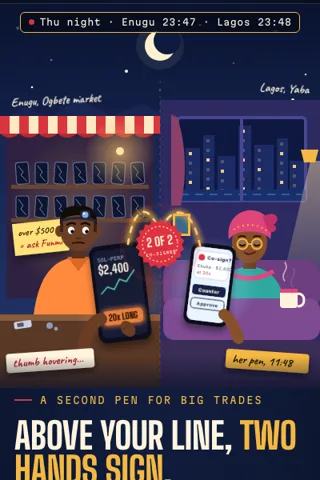
Let a trusted mentor co sign your risky trades above a size you choose.
 LIVE DEMO
Your perp bot follows your rules, and every rule you kept becomes a public, provable track record.
 LIVE DEMO
A tilt brake that delays your trades after losses until you answer one honest question.