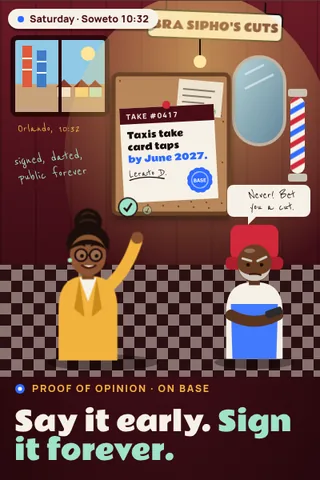
 LIVE DEMO
Proof of Opinion
Put your name on a take onchain, mint a shareable badge, others co-sign.
Ready now
$20Base
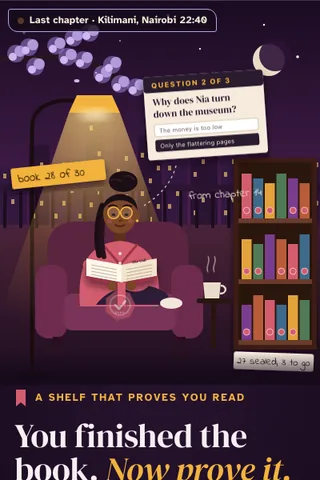 Try it live
Prove you read and understood the book, via a short quiz, and collect a reading shelf.
Try it live, freeZara reads 30 books a year. Each one ends with a quick AI generated comprehension check, and her shelf of verified reads helps her land a research role where depth matters.
Book lookup, LLM quiz generation, pass attestation, shelf profile.
Reshape it entirely: new features, your flows, your brand end to end, integrations you need. We scope it with you.
The parts exist in prototypes; quiz-verified per-book credentials are an uncommon combination.
Onchain Reads (EAS on Base) records books read, and Proof of Learning (ETHGlobal) issues soulbound NFTs after passing a quiz; none found combining per-book quizzes into a shelf.
Checked with web searches in October 2026. A search is not proof that nothing similar exists, and the market moves fast, so we recheck before every build.
User-owned AI angle; eligibility unknown.
The complete Read Receipt app: readers finish a book, pass a short quiz written from its middle chapters, and earn a seal on a shelf they can send, with a paywall and quiz writer agent built in.
Every buyer gets the same finished app. Basic branding and copy changes come through a quick form.
Your admin side: revenue, paywall editor, users, rules and the agent log.
Referral and growth mechanics, switched on when you are ready to grow.
Readers never pay to seal a book. Plans add tools around the shelf, clubs pay for a shared shelf, and recruiters pay a small fee to check a shelf with consent.
Optional shelf check fee for recruiters, $0.50 by default. Gas (about $0.004 per seal) can be sponsored by the owner.
Prices are yours to set. Illustrative, not a promise of income.
A shelf that proves you read: a short quiz from the chapters, then a seal anyone can check.
Problem: Saying you read widely is easy and impossible to check. Deep readers have no simple way to show which books they finished and understood.
Solution: An AI writes why and connect questions from the middle chapters. Pass, and a small attestation records the book fingerprint and score band, while answers and notes stay private.
Why now: Small models write good questions for a fraction of a cent, attestations on Base cost under a cent, and embedded wallets hide crypto from readers.
Market: Researchers, students and self taught readers, plus reading clubs, teachers, publishers and employers who value depth.
The ask: Pilot partners: two reading clubs and one university department, and grant funding from public goods rounds.
Funding is never guaranteed. Check each program's rules.
Many hackathons require code written at the event. See the Regatta Boardfor each race's rule.
Custom work from $1,000: your own question styles, a school or library deployment, catalogue or LMS integrations, extra languages. Scoped on a call.
Saying you read widely is easy and impossible to check. Readers who go deep, like researchers, students and self taught people, have no simple way to show which books they actually finished and understood, and readers who want to keep going lack a light ritual that marks the end of a book.
Parts of this exist. Onchain Reads records books read as EAS attestations on Base, and Proof of Learning (an ETHGlobal project) issues soulbound NFTs after a quiz. Goodreads and StoryGraph track reading but on self report. What we did not find is the combination: a per book comprehension quiz written from the chapters, with a passed result sealed onto a public shelf. The idea is a rare combination, not a new primitive.
Book metadata from an open catalogue (title, author, ISBN, chapter list). Chapter text or excerpts the reader supplies or the publisher licenses, used only to write questions. The reader's answers and score, kept in the app. Onchain: a book fingerprint, score band, date and question count per pass.
Make a reading life visible and honest, so depth counts for something.
The seal at the last page Finishing a book gets a small ceremony: three questions, then a wax seal on the spine. It turns the end of a book into a moment.
A shelf you can send One link shows every sealed book. It answers 'you say you read a lot' without a speech.
Sunday recall One question from a book finished months ago. Get it right and the seal earns a gold edge. Memory becomes a streak.
Sign in and wallet: Email or passkey sign in with an embedded wallet (for example Privy) on Base, or a NEAR account. The reader never needs to hold crypto; the app sponsors gas.
Book lookup: Search by title or ISBN against an open catalogue such as Open Library. The ISBN is hashed into a book fingerprint so editions of the same work can be grouped.
Question writer: A mid tier model (for example a Claude Haiku or GPT mini class model through OpenRouter) writes why and connect questions anchored to two chapters far apart, quoting a line rather than a page. A cheaper check pass rejects questions a summary could answer.
Grading and retries: Multiple choice is graded locally. A fail returns a hint pointing at chapters and unlocks fresh questions after 3 days. No record is written on a fail.
Attestation: On pass, an EAS attestation on Base (or a NEAR contract call) records book fingerprint, score band, date and question count. Answers are never written onchain.
Shelf page and recall: A public or private shelf page reads attestations from an indexer. A weekly job picks one old book and sends a recall question by push or email.
Per quiz: roughly 3,000 input and 600 output tokens on a small model, about $0.001 to $0.003, plus one EAS attestation on Base, usually well under $0.01 in gas. Call it under $0.01 per sealed book. Example: 2,000 readers sealing 3 books a month is 6,000 quizzes, about $30 to $60 a month in model and gas, plus hosting. Prices change; check current model and gas rates before launch.
Every shared shelf link is an invitation: a recruiter, a friend or a teacher sees the seals and asks how. Reading clubs bring members in batches, and Sunday recall keeps readers coming back between books.
Copyright: Do not store or display full book text. Use reader supplied excerpts or licensed text only to write questions, and quote at most a line per question.
Cheating: A determined person can read a detailed summary or ask a chatbot. Why and connect questions raise the bar but do not make cheating impossible. The seal means 'passed a comprehension check', nothing more.
Wrong questions: AI questions can be wrong or edition specific. Readers can flag a question; flagged questions are replaced and the attempt is not counted.
Privacy: A reading list can reveal health, faith or politics. Shelves default to private per book, and titles can be hidden while the count stays visible.
Overclaiming: Employers may overweight seals. The shelf page says plainly what a seal proves and what it does not.
Costs and tools are estimates at the time of writing. General information only, not legal or financial advice.
Nine routes from one vessel. Tap a port to open its chart.
Read Receipt turns reading into proof: a short comprehension check after each book and a shelf of verified reads that lives on your own wallet. If you run it, the readers, the book clubs and the shelf data are yours, not a reading platform's that can change rules or close. Your deployment becomes the place your community proves what it knows.
You do not need to. DEPLOYR deploys the app from your wallet and you run it from an admin screen: add books, set quiz length, invite readers. If something needs code later, that is what support and the service path are for.
Many people will not. Start with the ones who do: book clubs that want accountability, students, and job seekers in research or policy roles. Ten committed readers is a real start. If after a month nobody uses it, you have learned that cheaply.
Not perfectly. It proves someone answered questions about the book at a point in time. Be honest about that on your site. Let clubs add their own questions to make it stronger.
Yes. The contract is deployed from your wallet, the payments go to your wallet, and you can verify both on a block explorer. DEPLOYR does not take a cut of your users' payments.
Quizzes ask about a book, they do not reproduce it. Do not paste chapters or long passages into questions. If you work with a publisher, ask them in writing what they are comfortable with.
Readers pay a small monthly fee for unlimited verified reads and a public shelf; book clubs, schools and teams pay a group plan to run shared reading goals. Hitting about $1M a year is a target to aim at, not a promise, and most owners will land well below it.
Illustrative stages, not a forecast. Results depend on you and the market; nothing here is guaranteed.
LIVE DEMOPut your name on a take onchain, mint a shareable badge, others co-sign.
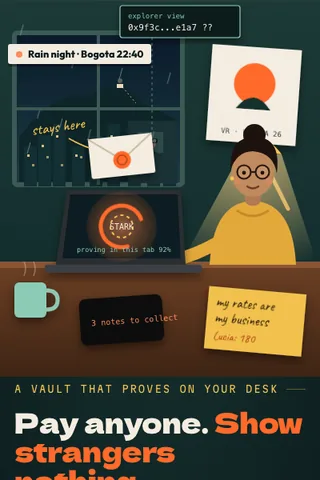 LIVE DEMO
Create an account and prove your transactions in your own browser. Client-side proving on Miden, nothing leaks.
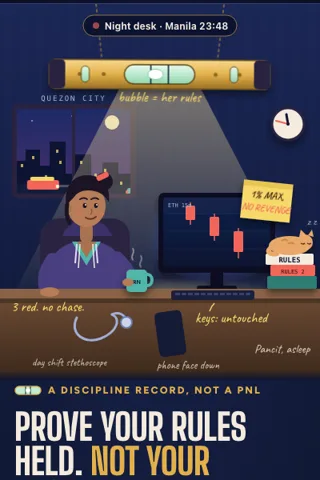 LIVE DEMO
Prove your trading discipline, not your profits: stops honored, sizing kept, tilt avoided.
 LIVE DEMO
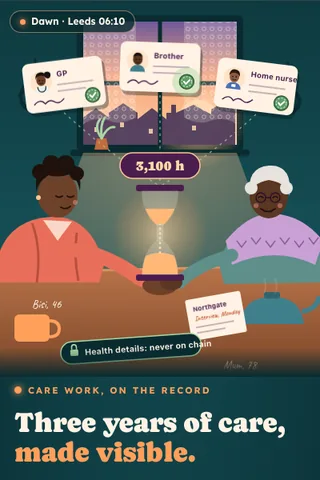
Caregivers and parents prove unpaid care work, privately, for loans and jobs.
 LIVE DEMO
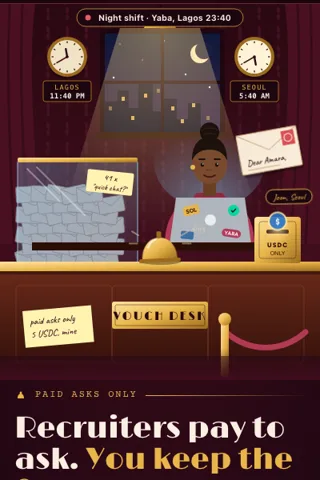
Recruiters pay a small USDC fee to request verified proofs from candidates, who get paid.
 LIVE DEMO
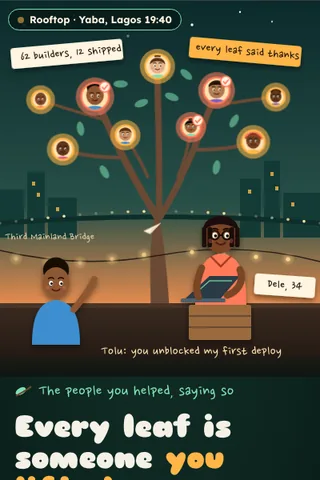
Mentees attest that you changed their path, building a lineage tree of who you lifted up.
 LIVE DEMO
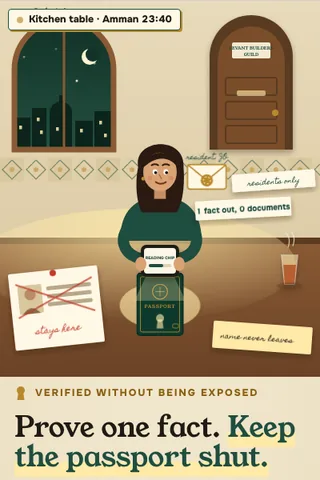
Prove you are over 18, a resident, or a degree holder without showing a single document.
 LIVE DEMO
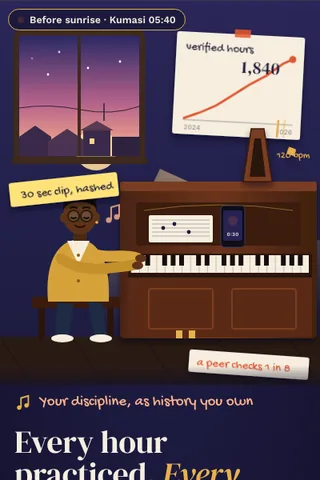
Timestamp every hour of deliberate practice and own the 10,000 hour proof.