 LIVE DEMO
Fix Proof
Tradespeople log each repair with photos and a customer signature, sealed onchain as a warranty.
Reserve · refundable deposit
$159Base · Polygon +1
 Try it live
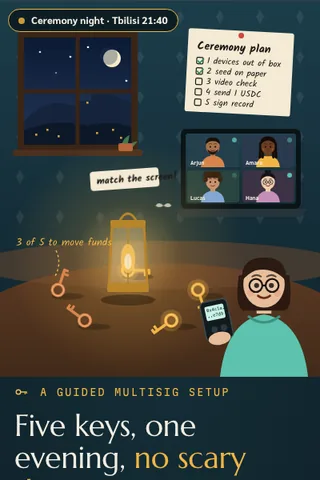
A guided, offline-first checklist for setting up a team multisig without a single scary step.
Try it live, freeA new DAO of five people needs a treasury. Key Ceremony walks them through hardware wallet setup, signer verification by video call, a test transaction, and a signed record of who holds what.
Step-by-step ceremony, Safe deployment, signer verification, test tx, signed ceremony record.
Reshape it entirely: new features, your flows, your brand end to end, integrations you need. We scope it with you.
Ceremony guidance exists as docs; an interactive guided tool is the new part.
Security Alliance publishes a multisig implementation checklist and spark.money offers a Bitcoin key ceremony planner, but as docs rather than an interactive Safe tool.
Checked with web searches in October 2026. A search is not proof that nothing similar exists, and the market moves fast, so we recheck before every build.
Security public good; existing projects OK.
Existing projects OK.
The complete Key Ceremony app: a small team sets up a shared Safe vault together on one call, verifies every address aloud from the device screen, sends a test in and out, and signs a record of who holds what, with rotation, drills and a paywall built in.
Every buyer gets the same finished app. Basic branding and copy changes come through a quick form.
Your admin side: revenue, paywall editor, users, rules and the agent log.
Referral and growth mechanics, switched on when you are ready to grow.
The first ceremony is free so every team can start safely. Teams pay monthly to keep the vault healthy with rotations, drills and more vaults, and guided sessions with a live facilitator sell once.
Gas for the Safe, test send and attestation (cents on Base) can be sponsored by the owner. Facilitators receive a share of each guided session.
Prices are yours to set. Illustrative, not a promise of income.
A guided multisig key ceremony for small teams: one call, every address read aloud, a test send and a signed record of who holds what.
Problem: Small DAOs, clubs and startups set up shared treasuries from scattered guides, often late at night and often alone. Money is lost to small slips: one person holding every key, a poisoned clipboard, a vault nobody tested.
Solution: An interactive ceremony the whole team runs together: threshold with plain consequences, addresses verified from device screens only, a forced test send in and out, an attested record, rotation and quarterly drills.
Why now: Safe on cheap L2s like Base, EAS attestations for cents and small models that can guide a call make a full ceremony affordable for any five person team.
Market: Small DAOs, grant recipients, community clubs, co-ops and early startups holding shared crypto treasuries, plus the grant programs that fund them.
The ask: Pilot partners: two grant programs willing to ask grantees for a ceremony record, and public goods funding such as Ethereum Foundation ESP or Arbitrum grants.
Funding is never guaranteed. Check each program's rules.
Many hackathons require code written at the event. See the Regatta Boardfor each race's rule.
Custom work from $1,500: other vault types or chains, your own ceremony steps and record fields, branded checklists and languages, or integrations with a grant program's dashboard. Scoped on a call.
Small DAOs, clubs and startup teams set up shared treasuries from scattered guides, often late at night, often with one person doing it alone. The usual losses are small slips: one person holding every key, an address pasted from a poisoned clipboard, a vault nobody tested before real money arrived.
Guidance exists as documents. The Security Alliance publishes a multisig implementation checklist for protocols, and spark.money offers a Bitcoin multisig key ceremony planner. Safe itself handles vault creation well. Research verdict: rare, medium novelty. What this app adds is an interactive, offline friendly guided ceremony for a whole team on a call: address checks read aloud from each device screen, a threshold chosen with plain consequences, a forced test send in and out, a signed ceremony record, key rotation, and a quarterly drill that proves every key still works.
The vault address and owner list (public onchain), the test transaction, a hash of the ceremony record as an EAS attestation, and drill signatures over a harmless message. The record itself (names, device types, backup place types) stays with the team. Seed words are never entered, stored or transmitted.
Give every small team shared confidence in who controls its money, with no single scary step.
A ceremony, not a tutorial Everyone on one call, one step at a time, each step checked by the group. It feels like an event the team did together.
A paper you can show members The signed record answers the question every community asks: who holds the keys, and what happens if one is lost.
The quarterly drill Ten minutes, no money moves, and a streak that shows all five keys are alive.
Guided checklist app: A Next.js web app that works offline once loaded, with a printable one page checklist per signer in their language. No links inside the printed copy.
Vault creation: Deploys a Safe on Base, Arbitrum, Ethereum or Polygon with the verified owner addresses and the chosen threshold, using the Safe protocol kit. Optional delay module for large payouts.
Address verification: Each signer reads the first and last characters from the hardware device screen aloud on the call; two others confirm. Pasted text is never accepted as proof.
Test send: A small USDC amount goes in and comes back out, signed by the threshold, before the treasury is funded.
Ceremony record: The record is hashed and attested with EAS on the vault's chain, signed by all owners. The full record is exported as PDF to the team.
Guide assistant: A small model (for example Claude Haiku tier) answers questions in plain words and writes the record; it never sees seed words and cannot sign anything.
Reminders: Quarterly drill and rotation reminders through calendar invites and the team's chat, since email reminders are easy to miss.
Per ceremony: Safe deployment on Base is usually a few cents of gas, the test send and return under $0.05, the EAS attestation a cent or two. Guide assistant usage is a few thousand tokens per ceremony, well under $0.10 at small model prices. On Ethereum mainnet gas can run several dollars to tens of dollars. Example month: 40 team ceremonies on L2s cost roughly $10 to $20 in gas and model use, plus hosting.
Every signed record is shared with members, who see the app name on it. Signers who sat through one ceremony bring it to the next DAO, club or startup they join. Drill streaks give teams something to post.
False confidence: A guide cannot make a team safe on its own. The app states clearly what it checks and what it cannot, such as device supply chain or social pressure on a signer.
Seed exposure: The app never asks for seed words and blocks paste fields that look like a seed phrase, with a warning.
Clipboard and malware: Addresses are verified from device screens only, read aloud and confirmed by others, because pasted text can be swapped.
Lost keys and stale signers: Rotation ceremonies and quarterly drills catch dead keys early, but a team that ignores drills can still lock itself out.
Privacy: The record holds names and roles. It stays offchain with the team; only its hash is attested.
Not advice: The app offers setup guidance, not legal, tax or investment advice.
Costs and tools are estimates at the time of writing. General information only, not legal or financial advice.
Nine routes from one vessel. Tap a port to open its chart.
Key Ceremony walks a team through setting up a multisig, from hardware wallets to signer checks by video call to a test transaction and a signed record of who holds what. Owning it means teams trust your brand at the most nervous moment of their onchain life, and every ceremony you run becomes an onchain record of your care. That trust turns into repeat work: signer rotations, audits of who holds keys, and referrals.
The app guides people through established multisig tools, it does not invent new cryptography. You need to understand the checklist well enough to run it, which you can learn by running it on your own test multisig first.
Be clear that Key Ceremony is a checklist and record, not custody or insurance. You never touch keys. Write that plainly in every session, and recommend a test transaction before real funds move.
Yes. Records deploy from your wallet, the brand and client list are yours, and nothing routes through DEPLOYR after purchase.
Teams pay for a calm guide on a scary day. Many will start with the free version, so price the guided session and the yearly signer review, not the PDF.
The ceremony record is onchain and the checklist works offline, so a broken page does not lock anyone out. Setup issues are covered by the get-it-shipped promise.
You charge per guided ceremony and a yearly plan for signer reviews and rotations, with a higher tier for teams that want you on the video call. Reaching $1M a year is a target, not a promise, and depends on steady referrals from DAO tooling communities.
Illustrative stages, not a forecast. Results depend on you and the market; nothing here is guaranteed.
LIVE DEMOTradespeople log each repair with photos and a customer signature, sealed onchain as a warranty.
 LIVE DEMO
Leave clear onchain instructions so the people you trust can reach your crypto if you cannot.
 LIVE DEMO
A weekly ritual that finds risky token approvals and lets you revoke them in one tidy pass.
 LIVE DEMO
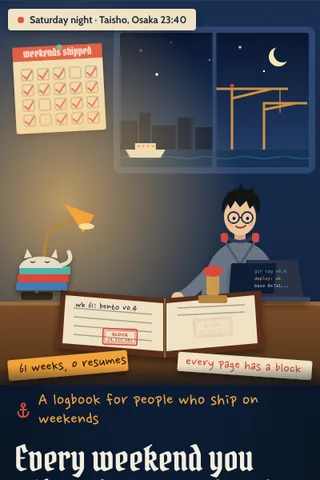
Every commit, deploy, and demo you ship becomes a signed, timestamped builder diary.
 LIVE DEMO
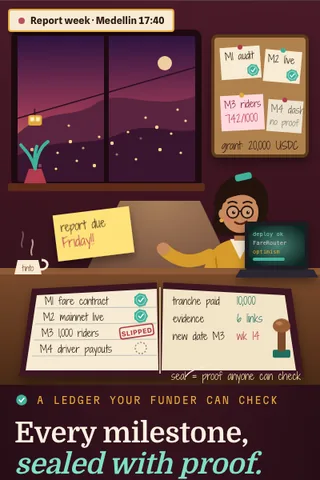
Show funders exactly what their grant built, milestone by milestone, with proof attached.
 LIVE DEMO
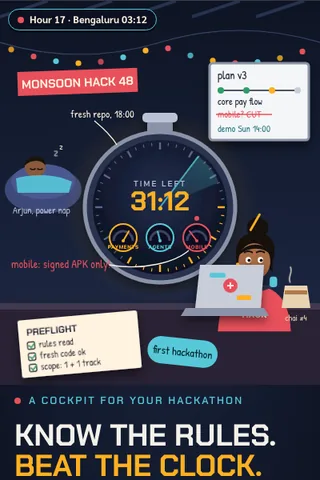
A hackathon cockpit that plans your scope, tracks bounties, and drafts a judge-ready submission.
 LIVE DEMO
Your DePIN devices report uptime and earnings in one honest dashboard with tax-ready exports.
 LIVE DEMO
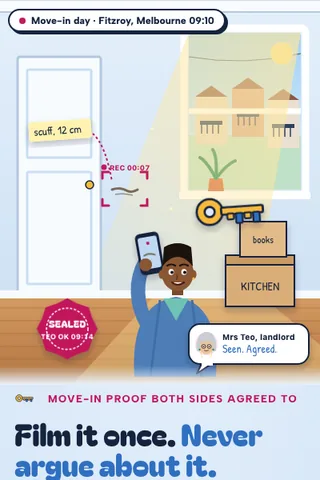
Tenants and landlords seal move-in photos and rent receipts so deposit disputes end fast.