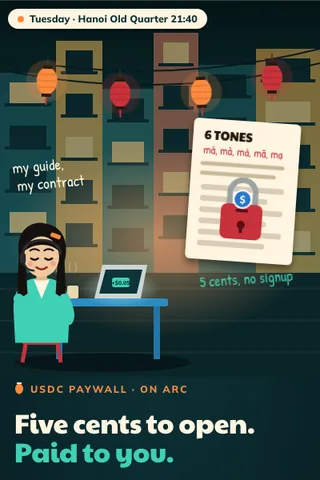
 LIVE DEMO
USDC Paywall
Lock content behind a fraction-of-a-cent USDC payment, on your own Arc contract. Deploy it, become the onchain creator.
Ready now
$20Arc
 Try it live
Say what you want in one sentence; a solver fills it across chains within your limits.
Try it live, freeKunle types swap my Arbitrum USDC into SOL on Solana under 0.3 percent cost by Friday. Intent Desk posts it to solvers and fills only if limits hold.
NL intent parser, solver submission, limit enforcement, status tracker
Reshape it entirely: new features, your flows, your brand end to end, integrations you need. We scope it with you.
Plain-language cross-chain intents are already offered; multi-day limits are an incremental addition.
Ophis runs a natural-language intent DEX aggregator on about a dozen EVM chains, Velora offers crosschain intents with limit orders, and AISwap-X and Nexus Intent demoed plain-English cross-chain intents.
Checked with web searches in October 2026. A search is not proof that nothing similar exists, and the market moves fast, so we recheck before every build.
Existing OSS repos allowed; judged on new work
The complete Intent Desk app: people type what they want with their money in one sentence, it is read back as hard limits, and solvers fill it across Arbitrum, Base and Solana only inside the user's cap and deadline, with plans, checkout and receipts built in.
Every buyer gets the same finished app. Basic branding and copy changes come through a quick form.
Your admin side: revenue, paywall editor, users, rules and the agent log.
Referral and growth mechanics, switched on when you are ready to grow.
A monthly Desk subscription for people who move money every week, plus a small routing fee per fill that always counts inside the user's cap.
Routing fee set by the owner, 0.03% per fill by default, shown inside the all-in number. A quote that the fee would push over the cap does not qualify.
Prices are yours to set. Illustrative, not a promise of income.
Say what you want with your money in one sentence; it fills across chains only inside your limits.
Problem: Moving money across chains still means comparing bridges and aggregators by hand, and quotes often hide destination gas and rent, so people lose evenings and still overpay.
Solution: A desk that turns a sentence into hard limits, collects solver quotes, scores them all-in by what lands in the wallet, and waits until the deadline rather than chasing a bad price.
Why now: Intent rails such as ERC-7683 settlers, Across and deBridge, plus native USDC via CCTP, make solver fills practical, and small fast models make parsing a sentence cost well under a cent.
Market: Freelancers and creators paid in stablecoins who move income across chains weekly, and the group chats where they compare routes.
The ask: Launch partners: creator and freelancer communities to run payday nights, and solvers willing to post bonds.
Funding is never guaranteed. Check each program's rules.
Many hackathons require code written at the event. See the Regatta Boardfor each race's rule.
Custom work covers new chains and rails, your own solver or settler integration, branded front ends such as a Telegram or WhatsApp bot, and team approval flows, scoped on a call from $2,000.
Moving money across chains still means comparing bridges, aggregators and fees by hand. People lose evenings to route hunting and still overpay, often because quotes hide gas or rent on the destination chain.
Plain-language cross-chain intents already exist: Ophis runs a natural-language intent DEX aggregator on about a dozen EVM chains, Velora offers crosschain intents with limit orders, and AISwap-X and Nexus Intent demoed plain-English cross-chain intents at ETHGlobal. Research verdict: exists, low novelty. What this build adds is incremental: multi-day limits that hold until a deadline, all-in cost scoring by what lands in the wallet, a clarify-before-signing rule for vague sentences, and a standing weekly intent.
The user's sentence (kept on device), the parsed limits they confirm, solver quotes, the signed intent, escrow and delivery transactions on each chain, and a fill history for the digest.
Say what you want with your money in plain words, and have it happen only on your terms.
One sentence, no tabs Type it like a text message. The desk reads it back as hard limits before anything is signed.
It waits for you If quotes are above your cap, it waits until your deadline instead of chasing a bad price.
Friday sweep A standing weekly intent turns this week's income into the asset you want, inside your cap.
Wallet: Privy embedded or connected wallet on Arbitrum, Base and Solana. One EIP-712 signature per intent, no open-ended approvals.
Sentence parser: A small fast model (for example Claude Haiku tier via OpenRouter) turns the sentence into a strict schema: amount, assets, chains, max all-in cost, deadline, fill style. Ambiguity triggers a question, never a guess.
Solver networks: Post intents to existing cross-chain intent rails (for example ERC-7683 compatible settlers, Across, or deBridge DLN) and collect quotes. Circle CCTP routes USDC natively where available.
Limit enforcement: Every quote is scored all-in by the amount delivered versus a reference mid price, including destination gas and rent. Only a quote under the cap, before the deadline, to the user's own address, can be accepted.
Escrow and settlement: Funds lock in the settler contract only when a valid fill is accepted; the solver delivers on the destination chain and is repaid after proof. Expired intents never lock funds.
Status and digest: An indexer tracks both legs, shows a receipt per fill, and sends the Friday digest by push or email.
Per intent: parsing with a small model is well under 1 cent; quote polling is a few RPC calls. Onchain costs are the user's gas on the source chain (cents on Arbitrum or Base) plus the solver's spread, which is what the cap limits. Example month: 2,000 intents cost roughly $10 to $20 in model calls and $50 to $150 in RPC and indexing.
Each fill ends with a shareable receipt showing the sentence and the cost. Group chats that compare bridges become the funnel. Standing weekly intents keep users returning every Friday.
Parser mistakes: A misread sentence could move the wrong asset. The desk always reads limits back for confirmation and refuses to guess on vague input.
Solver failure: A solver could fail to deliver. Use settlers with bonds or proofs and refund paths; show status on both chains.
Hidden costs: Quotes can omit fees. All-in scoring by delivered amount, and a public method for how cost is measured.
Regulation: Swapping and routing may be regulated in some places. Non-custodial design, clear terms, and geo restrictions where required.
Market moves: Some intents will never fill inside a tight cap. The app says so plainly and never loosens limits on its own.
Costs and tools are estimates at the time of writing. General information only, not legal or financial advice.
Nine routes from one vessel. Tap a port to open its chart.
Cross chain moves still mean five tabs, three bridges and a prayer. Own Intent Desk and you run the one sentence front door to solvers, from your wallet and brand, with limits the user sets. The fees, the users and the record of every fill are yours.
The fill only happens if your limits hold; otherwise nothing moves. Show that clearly and keep a status page for failed or expired intents.
No, the solvers fill against the user's own wallet. Do not build custody into it, and check local money transmission rules before you add fees in fiat.
You do not need to. Intent Desk arrives working, deployed from your own wallet with a written guide for every step. You will click, paste and fill in names. If you ever want a change you cannot make, the custom option or a freelancer can handle it, but the first launch needs no code.
Yes. The contract is deployed from your wallet on Base, the code sits in your own git repo, and the name and brand are yours. DEPLOYR does not hold your keys or take a cut of what Intent Desk earns. If you stop paying anyone tomorrow, the app keeps running on your wallet.
That is the most likely early outcome, and it is fixable. The paths below start with you as the first user, then ten real crypto users who move money across chains you can name today. If ten people you message do not care after you have shown it to them, you have learned something useful in a week instead of a year.
A small fee per filled intent (a few basis points), plus a pro plan for frequent users and teams with saved routes. This ladder is a target, not a promise.
Illustrative stages, not a forecast. Results depend on you and the market; nothing here is guaranteed.
LIVE DEMOLock content behind a fraction-of-a-cent USDC payment, on your own Arc contract. Deploy it, become the onchain creator.
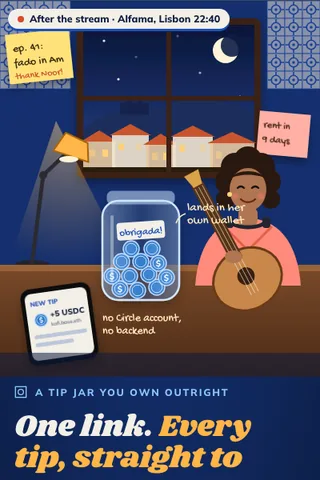 LIVE DEMO
Take pay-what-you-want USDC tips on Base, with a live supporters feed read straight from chain. No Circle account, no backend.
 LIVE DEMO
Your own swap/bridge front-end. Integrator fee optional and disclosed.
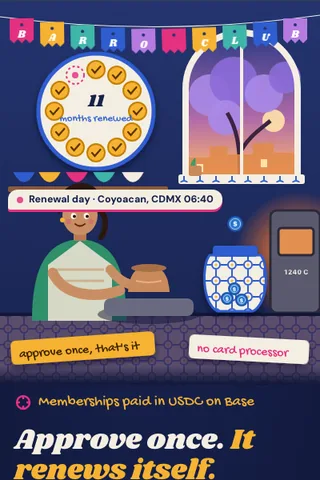 LIVE DEMO
Recurring USDC on Base. Members approve once, it renews itself. No card processor, no contract.
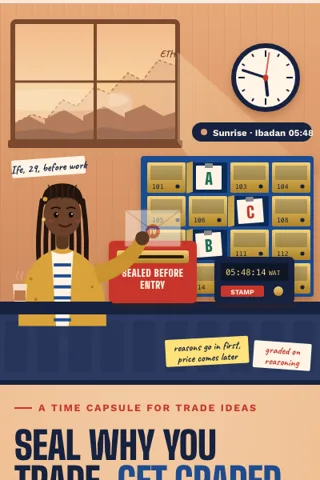 LIVE DEMO
Write why you entered a trade, seal it with the timestamp, and get graded on reasoning, not luck.
 LIVE DEMO
Let a trusted mentor co sign your risky trades above a size you choose.
 LIVE DEMO
Your perp bot follows your rules, and every rule you kept becomes a public, provable track record.
 LIVE DEMO
A tilt brake that delays your trades after losses until you answer one honest question.