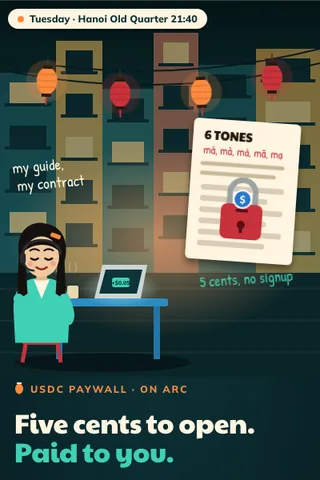
 LIVE DEMO
USDC Paywall
Lock content behind a fraction-of-a-cent USDC payment, on your own Arc contract. Deploy it, become the onchain creator.
Ready now
$20Arc
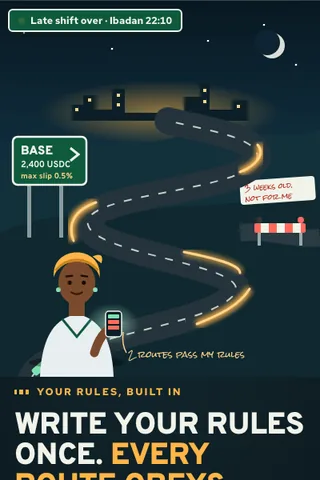 Try it live
Bridge and route aggregation that refuses paths breaking your own safety rules.
Try it live, freeSade sets rules: no bridges under a year old, max 0.5 percent slippage, never unaudited pools. Every route quote is filtered and explained in plain words before she signs.
LI.FI powered routing with user policy filter and plain language route explainer
Reshape it entirely: new features, your flows, your brand end to end, integrations you need. We scope it with you.
Brings institutional-style bridge policies to individual users, an incremental upgrade over aggregators.
LI.FI, Socket and Jumper let integrators allow or deny bridges, and Elliptic sells institutional bridge risk rules, but consumer user-authored routing policies with explanations were not found.
Checked with web searches in October 2026. A search is not proof that nothing similar exists, and the market moves fast, so we recheck before every build.
Existing projects OK
The complete Guardrail Router app: people write their bridge rules once, and every route quote is filtered, explained in plain words and re-checked before they sign, with receipts, a weekly road report and a paywall built in.
Every buyer gets the same finished app. Basic branding and copy changes come through a quick form.
Your admin side: revenue, paywall editor, users, rules and the agent log.
Referral and growth mechanics, switched on when you are ready to grow.
A small, disclosed integrator fee on routed volume, plus monthly plans for people and small teams who want more chains, the road report and shared policies. Volume is never guaranteed.
Integrator fee set by the owner, 0 to 0.50% of routed volume, shown on every quote when disclosure is on.
Prices are yours to set. Illustrative, not a promise of income.
Bridge routing that refuses paths breaking your own safety rules, and explains every no.
Problem: Aggregators rank routes by price and speed. The cheapest path is sometimes a brand new bridge or an unaudited pool, and individuals have no way to say never that once and have it enforced.
Solution: A personal policy engine on top of route aggregation: deterministic checks for age, slippage, audits, hops and pauses, fail closed on unknown data, quote expiry, and one plain sentence per refused route.
Why now: Stablecoin payments between chains are now everyday business for small merchants, while integrator tools already expose bridge allow and deny lists that consumers never see.
Market: People and small businesses moving stablecoins between L2s, plus DAO treasuries that must follow written risk rules.
The ask: Pilot with communities that lost money to a bridge incident, and one DAO treasury on a paid policy plan.
Funding is never guaranteed. Check each program's rules.
Many hackathons require code written at the event. See the Regatta Boardfor each race's rule.
New rule types, extra chains or route sources, your own risk data feeds, white label for a wallet or community, and treasury reporting formats are scoped and priced together.
People moving stablecoins between chains pick routes by price and speed, because aggregators rank that way. The cheapest path is sometimes a brand new bridge or an unaudited pool, and most individuals have no way to say 'never that' once and have it enforced.
Bridge allow and deny lists already exist for integrators: LI.FI, Socket and Jumper let apps include or exclude bridges, and Elliptic sells institutional bridge risk monitoring and rules. Consumer, user authored routing policies with plain language explanations were not found in research. Verdict: rare, medium novelty. The routing itself is not new; this app adds a personal policy, fail closed checks when data is missing, and an explanation for every refused route.
Route quotes from an aggregator, bridge launch dates and audit links from public registries and the bridges' own reports, pause and upgrade events, the user's policy (stored on device), and the user's own transfer history.
Let anyone encode their risk appetite once, and have every money move respect it in plain words.
Every no has a reason Refused routes say exactly which rule they broke, so users learn what risk they are avoiding.
The cost of calm The app shows what your rules cost you versus the cheapest quote, usually cents.
Monday road report A weekly note on upgrades, pauses and new audits for the bridges you allow.
Wallet: Privy embedded wallet or the user's own wallet. The app never takes custody; the user signs every move.
Quotes: LI.FI API for routes across Base, Arbitrum, Optimism and Polygon, using its bridge allow and deny parameters as a first filter.
Policy engine: Deterministic checks for bridge age, audit status, max slippage, hop count and pause status. Unknown data fails closed. Quotes expire after 30 seconds and are re-checked before signing.
Risk data: A small indexer tracks bridge launch dates, audit links, contract upgrades and pause events, refreshed hourly.
Explainer: A small model such as Claude Haiku or GPT-4o mini rewrites the rule results into one plain sentence per route; the decision itself is never made by the model.
Receipts and alerts: Transfers are recorded from chain data; refused routes and reasons are stored privately. Weekly email or push digest for changes to allowed bridges.
Quote and policy checks are cheap compute, under 0.1 cent per request. The explainer costs roughly $0.0003 per quote set with a small model. Gas and bridge fees are paid by the user per move. Example: 3,000 users making 4 moves a month is about $30 to $60 a month in hosting, indexing and model calls, before any LI.FI integrator fee arrangement.
Users share their policy as a template ('Sade's careful defaults'), and the share card shows what the rules cost per week. Small businesses bring their staff onto one shared policy.
False sense of safety: Old, audited bridges can still fail. The app says rules lower risk, not remove it, and never calls a route safe.
Bad risk data: Wrong launch dates or missing audits can mislead. Unknown data fails closed, and sources are linked.
Stale quotes: Prices move while users read. Quotes expire and are re-checked before signing.
Dependence on one aggregator: If the route API is down, the app refuses to route rather than guessing. A second source can be added.
Legal: The app is non custodial software, but owners should check money transmission rules where they operate and avoid offering fiat services without licences.
Costs and tools are estimates at the time of writing. General information only, not legal or financial advice.
Nine routes from one vessel. Tap a port to open its chart.
Guardrail Router finds bridge and swap routes, then refuses any path that breaks the user's own safety rules and explains each choice in plain words before they sign. If people use a generic aggregator, that site keeps the integrator fees, the user base and the trust. Own it, and the routing front end, the integrator fee on every route and the brand people associate with 'safe crossings' are yours.
Routing runs through LI.FI and the underlying bridges, and users sign every transaction themselves. Your filter reduces risk; it does not remove it. Say that clearly in the interface and terms, and never call a route 'guaranteed safe'.
The routing, policy filter and explainer come built. You set default rules, branding and your integrator fee address. Adding new rule types later is developer work.
Because big aggregators optimise for price and speed. Yours optimises for the user's own rules. Cautious users, treasuries and communities that have been burned are your audience.
Integrator fees are common, but rules on financial services vary by country. Check with a local adviser before you turn fees on, and do not hold user funds.
Yes. Your domain, your git, your fee address. No custody of user funds at any point.
A small integrator fee on routed volume, plus paid policy plans for DAO treasuries and teams that must follow written risk rules. Volume is never guaranteed, so this is a target, not a promise.
Illustrative stages, not a forecast. Results depend on you and the market; nothing here is guaranteed.
LIVE DEMOLock content behind a fraction-of-a-cent USDC payment, on your own Arc contract. Deploy it, become the onchain creator.
 LIVE DEMO
Take pay-what-you-want USDC tips on Base, with a live supporters feed read straight from chain. No Circle account, no backend.
 LIVE DEMO
Your own swap/bridge front-end. Integrator fee optional and disclosed.
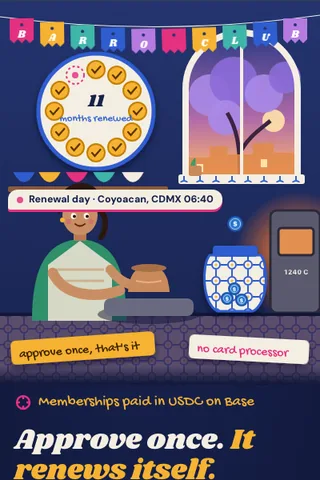 LIVE DEMO
Recurring USDC on Base. Members approve once, it renews itself. No card processor, no contract.
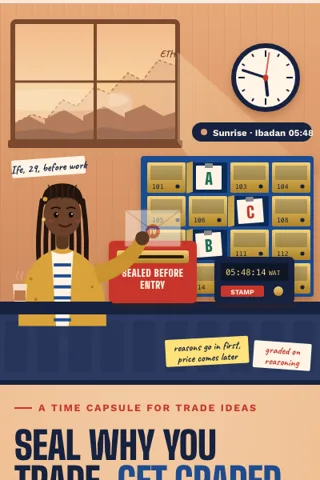 LIVE DEMO
Write why you entered a trade, seal it with the timestamp, and get graded on reasoning, not luck.
 LIVE DEMO
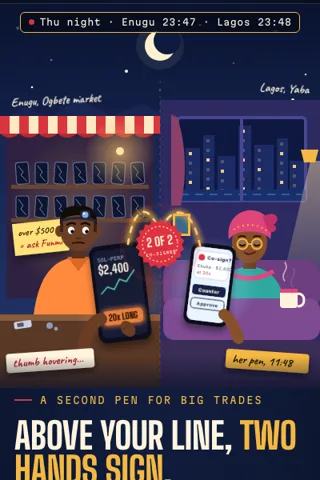
Let a trusted mentor co sign your risky trades above a size you choose.
 LIVE DEMO
Your perp bot follows your rules, and every rule you kept becomes a public, provable track record.
 LIVE DEMO
A tilt brake that delays your trades after losses until you answer one honest question.