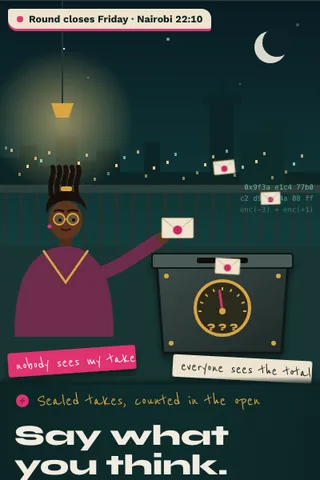
 LIVE DEMO
Sealed Take
Everyone stakes a conviction, encrypted. The chain tallies it without ever seeing a single take. FHE on Base.
Ready now
$20Fhenix
 Try it live
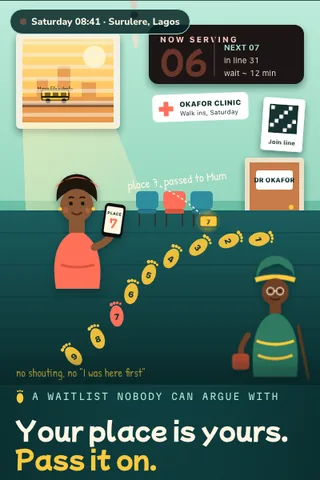
A public waitlist for clinics, barbers and food spots where your place is onchain and you can hand it to someone.
Try it live, freeDr Okafor's clinic has forty walk ins on Saturday. Fair Queue gives each patient a spot onchain, shows the line live, and lets a parent pass their place to a grandmother who arrived late.
Join by QR, live line page, transfer place, staff console.
Reshape it entirely: new features, your flows, your brand end to end, integrations you need. We scope it with you.
ThanQ (ETHGlobal) built a blockchain queue; transferable queue positions were not found.
ThanQ (ETHGlobal Bangkok); digiQueue (off chain).
Checked with web searches in October 2026. A search is not proof that nothing similar exists, and the market moves fast, so we recheck before every build.
Ecosystem program for shipped apps; check current terms.
The complete Fair Queue app: visitors join a line by QR, hold a place nobody can argue with, keep it when they step out, and pass it to someone they love, while names and symptoms never go onchain, with a paywall and line agent built in.
Every buyer gets the same finished app. Basic branding and copy changes come through a quick form.
Your admin side: revenue, paywall editor, users, rules and the agent log.
Referral and growth mechanics, switched on when you are ready to grow.
Visitors never pay; clinics and whole streets subscribe in USDC.
Roughly $0.05 to $0.10 per visitor in SMS and gas, paid by the venue plan.
Prices are yours to set. Illustrative, not a promise of income.
A fair and kind line: your place is a record nobody can argue with, and you can hand it to someone you love.
Problem: Walk in clinics and offices waste hours, people lose their place for stepping out, and touts sell spots.
Solution: A queue contract with rotating gate codes, grace instead of skips, one place per phone and one transfer per place.
Why now: Monad makes per visitor contract calls cost a fraction of a cent, and every visitor has a phone.
Market: Clinics, offices, barbers and markets, from free to $149 a month for a whole street.
The ask: Four Saturday pilot with one Lagos clinic, then a street.
Funding is never guaranteed. Check each program's rules.
Many hackathons require code written at the event. See the Regatta Boardfor each race's rule.
Multi desk routing, book ahead slots, kiosks and branded line pages, scoped on a call from $1,000.
Clinics, barbers and food spots with walk in lines run on paper lists and memory. People argue about who came first, anyone who steps out loses their turn, and a parent cannot hold a place for a grandmother who is stuck in traffic. Staff spend their morning refereeing instead of serving.
Blockchain queues exist as prototypes: ThanQ, built at ETHGlobal Bangkok, put a queue onchain, and off chain tools such as digiQueue already run virtual waitlists with SMS. What our research did not find is a queue where a place can be passed, once and under the venue's rules, to a named person, with the full chain of holders visible to the front desk. The new parts are the transferable place, the rules written in the contract, and the move back instead of kick out handling for people who step away. It is a medium novelty product on top of known patterns, not a new primitive.
Per venue: the day's rules (capacity, grace minutes, transfer policy, places per phone), each place as a record with a join time, a short code and a salted hash of the holder's phone, every handover, hold and move back event, and served or rebooked status. Names, phone numbers and the reason for a visit stay off chain or are never collected.
Make waiting in line fair and kind: your place is a record nobody can argue with, and you can hand it to someone you love.
The pass Handing a place to Mum with one tap is the moment people tell their friends about. It turns a stressful wait into an act of care.
Wait anywhere The live line page means people wait at home or at work and come in at 15 minutes. Time in the room drops even when the doctor's pace does not.
No referee Staff point at the record instead of arguing. The desk gets quieter every week, which is why venues keep it.
Join by QR: A rotating QR at the gate opens a web page. The visitor enters a phone number; the app creates an embedded wallet with Privy so nobody needs a crypto app. The code changes every 2 minutes so places cannot be claimed from a photo.
Queue contract on Monad: A small Solidity contract per venue holds the day's rules and an ordered list of places. Join, pass, hold, move back and serve are single calls. Monad's fast blocks keep the line page close to real time, and the venue pays gas through a sponsored paymaster.
Transferable place: Each place records its holder and a pass counter. The rules decide whether it can be passed, how many times and to whom (for example only to a phone named at join). Sales to unknown wallets revert.
Live line page: An indexer such as Envio or a small Ponder service listens to queue events and pushes updates over websockets to every phone, showing place, now serving and an estimated wait.
Line keeper agent: A small model such as Claude Haiku or GPT-4o mini reads anonymised events to estimate waits, spot many places on one phone and draft the Friday reminder. It suggests; it cannot remove anyone.
Staff console: A tablet view for the desk: call next, start a hold, mark served, confirm priority by eye, rebook to Monday. Every action is an event the visitor can see.
Notifications: SMS or WhatsApp messages via a provider such as Termii or Twilio for your turn soon, called, and passed to you. Message content is stored off chain.
Per visitor, roughly: a few contract calls on Monad at well under one US cent each in total, about 2 to 3 SMS at around $0.01 to $0.03 each depending on country and provider, and a few hundred model tokens for wait estimates at a small fraction of a cent. Call it $0.05 to $0.10 per visitor. A clinic with 40 walk ins every Saturday is about 160 visitors a month, so roughly $8 to $16 a month plus about $10 to $20 hosting. Gas and SMS prices change; check current rates before pricing.
Each visitor sees the app at the gate and again when a relative passes them a place, often someone who has never used it. Venues on the same street share visitors, so a barber sees the clinic's line page and asks for the same. The share card from a passed place is the warmest ad the app has.
Touting and resale: Places can become a market. Defaults are one place per phone, one pass per place, and passes only to a phone named at join. Venues can switch transfers off.
Privacy: A clinic line can reveal who is ill. Only salted hashes and place numbers go onchain; names, numbers and reasons for a visit never do. Short codes rotate per day.
People without phones: Some elders do not carry phones. The desk can issue a printed code tied to the same contract, and a relative can hold it for them.
Unfair removal: Early testing showed auto skipping was cruel. The default is to ping, hold, then move back three places. The agent can never remove a person.
Clinical priority: The app does not triage. Emergencies go straight in; priority lanes are confirmed by staff, not by the software.
Network or app downtime: If the indexer lags, the desk console works from the last known order and the paper fallback prints from it.
Costs and tools are estimates at the time of writing. General information only, not legal or financial advice.
Nine routes from one vessel. Tap a port to open its chart.
Fair Queue: A public waitlist for clinics, barbers and food spots where your place is onchain and you can hand it to someone. Using someone else's version means their rules, their brand and their revenue. Owning Fair Queue means it is deployed under your wallet, carries your name, and every customer, partner and result builds your track record instead of theirs.
Fair Queue arrives deployed with a guide. Running it is settings and sharing links, not code. If you get stuck, we help you ship it.
Start with ten people you already know. The first move below takes under an hour and tells you fast whether people care.
Each step is sized in minutes. Most owners spend an hour a week, and the app does the repetitive part.
Nothing is guaranteed. The playbook gives you a clear path and honest numbers, and you decide how far to take it.
Charge the people who get the most value from Fair Queue: a monthly plan for groups or teams, plus setup fees for anyone who wants it done for them.
Illustrative stages, not a forecast. Results depend on you and the market; nothing here is guaranteed.
A starter chart. A fuller, app-specific playbook is being written.
LIVE DEMOEveryone stakes a conviction, encrypted. The chain tallies it without ever seeing a single take. FHE on Base.
 LIVE DEMO
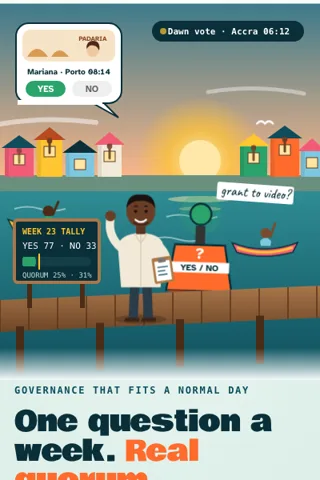
Governance by text-sized questions: one decision a week, answered in ten seconds, with real quorum.
 LIVE DEMO
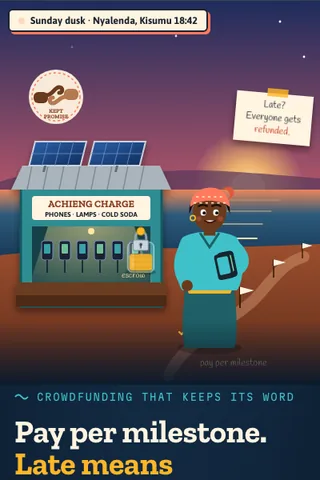
Crowdfunding where backers get refunded by contract if the goal or the milestones are missed.
 LIVE DEMO
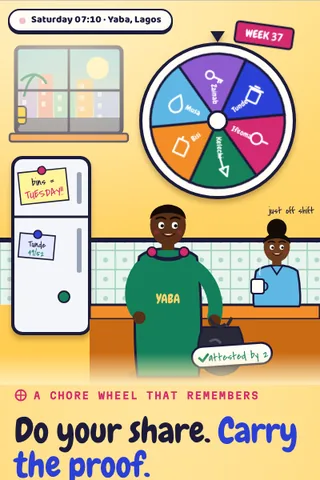
A shared house or club tracks who did the work, and the record becomes everyone's portable reliability score.
 LIVE DEMO
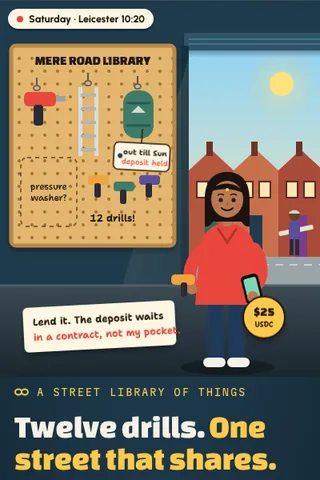
Lend the ladder, the drill, the tent: a street library of things with deposits held by contract.
 LIVE DEMO
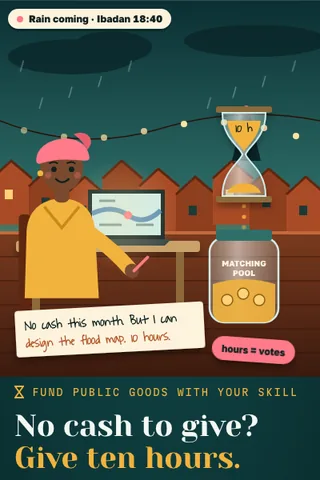
Fund a public good with hours of your skill, not just money, and get matched like a donation.
 LIVE DEMO
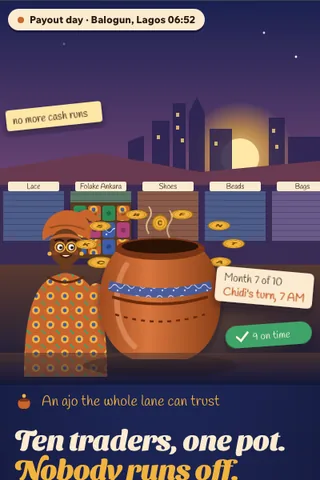
A rotating savings circle (ajo, susu, chama) with payouts enforced by contract and trust scores for members.
 LIVE DEMO
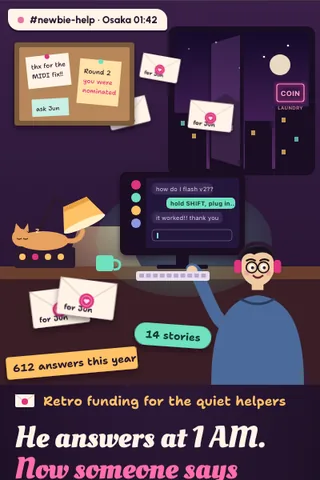
Retro funding for the quiet helpers: the community nominates who mattered, a pot pays them.