 LIVE DEMO
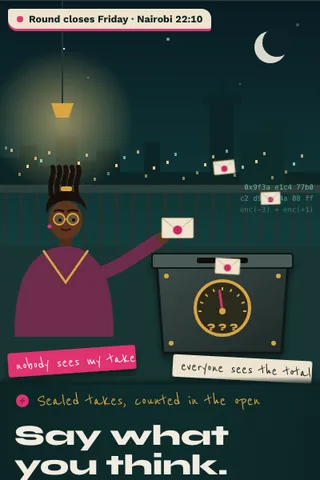
Sealed Take
Everyone stakes a conviction, encrypted. The chain tallies it without ever seeing a single take. FHE on Base.
Ready now
$20Fhenix
 Try it live
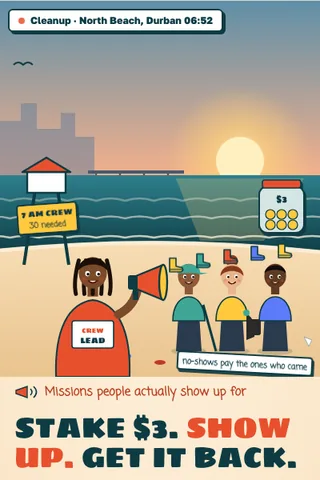
Post a mission, people commit a stake to show up, and no-shows fund the ones who came.
Try it live, freeA beach cleanup needs 30 people at 7am Saturday. Crew Call asks each volunteer to stake $3, attendance is confirmed at the beach, and the no-show stakes split among attendees, so turnout jumps and showing up earns a streak.
Mission page, USDC stake RSVP, organiser check-in, auto redistribution, attendance streak badge.
Reshape it entirely: new features, your flows, your brand end to end, integrations you need. We scope it with you.
Stake-to-attend with no-shows funding attendees is live; Crew Call would apply it to missions rather than events.
Unlock Labs Events has an "I'm Going" stake-to-RSVP feature, Show Up Protocol targets no-shows, and ShowUp (ETHGlobal NY 2025) redistributes forfeited stakes to attendees.
Checked with web searches in October 2026. A search is not proof that nothing similar exists, and the market moves fast, so we recheck before every build.
Shipped Base apps; retroactive
Only events allowing existing code; most require building during event
The complete Crew Call app: organisers post a mission, volunteers stake a few dollars of USDC to say yes, people who show up get their stake back plus a share of no-shows, and cancelled missions refund everyone, with a paywall and helper agent built in.
Every buyer gets the same finished app. Basic branding and copy changes come through a quick form.
Your admin side: revenue, paywall editor, users, rules and the agent log.
Referral and growth mechanics, switched on when you are ready to grow.
Organisers subscribe in USDC; brands pay to sponsor missions that top up the attendee pot.
Owner can take a share of the no-show pool, 0% by default. Gas is sponsored at a few cents per mission.
Prices are yours to set. Illustrative, not a promise of income.
Make a yes mean something: volunteers stake a few dollars and the people who show up are never short-handed.
Problem: Free RSVPs are cheap; a third of volunteers do not show and organisers are left short.
Solution: A small USDC stake in escrow, tap or rotating code check-in, no-shows split among attendees, and full refunds when a mission is cancelled.
Why now: Stablecoin escrow on Base costs a few cents per mission and sign in is email.
Market: Volunteer groups, run clubs, meetups and brands, from free to $1,000 a month sponsors.
The ask: Pilot with ten Durban and Cape Town groups and one brand sponsor.
Funding is never guaranteed. Check each program's rules.
Many hackathons require code written at the event. See the Regatta Boardfor each race's rule.
Custom check-in methods, sponsor flows, new chains and branded mission pages, scoped on a call from $1,000.
Volunteer organisers plan for 40 people and get 11. Free RSVPs cost nothing, so a yes means little, and organisers waste borrowed gear, food and goodwill.
This mechanism exists. Unlock Labs Events has an "I'm Going" commitment stake for RSVPs, Show Up Protocol targets no-shows, and ShowUp (ETHGlobal NY 2025) redistributes forfeited stakes to attendees. Crew Call applies the same idea to recurring volunteer missions, with organiser check-in, weather cancels that refund everyone, spot swaps and an attendance streak. Research verdict: exists, low novelty; the value is in a polished, mission-first package.
Mission details, stake size, list of committed wallets, check-in taps or rotating codes with timestamps, swaps, cancel events, settlement amounts, streaks. Names and phone numbers stay offchain.
Make a yes mean something, so the people who show up for their community are never left short-handed.
Skin in the game, tiny A $3 stake is small enough for anyone and big enough to get you out of bed.
Showing up is rewarded No-show stakes go to the people who came, never to the organiser.
Streaks A row of boots for every Saturday you came. Cancelled days and early swaps never break it.
Wallets: Privy embedded wallets with email or phone sign-in on Base (Arbitrum or Polygon as options). Stakes paid in USDC, with a card on-ramp for first-timers.
Stake escrow: A small audited escrow contract per mission: deposit, swap (transfer a spot before a deadline), organiser cancel (full refund), and settle after the check-in window.
Check-in: Organiser taps each phone (NFC or QR scan) or shows a code that rotates every 20 seconds. The app signs a check-in that the contract accepts until the window closes.
Settlement: At close, the contract returns stakes to attendees and splits no-show stakes equally among them. One transaction per mission, batched.
Helper agent: A low-cost model tier (for example a Claude Haiku class model) writes reminders, reads a weather API and prompts the organiser to cancel. It can trigger refunds only with organiser approval and can never redirect stakes.
Notifications and streaks: WhatsApp, SMS or push reminders; an onchain streak counter or EAS attestation per attended mission.
Per mission of 30 people: 30 deposits plus one settlement on Base is typically a few cents in total gas, often sponsored by the operator with a paymaster. Helper model calls for reminders and a weather check cost well under one cent. Example month with 20 missions: about $2 to $5 in gas, under $1 in model costs, $15 in SMS, $20 hosting. Around $40 a month.
Every mission has a public page and a share card. Volunteers bring friends to fill spots, swaps pull new people in, and organisers in other cities copy a mission template.
Gambling or money rules: Forfeiting stakes to others may be regulated in some places. Keep stakes small, refund on cancel, and let the owner check local law.
Excluding people: Even $3 can be a barrier. Allow organisers or sponsors to cover stakes for some volunteers.
Unfair forfeits: Illness and emergencies happen. Swaps, organiser-approved excuses and full refunds on cancel limit harm.
Fake check-ins: Shared codes and collusion. Rotating codes, tap-to-check-in and per-person limits reduce it but cannot remove it.
Contract bugs: Funds sit in escrow. Use a small, audited contract and cap stake size.
Costs and tools are estimates at the time of writing. General information only, not legal or financial advice.
Nine routes from one vessel. Tap a port to open its chart.
Crew Call lets an organiser post a mission, asks each volunteer to stake a few dollars to RSVP, and splits no-show stakes among the people who came. On an events platform, the platform keeps the attendee list and the fees, and turnout is still a guess. Own it, and your missions, your attendance streaks and every organiser who uses your tool to fill a beach cleanup or a Saturday build run through your deployment.
Some will. Keep stakes small, like $3, and explain that it comes back if they show up. Offer a no stake option for people without wallets, at least at first.
Deposits that are returned or redistributed may be treated differently in different places. Check locally, keep amounts small, and never take a cut of no-show stakes without saying so.
Have a backup: the organiser can mark attendance manually. Test check in before the day.
Mission page, USDC stake RSVP, check in and redistribution come built.
Yes. Deployed from your wallet on Base, Arbitrum or Polygon.
A small organiser fee per mission or a monthly plan for groups that run many events, plus partnerships with brands sponsoring missions. This is a target, not a promise.
Illustrative stages, not a forecast. Results depend on you and the market; nothing here is guaranteed.
LIVE DEMOEveryone stakes a conviction, encrypted. The chain tallies it without ever seeing a single take. FHE on Base.
 LIVE DEMO
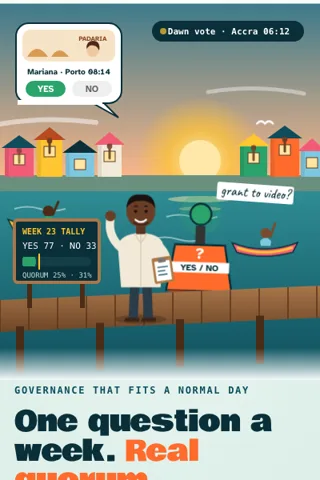
Governance by text-sized questions: one decision a week, answered in ten seconds, with real quorum.
 LIVE DEMO
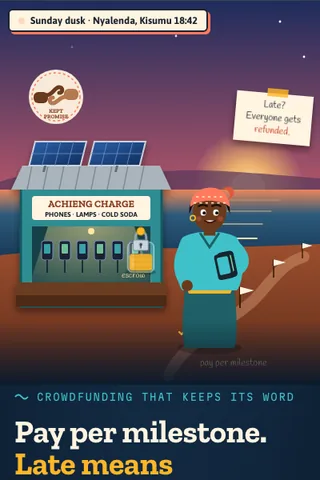
Crowdfunding where backers get refunded by contract if the goal or the milestones are missed.
 LIVE DEMO
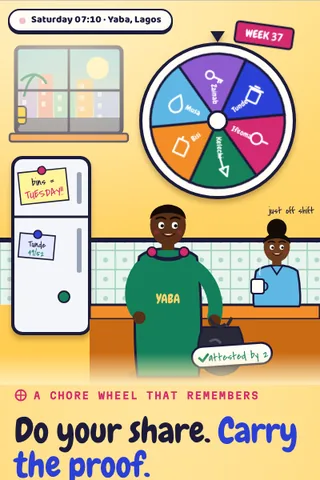
A shared house or club tracks who did the work, and the record becomes everyone's portable reliability score.
 LIVE DEMO
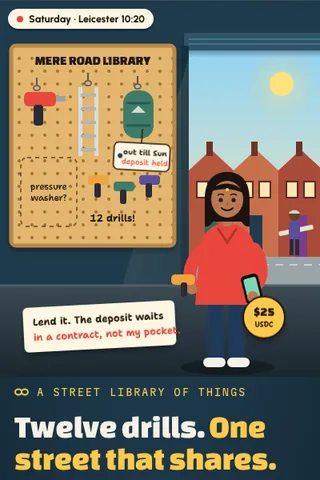
Lend the ladder, the drill, the tent: a street library of things with deposits held by contract.
 LIVE DEMO
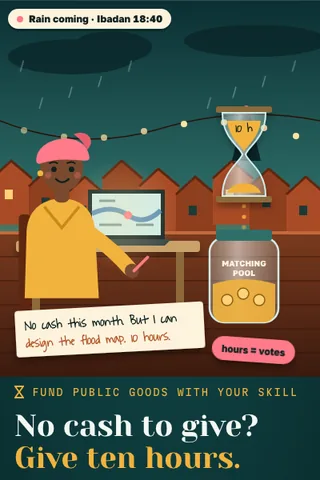
Fund a public good with hours of your skill, not just money, and get matched like a donation.
 LIVE DEMO
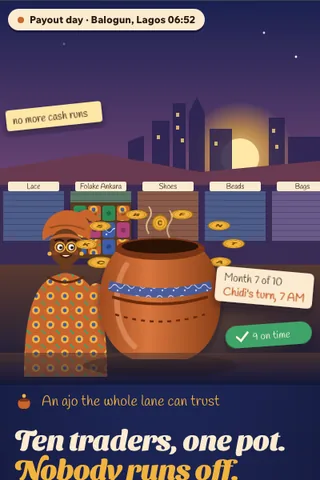
A rotating savings circle (ajo, susu, chama) with payouts enforced by contract and trust scores for members.
 LIVE DEMO
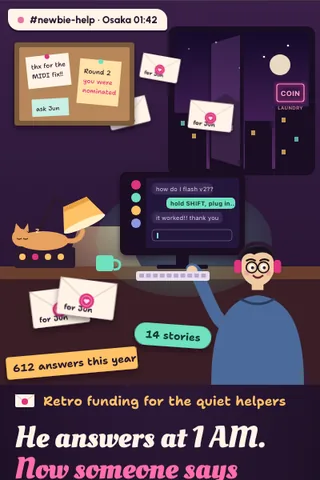
Retro funding for the quiet helpers: the community nominates who mattered, a pot pays them.