Craft Graph, first screen of the live demoTry it live
Live demo with sample data. No wallet needed.
Reserve · refundable depositBUILDER STATUS

Craft Graph

Merge your GitHub, Figma, and onchain deploys into one verified contribution map.

Try it live, free
$299one time, base tier
Built on order. Reserve it today for a $75 refundable deposit, pay the balance when it is delivered. Delivery: 2 to 3 days after the base build exists.
Reserve for $75Want it fully custom? From $2,500 · talk to us
PortsBase · Optimism · Arbitrum · Solana
KindIdentity
OwnerYou, on your wallet and git
Picture this

Who it is for

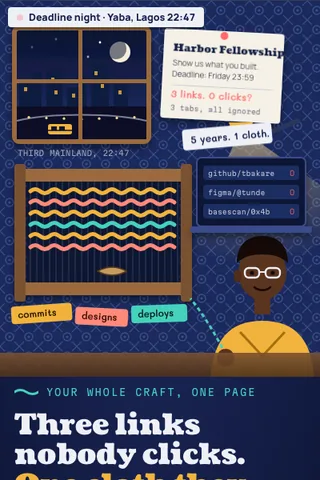
Tunde applies to an accelerator with three links that nobody clicks. With Craft Graph he sends one page that shows signed proof of his commits, his contract deploys and his design files over five years, verified rather than claimed.

Two ways to own it

What you get

Base$299
$75 deposit to reserve

GitHub and contract deploy connectors, attestation anchoring, visual contribution heatmap, public profile.

  • You choose: chain
  • You choose: name and logo
  • You choose: accent color
  • You choose: connectors
Customfrom $2,500
Built around you

Reshape it entirely: new features, your flows, your brand end to end, integrations you need. We scope it with you.

  • Everything in Base
  • Custom features and design
  • Priority build
Why it is new

What exists today, and what this does differently

What is new

Adding design-tool proofs and an owned profile extends a live aggregator rather than inventing one.

Closest things out there

Talent Protocol already merges GitHub, onchain activity and credentials into a Builder Score; no source found pulling Figma or design work.

Checked with web searches in October 2026. A search is not proof that nothing similar exists, and the market moves fast, so we recheck before every build.

What it unlocks

The human in it

Shows the whole craftsperson, not just the code.
The Regatta Board

Races it can enter

grant · Optimism Collective · rolling
Optimism Retro Funding
rounds/seasons; current round unknown
Official page ↗

Dev tooling; retroactive with measurable impact required.

Their rule on existing code: Retroactive: existing deployed projects with measurable impact required
hackathon · ETHGlobal · rolling
ETHGlobal Continuity Track
Offered at select 2026 events (reported for ETHGlobal New York 2026); per-event
Official page ↗

Only via Continuity Track if open-sourced; fresh-code-only hackathons excluded.

Their rule on existing code: Existing open-source repos allowed; judged on work added during the event. Exact diff/disclosure rules unknown
What you own

The whole app, not a starter kit.

The complete Craft Graph app: builders weave their commits, Figma files and contract deploys into one cloth with a signed proof behind every thread, with plans and USDC checkout built in.

Base price · $299

The user app, complete

Every buyer gets the same finished app. Basic branding and copy changes come through a quick form.

Three step onboardingHome
Shown once: three ignored links, one woven cloth, signed not claimed.
Progress and next actionHome
Connect, weave, send and read, with one clear next step and the open deadline.
Source and chain pickerWeave
GitHub commits, Figma files and deploys on Base, Optimism, Arbitrum and Solana, with a years back slider.
Weave with live snagsWeave
Rate limit fallback and a one signature check for unverified commit emails before anything is claimed.
Figma design threadsWeave
Version history becomes coral design threads. Gated behind Craft.
Public cloth with tap to see proofCloth
Every month opens to its proof; no login for reviewers.
Send to a programCloth
One link per fellowship, grant or hackathon, with the fields you choose and open notifications.
Claim checksCloth
Someone claiming your contract is rejected by deployer signature mismatch, shown openly.
Sunday rows and streakSunday
Pin the story of the week and approve the row before it is anchored.
Sunday digestSunday
A short weekly note written from the counts, never changing them. Gated behind Craft.
Onchain receipts and hideable threadsProofs
What is onchain, what never is, and per thread show or hide.
Private repo proofs with client co-signProofs
Private work counts as numbers only, co-signed by the client. Gated behind Craft.
Plans, USDC checkout and custom domainMe
Pricing from the owner paywall, shared crypto checkout with receipt, gated custom domain.
Open the full app demo
Add-on

Owner console

Your admin side: revenue, paywall editor, users, rules and the agent log.

Revenue and paywall editorRevenue
MRR, program fees, incoming USDC payments, payouts, accepted methods and live tier editing.
Programs and reviewer viewPrograms
Fellowships and grants that request cloths, shortlists and a reviewer preview.
Rules, agent log and roadmapRules
Anchor cadence, chain, signature rules, name hiding, gas sponsoring; plus the Agent log and priced Roadmap.
Top-up

Growth and referrals

Referral and growth mechanics, switched on when you are ready to grow.

Growth loops and cohortsGrowth
Weave nights, woven by tag, builder referral codes and cohort retention.
The money path, built in

How it earns for you

Builders never pay to prove their own work. Craft unlocks design threads and private work, Studio serves agencies and crews, and programs pay a small fee per reviewed cloth.

MakerFreeOne cloth with GitHub and deploys, public page, tap to see proof, weekly rows
Craft$6 a monthFigma design threads, private repo proofs with client co-sign, Sunday digest, custom domain
Studio$49 a monthTeam cloths for agencies and hackathon crews, reviewer view with shortlists, CSV export

Programs pay about $2 per reviewed cloth. Gas for weekly rows (under a cent each on Base) can be sponsored by the owner.

Prices are yours to set. Illustrative, not a promise of income.

Growth loops, built in

How it spreads

  • Reviewers who read one cloth ask the next applicants for one
  • Woven by Craft Graph tag on every share card and embed
  • Weave nights with a builders guild before a deadline
  • Sunday row streaks that bring builders back weekly
  • Builder to builder referral codes worth a free month of Craft for both
Roadmap · build the next phase with us

Where it goes next

v1 included
The full builder app
  • GitHub, Figma and deploy connectors on 4 chains
  • Woven cloth with tap to see proof
  • Private repo proofs and client co-sign
  • Claim checks by deployer signature
  • Sunday rows, digest, plans and checkout
Included
v2
Reviewer portal and program forms
  • Programs request cloths inside their own forms
  • Reviewer shortlists, notes and scoring
  • Embeddable cloth widget for portfolios
  • Per review billing for large programs
Add-on from $500
v3
More crafts and an open schema
  • Writing, audio and hardware file threads
  • Team cloths that merge crew members
  • Open craft-thread schema on EAS
  • Grant evidence pack export
Add-on from $1,200
For investors and grant reviewers

The pitch, ready

One verified cloth for code, design and deploys, so reviewers see the whole craftsperson in one look.

Problem: Builders who design, code and ship contracts send three or four links that reviewers rarely click. Design work is nearly invisible, and a block explorer link proves a contract exists but not who made it.

Solution: Craft Graph weaves GitHub commits, Figma version history and deployer matched contracts into one map, anchoring a hash of each monthly thread as an attestation on Base. Private work counts as proof only, with a client co-sign.

Why now: Cheap attestations on Base, embedded email wallets, and fellowship and grant programs drowning in applications they cannot read.

Market: Independent builders, designers and agencies applying to fellowships, grants, hackathons and jobs, plus the programs that need to review them fairly.

The ask: Pilot programs: one fellowship and one builders guild, and retro funding from rounds such as Optimism Retro Funding.

Funding is never guaranteed. Check each program's rules.

For hackathons and demo days

Your 2 minute demo

  1. Home: meet Tunde, 29, in Yaba, the night before a fellowship deadline with three ignored links.
  2. Weave: pick GitHub, deploys and chains, start the weave, sign once from the old work inbox.
  3. Weave: unlock Figma threads through the USDC checkout and weave again.
  4. Cloth: tap March 2025 to see a signed proof, send the cloth to Harbor Fellowship, watch Ngozi open it.
  5. Cloth: simulate a copycat claim on his escrow contract and watch the signature check reject it.
  6. Proofs: show what is onchain and what never is, then ask Kemi to co-sign the private repo.
  7. Owner Revenue: change the Craft price in the paywall editor and preview the user Plans sheet.
  8. Owner Programs and Roadmap: shortlist a cloth, then request the v2 reviewer portal.

Many hackathons require code written at the event. See the Regatta Boardfor each race's rule.

Make it entirely yours

Custom work from $2,500: new connectors such as GitLab, Dribbble or CAD history, branded cloths for a bootcamp or chain community, integrations with a grant platform, or extra languages. Scoped on a call.

Custom from $2,500
BLUEPRINT

Why it matters and how it really works

The need

Builders who design, code and ship contracts send reviewers three or four links, and most reviewers do not click them. Design work is nearly invisible, and a Basescan link proves a contract exists but not who made it. People need one page that shows the whole craft and proves it, without exposing private client work.

What exists and what is new

Much of this exists. Talent Protocol already merges GitHub, onchain activity and credentials into a Builder Score and profile, and GitHub itself shows a contribution graph. Research verdict: rare, medium novelty. Our research found no source that pulls Figma or other design work into a verified builder profile. What this app adds is design file proofs from version history, private repos shown as proof only with an optional client co-signature, deploys matched to the deployer wallet across chains, and a profile the builder owns. It extends a live idea rather than inventing one.

The data it runs on

Commit metadata from GitHub (counts, dates, repo names the builder chooses to show, signature status), Figma file version history timestamps through the Figma API, contract deployments read from Base, Optimism, Arbitrum and Solana by deployer address with source verification status, wallet signatures from the builder, and optional co-signatures from clients. Code and design content are never copied; only hashes and counts are stored.

1.The mission

Let anyone who makes things show their whole craft in one look, verified rather than claimed, and owned by them.

2.Why people can't resist it

Tap a thread, see the proof Every month on the cloth opens to a signed proof: commits, Figma versions or a verified deploy. Reviewers trust what they can check in one tap.

The Sunday row Each week adds a new row of threads and asks you to pin one story. Builders come back to keep the streak and the story current.

A cloth worth sharing The woven map is a striking image. Builders post it, and every view lands on a page that invites the viewer to weave their own.

3.How it works for real

Sign in and wallet: Privy for email or social login with an embedded wallet on Base, plus optional linking of an existing wallet that deployed contracts.

Connectors: GitHub OAuth (read only, metadata scopes) and the Figma REST API for file version history. Deploys are read from public RPC and block explorers by deployer address on Base, Optimism and Arbitrum, and from Solana program deploy records.

Identity matching: Commit emails are matched to verified emails; unverified ones need a one time signed message from that inbox. Deployer wallets must sign a message to be linked.

Attestations: Each monthly thread becomes an Ethereum Attestation Service (EAS) attestation on Base holding a hash of the underlying metadata, under one profile root the builder controls.

Private work: Private repos are counted and hashed, never read for content. A client can co-sign an attestation so the thread counts without revealing anything.

Agent: A background worker runs the pulls with retries and rate limit fallbacks. A small model (for example Claude Haiku via OpenRouter) writes the Sunday digest from structured counts and never changes them.

Public page and embed: A static profile page and an embeddable cloth image that re-renders when new attestations land.

4.Cost per use and pricing

An EAS attestation on Base usually costs well under one cent in gas; a first weave of about 40 monthly attestations is roughly $0.05 to $0.30 depending on gas, and can be batched. GitHub and Figma API reads are free within rate limits. A Sunday digest on a small model is a fraction of a cent. Example month with 1,000 profiles: about $25 hosting, $15 RPC, $10 gas for weekly rows, $5 model, near $55 total.

Maker Free
One cloth with GitHub and deploys, public page, monthly rows.
Craft $6 a month
Figma and design connectors, private repo proofs with client co-signs, Sunday digest and custom domain.
Studio $49 a month
Team cloths for agencies and hackathon crews, reviewer view with shortlists, CSV export for grant programs.

5.Growth loop

Builders paste one link into fellowship, grant and job forms. Reviewers who see a cloth ask the next applicants for one, and programs can request cloths in their forms. Each shared cloth carries a small woven by Craft Graph tag.

6.Risks and guardrails

Already close to existing tools: Talent Protocol and GitHub graphs cover code and onchain activity. The app must win on design proofs, private work handling and clarity, and should not claim to replace them.

Gaming with volume: Commit counts can be padded. Show rhythm and verified deploys, weight signed work, and never rank people by raw volume.

Privacy: Repo names, client names and file titles can leak sensitive work. Default to hidden names for private work and let the builder review every thread before it is anchored.

API dependence: Figma or GitHub can change limits or terms. Store proofs, not content, so existing cloths stay valid if a connector breaks.

False claims: Someone may try to claim another person's contract. Only the deployer wallet's signature can add a deploy thread, and disputes are shown openly.

7.Build order

  1. Privy sign in and wallet link on Base
  2. GitHub connector and monthly commit threads
  3. Deploy matching by signed deployer wallet on Base
  4. EAS attestations under one profile root
  5. Public cloth page with tap to see proof
  6. Figma version history connector
  7. Private repo proofs and client co-sign

8.Where this is going

  1. Now
    One verified cloth for code, design and deploys on Base, shared as a single link.
  2. Next
    More chains and more crafts: writing, audio, hardware design files, each as its own thread.
  3. Later
    Grant programs and hackathons read cloths directly, so builders stop rewriting the same story for every form.
  4. The world it builds
    Makers anywhere, with or without a famous school or employer, are judged by the work they can prove.

Costs and tools are estimates at the time of writing. General information only, not legal or financial advice.

OWNER PLAYBOOK

Own it, then chart your voyage

NRevenueVentureBuilder statusHackathonsProductivityInspire othersPartnershipsPortfolioAgencyCRAFT GRAPH

Nine routes from one vessel. Tap a port to open its chart.

Why own Craft Graph

Talent profiles on someone else's platform score you by their rules and can change those rules tomorrow. When you own Craft Graph, the contribution map, the verifier page and the list of builders who trust it all live under your name and your wallet. Every profile that gets shared in an accelerator application or a hiring thread points back to your brand, and that is a record you keep.

What’s stopping you?

“I can't code, so how would I run a tool for coders?”

You do not need to write code to run it. The connectors for GitHub and contract deploys come set up, and your job is picking the community you serve, onboarding the first profiles and keeping the page looking sharp. If you want a new connector later, that is a custom order, not something you have to build.

“Talent Protocol already does this. Why would anyone use mine?”

Honest answer: for generic builder scores, they might not. Your opening is a specific community, such as a bootcamp cohort, a design guild or a chain's local builder group, that wants its own branded map and wants design work counted next to code. Go narrow first. A small group that loves it beats a broad group that ignores it.

“Is a profile with my logo on it really mine?”

Yes. It deploys from your wallet, the attestations anchor from contracts you control, and the domain and brand are yours. DEPLOYR builds and hands it over. If you stop paying for hosting you can export the profiles and the anchored proofs stay onchain.

“What if a builder fakes their contributions?”

The map only shows what it can check: commits signed to a linked GitHub account, contracts deployed from a linked wallet, and files from linked design accounts. It cannot prove someone did the thinking behind a commit, so say that plainly on your verifier page. Verified activity is still far stronger than three unclicked links.

“What if nobody shares their profile?”

Then you learn that fast and cheap. Start with ten builders who are about to apply for something, a grant, a job or an accelerator, because that is the moment a proof page matters. If ten people with a real deadline do not use it, change the community, not the product.

The million-dollar ladder

Free basic profiles for builders, a paid Pro tier for builders who want custom domains, extra connectors and private sharing links, and team plans for bootcamps, DAOs, accelerators and hiring teams that want a branded directory of verified members. Team plans carry most of the revenue.

$120
$2,250
$15,000
$85,000
First proof: one community on the map
10 Pro builders
$12 per month
Word of mouth in your niche
150 Pro builders
$15 per month
Teams start paying
60 team plans
$250 per month
Default proof layer for a few ecosystems
340 team plans
$250 per month
  • Sell team plans to bootcamps and accelerators who need to show funders verified graduate output.
  • Add one connector your niche cares about, such as Figma for designers or Dune for analysts, that bigger tools ignore.
  • Put a small 'Verified on Craft Graph' badge on every shared profile so each share recruits the next builder.
  • Offer a hiring export so recruiters pay per verified shortlist.

Illustrative stages, not a forecast. Results depend on you and the market; nothing here is guaranteed.

Pick your destination

Grow it to a million-dollar app
Builders already need proof at the exact moment they apply for something, so a clear paid upgrade sits right next to a real deadline.ARRIVE: 10 paying Pro builders and 1 signed team plan within 60 days.5 moves · first one within the hour →
Raise for it
Builder reputation is public goods infrastructure, which is exactly what retro funding rounds and ecosystem grants are set up to support.ARRIVE: 2 grant or retro funding applications submitted with usage data attached.5 moves · first one within the hour →
Become a real builder on a chain
A builder reputation app is the most fitting thing to deploy from your own wallet, because your own profile becomes the first proof it works.ARRIVE: Contracts deployed and verified from your wallet, a public builder profile, and 30 days of real onchain activity.5 moves · first one within the hour →
Win with it at hackathons
Judges spend seconds per team; a verified map of your team's work is both a project and a credibility signal.ARRIVE: Craft Graph or a new feature on it submitted to one hackathon, with a demo video.5 moves · first one within the hour →
Run your own work on it
If you ever apply for grants, jobs or clients, one link to your verified work replaces the portfolio you rebuild every time.ARRIVE: Your own map live and used in at least 2 applications or pitches, saving an hour each.5 moves · first one within the hour →
Get your people moving
Seeing your own heatmap fill up is motivating, and seeing a whole cohort's maps grow turns shipping into a team habit.ARRIVE: Your class, team or community with 15 or more maps and a monthly showcase.4 moves · first one within the hour →
Partner with founders and projects
Ecosystems, bootcamps and hiring platforms all want verified builder data, which makes your map a natural integration partner.ARRIVE: 1 signed partnership with an ecosystem, program or platform that links to your maps.4 moves · first one within the hour →
Prove your skills with it
Running a reputation product shows you understand onchain identity, attestations and community growth, all hireable skills.ARRIVE: A case study with real numbers and one interview or client call from it.4 moves · first one within the hour →
Sell it as a service
Bootcamps, DAOs and agencies want branded verified directories but will not build them, so you can set them up for a fee.ARRIVE: 3 paid setups for clients at $500 or more each.4 moves · first one within the hour →
No budget yet? Be a CEO anyway at CEOism, then come back for your vessel. ceoism.com ↗
Moored nearby

Related vessels

Private Vault, first screen of the live demoLIVE DEMO

Private Vault

Create an account and prove your transactions in your own browser. Client-side proving on Miden, nothing leaks.
Ready now
$20Miden
Temperament, first screen of the live demoLIVE DEMO

Temperament

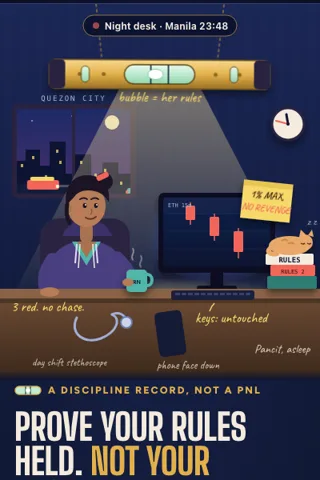
Prove your trading discipline, not your profits: stops honored, sizing kept, tilt avoided.
Reserve · refundable deposit
$349Hyperliquid · Base +1
Care Hours, first screen of the live demoLIVE DEMO

Care Hours

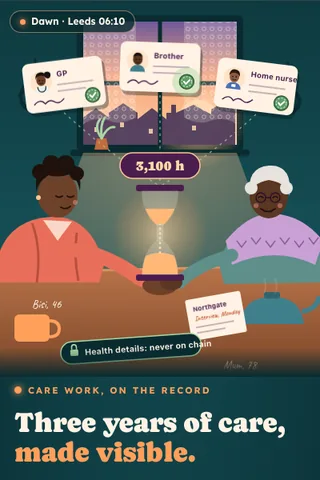
Caregivers and parents prove unpaid care work, privately, for loans and jobs.
Reserve · refundable deposit
$149Base · Celo
Vouch Desk, first screen of the live demoLIVE DEMO

Vouch Desk

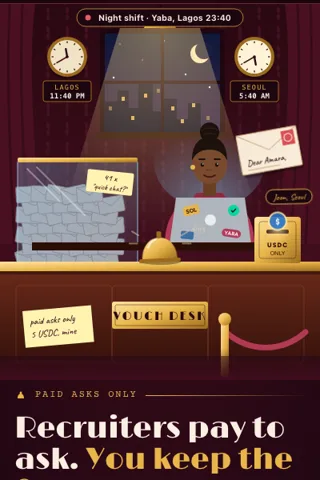
Recruiters pay a small USDC fee to request verified proofs from candidates, who get paid.
Reserve · refundable deposit
$219Base · Arc
Mentor Trail, first screen of the live demoLIVE DEMO

Mentor Trail

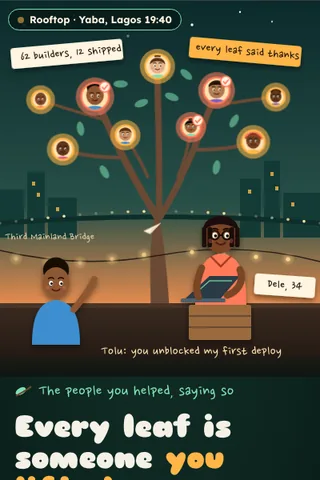
Mentees attest that you changed their path, building a lineage tree of who you lifted up.
Reserve · refundable deposit
$169Base · Optimism +1
Quiet Proof, first screen of the live demoLIVE DEMO

Quiet Proof

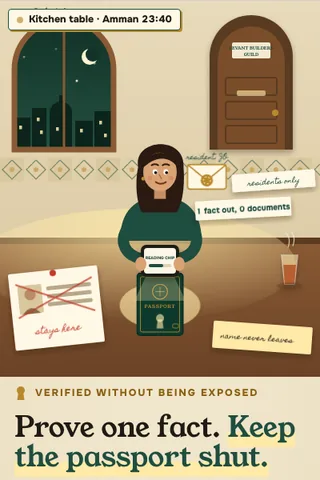
Prove you are over 18, a resident, or a degree holder without showing a single document.
Reserve · refundable deposit
$399Base · Ethereum +1
Practice Log, first screen of the live demoLIVE DEMO

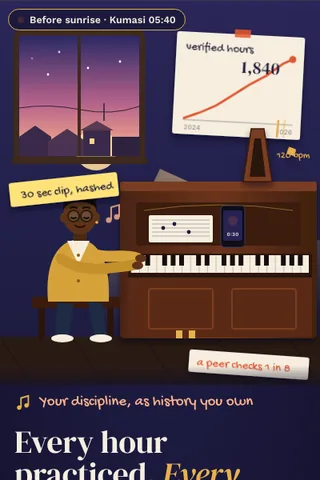
Practice Log

Timestamp every hour of deliberate practice and own the 10,000 hour proof.

Reserve · refundable deposit
$129Base · Solana
Contact us