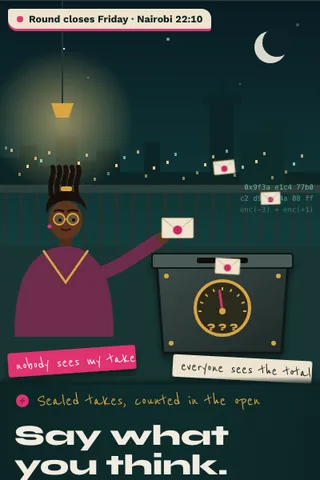
 LIVE DEMO
Sealed Take
Everyone stakes a conviction, encrypted. The chain tallies it without ever seeing a single take. FHE on Base.
Ready now
$20Fhenix
 Try it live
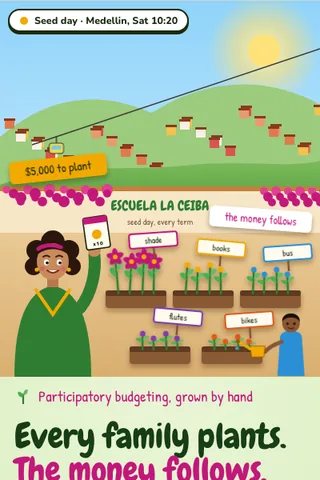
Participatory budgeting where every resident grows a garden of choices and the treasury follows.
Try it live, freeA school PTA has $5,000. Parents get equal seeds to plant across proposals, see the garden bloom live, and the top-funded ideas pay out by contract, with receipts posted after.
Proposal intake, equal seed allocation, quadratic tally, live garden visual, payout and receipts.
Reshape it entirely: new features, your flows, your brand end to end, integrations you need. We scope it with you.
The mechanic exists; the novelty is mainly a garden-style UX on top.
Decidim and clr.fund already run participatory budgeting and quadratic allocation; not separately searched beyond these known products.
Checked with web searches in October 2026. A search is not proof that nothing similar exists, and the market moves fast, so we recheck before every build.
Public goods tooling; OSS required
Existing projects OK
The complete Budget Garden app: a school or community gives every household equal seeds to plant in the ideas they want, the treasury funds the garden in order, and every coin has a receipt, with a paywall and steward agent built in.
Every buyer gets the same finished app. Basic branding and copy changes come through a quick form.
Your admin side: revenue, paywall editor, users, rules and the agent log.
Referral and growth mechanics, switched on when you are ready to grow.
Schools and districts subscribe in USDC; small communities start free.
No fee on the community budget itself; gas is a few cents per round.
Prices are yours to set. Illustrative, not a promise of income.
Participatory budgeting that looks like a garden: equal seeds, a treasury that follows, a receipt for every coin.
Problem: School and community budgets are decided by whoever shows up to the meeting, and families rarely see where money went.
Solution: Equal seeds per household, quadratic planting, funding in order, co-signed payouts and invoice receipts.
Why now: L2 gas is cents per round and every parent has a phone.
Market: Schools, parents' associations, clubs, councils and DAOs running rounds, from free to $199 a month.
The ask: Pilot with three Medellin schools next term.
Funding is never guaranteed. Check each program's rules.
Many hackathons require code written at the event. See the Regatta Boardfor each race's rule.
Custom rules, district rollouts, SMS planting and branded receipts pages, scoped on a call from $1,000.
Schools, neighbourhoods and small DAOs split shared money in meetings few people attend, then argue about it afterwards. Most members never see where their voice went or what the money bought.
Participatory budgeting and quadratic allocation already exist: Decidim runs participatory budgets for cities, and clr.fund runs quadratic funding rounds onchain. Budget Garden does not invent the mechanic. What is new is mainly the experience: a small, ready-to-run kit for a single school or club, a live garden that makes every family's seeds visible, and invoices pinned to each funded idea. Research verdict: rare, medium novelty, mostly a UX layer.
A membership roll held by the organiser (one packet per household), proposals with costs and supplier quotes, private ballots with public commitments, a tally root, payout transactions and invoice hashes.
Every member of a community sees their voice grow into something real, and can check where every coin went.
Watch it grow Beds grow as seeds land, so planting feels like a shared garden rather than a form.
Equal packets Every household gets the same seeds, and gentle quadratic counting stops one loud voice from piling a bed.
Receipts on the tag Each funded bed shows its invoice, payout and photo, so trust grows term after term.
Sign-in and roll: Privy email or phone login. The organiser uploads a roll; each household gets one claim code, checked offchain, so phones cannot multiply packets.
Treasury vault: USDC sits in a Safe on Optimism or Base with the treasurer and a co-signer. Payout rules are set in a small allocation contract before planting opens.
Private ballots: Ballots are stored encrypted; a commitment per household and the final tally Merkle root are posted onchain so anyone can verify inclusion.
Tally and payout: At close, the contract ranks ideas by quadratic weight, funds in order within budget (skip or stop rule), and queues payouts to vendor wallets for co-signing.
Steward agent: A small model (for example Claude Haiku or GPT-4o mini class) prices proposals, suggests merges, translates, and matches invoices. It never merges, votes or pays on its own.
Receipts and digest: Invoice hashes and photos attach to each bed as EAS attestations; a weekly email or WhatsApp-style digest asks families to confirm what they saw.
Per term for a 150-household school: L2 gas for commitments, tally root and a few payouts is well under $1 on Optimism or Base at typical fees. Steward agent work (pricing 10 proposals, translations, invoice matching) is roughly 200k tokens on a small model, a few cents to under $1. Hosting and notifications about $10 to $20 a month. Example: one term, about $25 all in.
Every bloom check and share card shows the school name and a link to plant next term. Parents who see it at one school ask their sports club or neighbourhood board to run one.
Fake households: One packet per roll code, codes issued by the organiser, duplicate claims declined and logged.
Privacy of ballots: Who planted what stays private; only commitments and totals are public. Small groups can see patterns, so a minimum group size is enforced.
Legal and tax: Holding money for a school can carry rules; the organiser stays responsible and payouts need a human co-signer.
Agent mistakes: The steward once merged ideas wrongly; it now only suggests. All money moves need people.
Vendor fraud: Invoices are checked against quotes, and families confirm delivery before the next round.
Costs and tools are estimates at the time of writing. General information only, not legal or financial advice.
Nine routes from one vessel. Tap a port to open its chart.
Shared budgets are usually decided by whoever shouts loudest in the meeting. Own Budget Garden and you run the fair, visual way to decide, from your wallet and brand, with payouts and receipts by contract. The groups, the rounds and the trust are yours.
Most people never need to know the math. They plant seeds; the garden shows the result. Explain it in one sentence and leave the formula on a separate page.
Equal seeds only work with one person, one account. Use an invite list for small groups and a personhood check for bigger ones.
You do not need to. Budget Garden arrives working, deployed from your own wallet with a written guide for every step. You will click, paste and fill in names. If you ever want a change you cannot make, the custom option or a freelancer can handle it, but the first launch needs no code.
Yes. The contract is deployed from your wallet on Optimism, the code sits in your own git repo, and the name and brand are yours. DEPLOYR does not hold your keys or take a cut of what Budget Garden earns. If you stop paying anyone tomorrow, the app keeps running on your wallet.
That is the most likely early outcome, and it is fixable. The paths below start with you as the first user, then ten real PTAs, clubs, DAOs and councils deciding how to spend shared money you can name today. If ten people you message do not care after you have shown it to them, you have learned something useful in a week instead of a year.
A fee per budgeting round, scaled by the size of the budget, plus yearly plans for groups that run several rounds. This ladder is a target, not a promise.
Illustrative stages, not a forecast. Results depend on you and the market; nothing here is guaranteed.
LIVE DEMOEveryone stakes a conviction, encrypted. The chain tallies it without ever seeing a single take. FHE on Base.
 LIVE DEMO
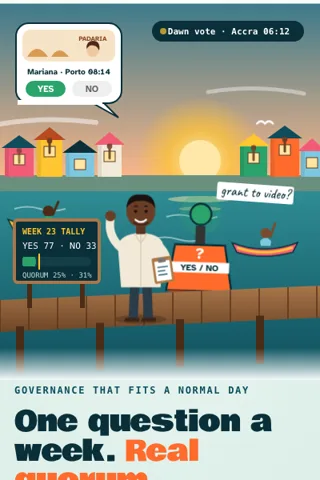
Governance by text-sized questions: one decision a week, answered in ten seconds, with real quorum.
 LIVE DEMO
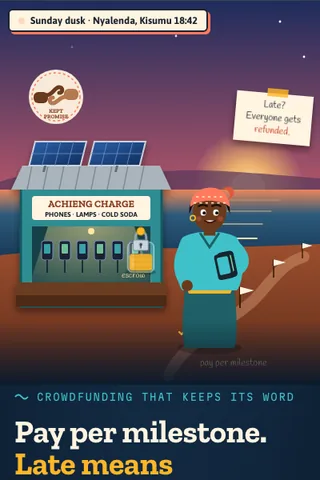
Crowdfunding where backers get refunded by contract if the goal or the milestones are missed.
 LIVE DEMO
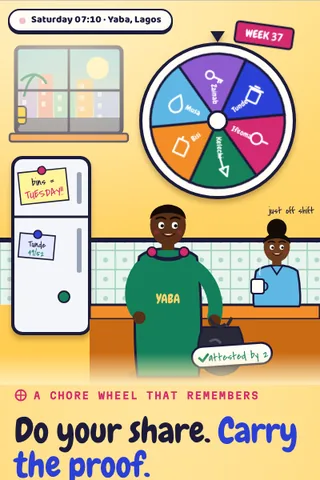
A shared house or club tracks who did the work, and the record becomes everyone's portable reliability score.
 LIVE DEMO
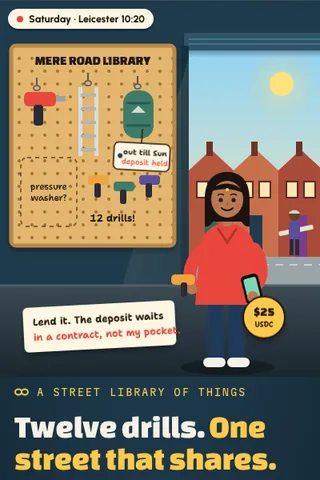
Lend the ladder, the drill, the tent: a street library of things with deposits held by contract.
 LIVE DEMO
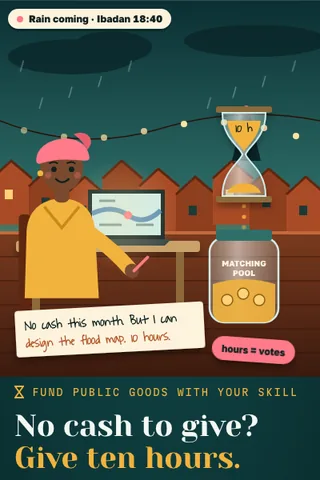
Fund a public good with hours of your skill, not just money, and get matched like a donation.
 LIVE DEMO
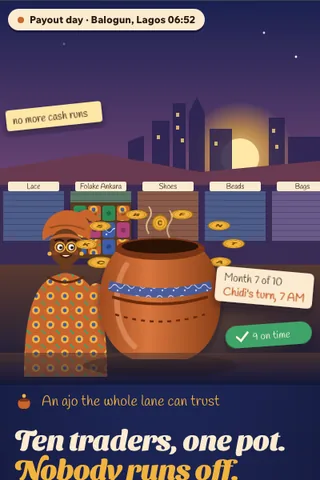
A rotating savings circle (ajo, susu, chama) with payouts enforced by contract and trust scores for members.
 LIVE DEMO
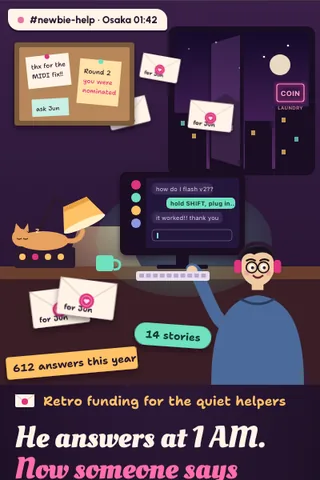
Retro funding for the quiet helpers: the community nominates who mattered, a pot pays them.