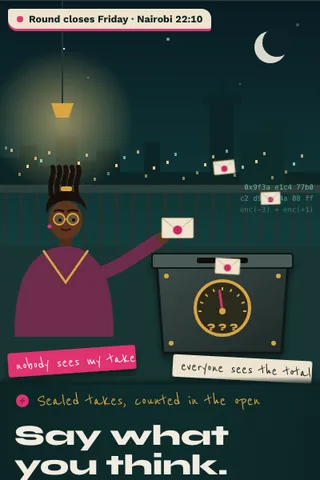
 LIVE DEMO
Sealed Take
Everyone stakes a conviction, encrypted. The chain tallies it without ever seeing a single take. FHE on Base.
Ready now
$20Fhenix
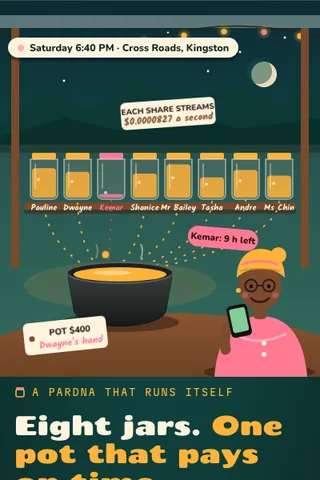 Try it live
A savings circle that runs itself: shares stream by the second into a pot that pays whoever's turn it is.
Try it live, freeEight people, fifty dollars a week. Each keeps a jar, their share streams out by the second, the pot fills in public and pays out the moment the round closes. Gaps stay on the record.
The full app from Terry's Arc portfolio: live surface, contracts on Arc, about page, handover of code and deployment.
Reshape it entirely: new features, your flows, your brand end to end, integrations you need. We scope it with you.
A rotating savings circle with per second streamed shares was not found.
WeTrust; off chain esusu apps.
Checked with web searches in October 2026. A search is not proof that nothing similar exists, and the market moves fast, so we recheck before every build.
Answers Arc's Request for Builders; check current terms.
The complete Round app: a pardna or savings circle where every member's share streams by the second from their own jar into a public pot that pays the turn holder on the second, with a paywall, keeper agent and gap record built in.
Every buyer gets the same finished app. Basic branding and copy changes come through a quick form.
Your admin side: revenue, paywall editor, users, rules and the agent log.
Referral and growth mechanics, switched on when you are ready to grow.
Members never pay to save. Bankers pay a small monthly plan for the tools that make running a circle easier, churches and credit unions pay for many circles, and the owner can set an optional small fee on each payout.
Optional payout fee set by the owner (0, 0.5% or 1%), shown on every receipt. Gas on Arc is paid in USDC and can be sponsored by the owner.
Prices are yours to set. Illustrative, not a promise of income.
A savings circle that runs itself: shares stream by the second into a public pot that pays whoever's turn it is, on the second.
Problem: Hundreds of millions of people save through rotating circles like pardna, susu and tanda. They run on one tired banker with an exercise book: cash in envelopes, chasing late members, covering gaps from their own purse, and no shared record.
Solution: Each member keeps a jar that streams their share into one public pot on Arc. A keeper warns low jars in the banker's own voice, closes the round at the agreed second and records gaps in hours, never reasons.
Why now: Arc settles in USDC with sub second finality and USDC as gas, passkey wallets work for people with no crypto experience, and small models can write warm reminders for cents.
Market: Circle bankers and members across the Caribbean, Africa, Latin America and their diasporas, plus the churches, credit unions and societies that host many circles.
The ask: Pilot partners: one church or credit union with 10 circles, and builder support from the Arc and Circle developer programs.
Funding is never guaranteed. Check each program's rules.
Many hackathons require code written at the event. See the Regatta Boardfor each race's rule.
Custom work from $2,500: your own circle rules and statements, mobile money or bank integrations, extra languages and voice prompts, or a society branded deployment. Scoped on a call.
Hundreds of millions of people save through rotating circles (pardna, susu, esusu, tanda, chit funds). They run on trust and one tired banker with an exercise book: cash in envelopes, chasing late members, covering gaps from their own purse, and no shared record when memories differ.
Rotating savings circles are old and already digital in places: WeTrust tried onchain circles years ago, and many offchain esusu and tanda apps collect contributions by card or mobile money. What we did not find is a circle where each member's share streams by the second from their own jar into a public pot that pays out at the exact close, with gaps recorded in hours. Novelty is medium: the circle is familiar, the streaming mechanics and the plain gap record are the new part.
Circle rules (members' wallet addresses, hand amount, order, gap rule), per-second stream rates, jar balances, payouts and gap records in hours. Names, phone numbers, voice notes and reasons for lateness stay offchain with the banker.
Give every savings circle a pot that pays on time and a record everyone can trust, so the banker never has to chase or cover again.
Watch the pot fill The pot rises all week in public. Seeing it nearly full by Saturday is the reason people open the app.
Paid on the second Hand day is a moment: the payout lands at 6:00:00 PM Sunday and everyone sees it.
No shame, just hours Gaps show as hours and whether they were made whole, never reasons or scores, so people stay in.
Wallets: Privy embedded wallets with passkeys so members without crypto experience get a jar; optional fiat onramp to buy USDC.
Circle contract on Arc: One contract per circle on Arc, where USDC is the gas token: members, hand, order, gap rule and buffer percentage, set at creation and changeable only with every member's signature.
Streams: Each jar streams to the pot at hand divided by seconds in the round. Balances are computed lazily (rate times elapsed time), so no transaction is needed per second.
Close and payout: A keeper calls close at the round end; the contract settles streams, applies the gap rule and pays the turn holder in one transaction.
Keeper agent: A small model (Claude Haiku class via OpenRouter) writes warm reminders from runway data; the runway maths and all money movement are plain code. It cannot move funds.
Notifications: WhatsApp Business API or SMS for runway warnings and hand day, with a voice note recorded once by the banker.
Indexer: Convex indexes contract events for the pot view, turn calendar and record.
Arc is new and fee levels can change, so check current fees before launch. Per circle per week: one close and payout transaction plus occasional top ups, expected to cost cents in USDC. Reminder text from a small model is well under one cent each. Messaging costs depend on the provider and country, roughly 1 to 5 cents per WhatsApp or SMS. Example: 100 circles of 8, weekly, about $20 to $60 a month in messaging and gas.
Each circle has 6 to 12 members, and members often bank their own circle next. The share card from hand day and the public pot link are the invitation.
Regulation: Pooling and paying out money may count as a regulated savings or remittance activity in some countries. Get local advice; the owner never holds member funds.
Default after payout: A member who received the pot early can stop paying. Streams make this visible fast but cannot prevent it. Order rules and small buffers reduce harm; say this plainly at setup.
Stablecoin and chain risk: USDC and Arc carry issuer and network risk. Arc is young; keep circles small at first.
Privacy: Wallet activity is public. Keep names offchain and avoid linking addresses to identities in the public view.
Smart contract bugs: Audit the circle contract, cap circle size and value early, and include a unanimous-exit path.
Costs and tools are estimates at the time of writing. General information only, not legal or financial advice.
Nine routes from one vessel. Tap a port to open its chart.
Round: A savings circle that runs itself: shares stream by the second into a pot that pays whoever's turn it is. Using someone else's version means their rules, their brand and their revenue. Owning Round means it is deployed under your wallet, carries your name, and every customer, partner and result builds your track record instead of theirs.
Round arrives deployed with a guide. Running it is settings and sharing links, not code. If you get stuck, we help you ship it.
Start with ten people you already know. The first move below takes under an hour and tells you fast whether people care.
Each step is sized in minutes. Most owners spend an hour a week, and the app does the repetitive part.
Nothing is guaranteed. The playbook gives you a clear path and honest numbers, and you decide how far to take it.
Charge the people who get the most value from Round: a monthly plan for groups or teams, plus setup fees for anyone who wants it done for them.
Illustrative stages, not a forecast. Results depend on you and the market; nothing here is guaranteed.
A starter chart. A fuller, app-specific playbook is being written.
LIVE DEMOEveryone stakes a conviction, encrypted. The chain tallies it without ever seeing a single take. FHE on Base.
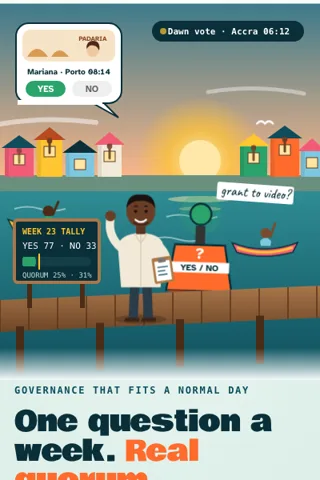 LIVE DEMO
Governance by text-sized questions: one decision a week, answered in ten seconds, with real quorum.
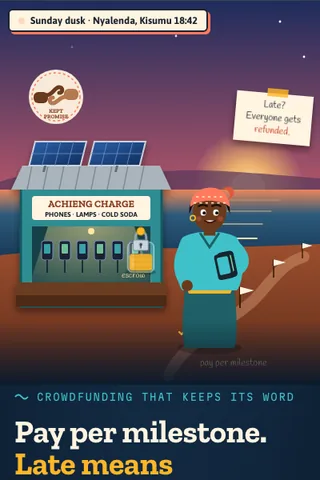 LIVE DEMO
Crowdfunding where backers get refunded by contract if the goal or the milestones are missed.
 LIVE DEMO
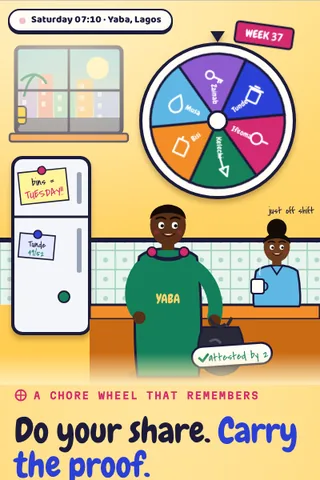
A shared house or club tracks who did the work, and the record becomes everyone's portable reliability score.
 LIVE DEMO
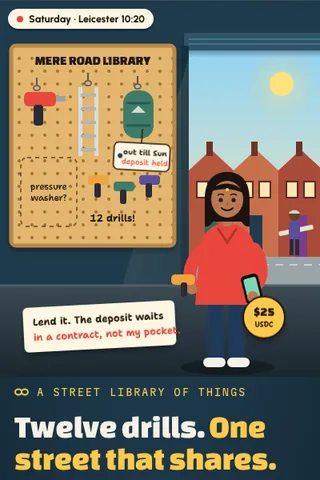
Lend the ladder, the drill, the tent: a street library of things with deposits held by contract.
 LIVE DEMO
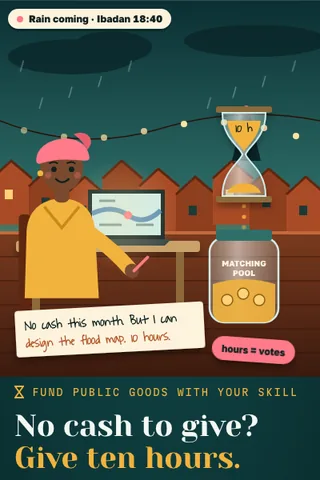
Fund a public good with hours of your skill, not just money, and get matched like a donation.
 LIVE DEMO
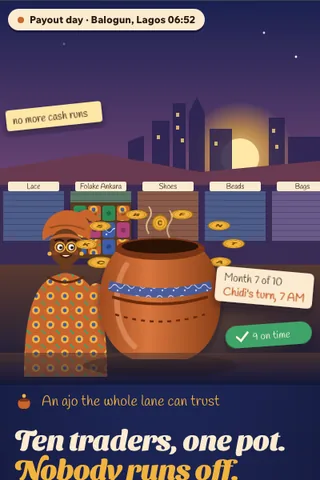
A rotating savings circle (ajo, susu, chama) with payouts enforced by contract and trust scores for members.
 LIVE DEMO
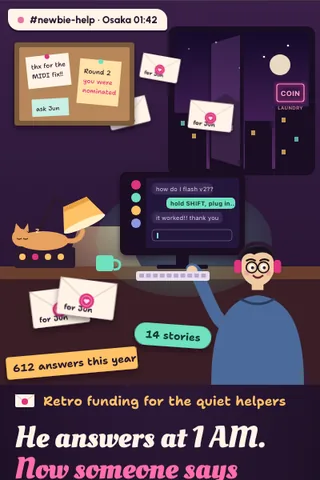
Retro funding for the quiet helpers: the community nominates who mattered, a pot pays them.