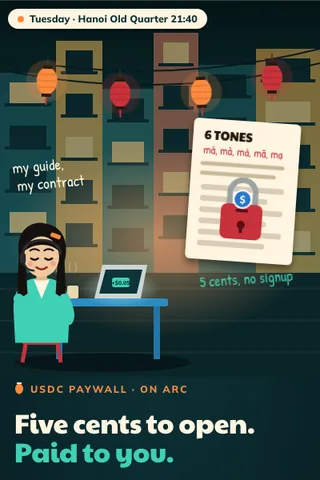
 LIVE DEMO
USDC Paywall
Lock content behind a fraction-of-a-cent USDC payment, on your own Arc contract. Deploy it, become the onchain creator.
Ready now
$20Arc
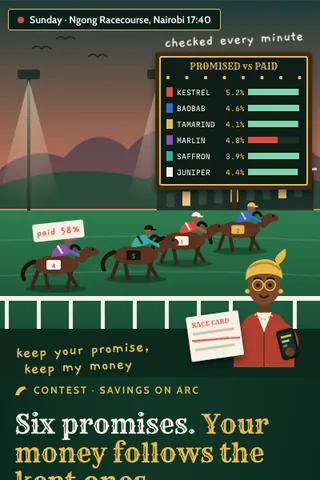 Try it live
Your savings ride with whichever yield provider is keeping its promise, and money moves away from any that fall behind.
Try it live, freeSix stables promise a return. Every minute the contract compares what each paid against what it promised and moves a third of the worst one's share to the best. Stables post a bond and lose it if they fall too far behind.
The full app from Terry's Arc portfolio: live surface, contracts on Arc, about page, handover of code and deployment.
Reshape it entirely: new features, your flows, your brand end to end, integrations you need. We scope it with you.
Continuous, contract enforced reallocation by kept promises was not found.
Yield aggregators like Yearn.
Checked with web searches in October 2026. A search is not proof that nothing similar exists, and the market moves fast, so we recheck before every build.
Answers Arc's Request for Builders; check current terms.
The complete Contest app: savers put USDC in a pool where yield providers race against their own public promises every minute, with bonds that pay savers first, plus a paywall and steward agent built in.
Every buyer gets the same finished app. Basic branding and copy changes come through a quick form.
Your admin side: revenue, paywall editor, users, rules and the agent log.
Referral and growth mechanics, switched on when you are ready to grow.
A small owner set fee on yield earned, group pools for savings groups, and an optional Saver Plus subscription, all in USDC.
Owner sets a fee on yield earned, 10% by default. Slashed bonds go to savers first.
Prices are yours to set. Illustrative, not a promise of income.
A savings pool where yield providers race their own promises every minute, with their own money on the line.
Problem: Savers cannot tell which yield promise will be kept, and when a provider slips they find out months later.
Solution: A pool that compares paid to promised every minute, moves money away from laggards, and slashes bonds to pay savers first.
Why now: Stablecoin yield providers are multiplying and cheap chains make minute by minute checks affordable.
Market: Savings groups, SACCOs and individual stablecoin savers, starting with one community pool.
The ask: Launch one capped pool with a Nairobi SACCO and six providers.
Funding is never guaranteed. Check each program's rules.
Many hackathons require code written at the event. See the Regatta Boardfor each race's rule.
Custom pools, new chains, provider integrations and branded race cards, scoped on a call from $1,000.
Savers who park USDC with a yield provider usually learn it missed its promised rate weeks or months later, in a report. By then the money sat earning less, or nothing, and moving it was a manual job.
Yield aggregators such as Yearn already move deposits between strategies to chase the best rate, and many vaults rebalance automatically. What the research did not find is continuous, contract enforced reallocation judged by kept promises: providers publish a rate and post a bond, the contract compares paid against promised every minute relative to the field, and moves part of the worst share to the best while slashing bonds below a line. Research verdict: high novelty for the mechanism; the underlying idea of automated reallocation is not new.
Each provider's promised rate and bond, oracle readings of what each actually paid (checked against onchain transfers), the pool rules (move size, tolerance, bond line), every share move and slash, and depositor balances by wallet address. No names or phone numbers.
Make a yield promise something a provider has to keep in public, every minute, with its own money on the line.
Watch it like a race A live board ranks providers by promises kept. Savers check it the way they check a score.
Bond pays first If a provider falls far behind, its bond covers the gap before depositors lose anything.
Sunday race card One weekly card with the field ranked by kept promises, a streak for checking, and one tap to leave.
Wallets: Privy embedded wallets with passkeys so savers deposit USDC without a seed phrase. Withdraw any time, no lockup.
Contest pool contract on Arc: A pool contract on Arc, Circle's USDC native chain with sub second finality, holds deposits, per provider shares, rules and bonds. Shares move by fixed rules only.
Provider adapters: Each stable is an adapter contract to a yield source (tokenized treasury bills, lending markets). It reports accrued yield and must post a USDC bond to join.
Paid vs promised oracle: A keeper reads accrued yield each minute and compares a rolling 60 minute average against the promise, relative to the field median, so a market wide dip does not trigger churn.
Steward watcher: A small model (a Claude Haiku class model via OpenRouter) writes the plain language log and weekly card from events. It cannot move funds or change rules; rule changes go to a depositor vote.
Indexer and notifications: Convex indexes pool events for the live board, push notifications and the Sunday card.
Arc is new and fees may change, so check the current network before launch. Keeper checks every minute are 43,200 small transactions a month; at an assumed fraction of a cent each that is roughly $40 to $200 a month for the whole pool, not per saver. Moves only happen when a rule triggers. The watcher model costs under $5 a month at a Haiku class price. Example: a pool with 2,000 savers runs for about $150 to $400 a month including hosting.
The weekly race card is shareable and ranks providers in public, which providers themselves will promote when they rank well. Start with one community, such as a SACCO or a savings group, then open more pools with different fields.
Not a guarantee: Rates can fall for everyone and a provider can fail by more than its bond. Say so plainly everywhere. Nothing here is financial advice.
Regulation: Pooling deposits and paying yield may be regulated as a collective investment scheme in many countries. Get local legal advice before opening to the public.
Oracle errors: A wrong reading moves money wrongly. Use rolling averages, cross check transfers, cap moves per hour, and allow a pause.
Provider gaming: A provider could overpay briefly to attract share. Judge on rolling windows and weight longer history.
Smart contract risk: Audit the pool and adapters, start with deposit caps, and keep an emergency withdraw path.
Young chain: Arc may change. Keep adapters modular so the pool can be redeployed.
Costs and tools are estimates at the time of writing. General information only, not legal or financial advice.
Nine routes from one vessel. Tap a port to open its chart.
Contest: Your savings ride with whichever yield provider is keeping its promise, and money moves away from any that fall behind. Using someone else's version means their rules, their brand and their revenue. Owning Contest means it is deployed under your wallet, carries your name, and every customer, partner and result builds your track record instead of theirs.
Contest arrives deployed with a guide. Running it is settings and sharing links, not code. If you get stuck, we help you ship it.
Start with ten people you already know. The first move below takes under an hour and tells you fast whether people care.
Each step is sized in minutes. Most owners spend an hour a week, and the app does the repetitive part.
Nothing is guaranteed. The playbook gives you a clear path and honest numbers, and you decide how far to take it.
Charge the people who get the most value from Contest: a monthly plan for groups or teams, plus setup fees for anyone who wants it done for them.
Illustrative stages, not a forecast. Results depend on you and the market; nothing here is guaranteed.
A starter chart. A fuller, app-specific playbook is being written.
LIVE DEMOLock content behind a fraction-of-a-cent USDC payment, on your own Arc contract. Deploy it, become the onchain creator.
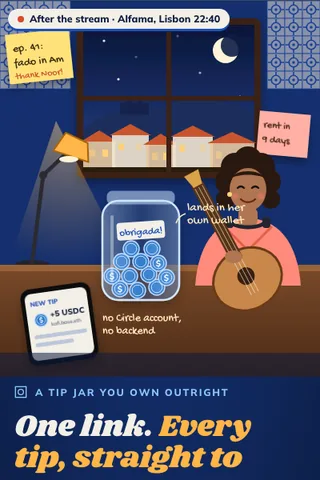 LIVE DEMO
Take pay-what-you-want USDC tips on Base, with a live supporters feed read straight from chain. No Circle account, no backend.
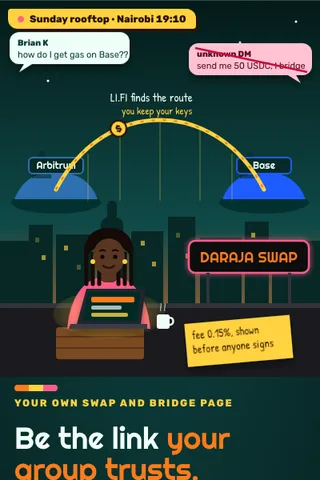 LIVE DEMO
Your own swap/bridge front-end. Integrator fee optional and disclosed.
 LIVE DEMO
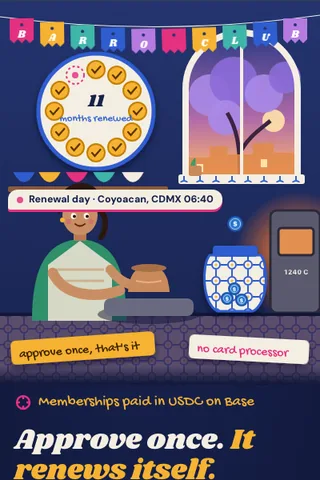
Recurring USDC on Base. Members approve once, it renews itself. No card processor, no contract.
 LIVE DEMO
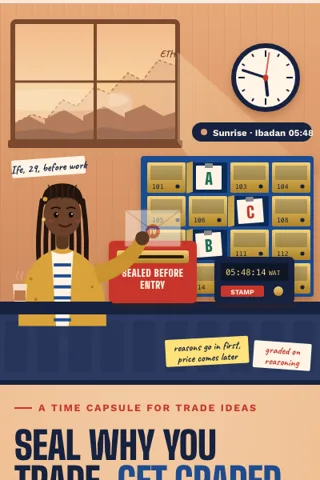
Write why you entered a trade, seal it with the timestamp, and get graded on reasoning, not luck.
 LIVE DEMO
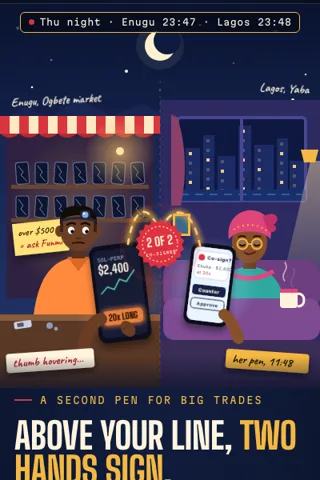
Let a trusted mentor co sign your risky trades above a size you choose.
 LIVE DEMO
Your perp bot follows your rules, and every rule you kept becomes a public, provable track record.
 LIVE DEMO
A tilt brake that delays your trades after losses until you answer one honest question.