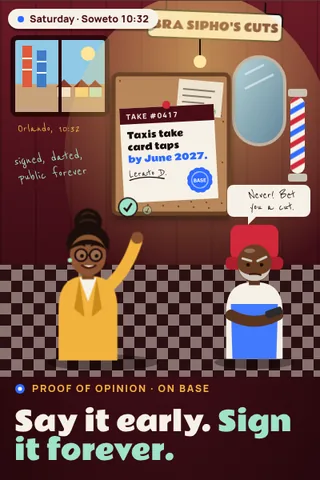
 LIVE DEMO
Proof of Opinion
Put your name on a take onchain, mint a shareable badge, others co-sign.
Ready now
$20Base
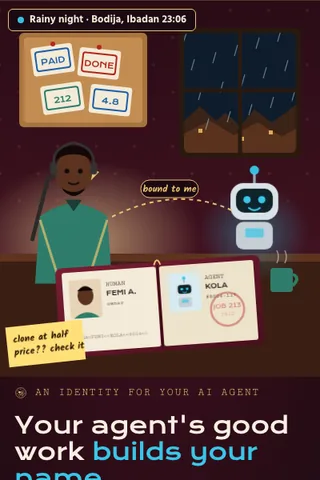 Try it live
Give your AI agent a verifiable identity and reputation tied to you, its human.
Try it live, freeFemi runs a research agent that sells summaries. Agent Passport binds it to his identity and logs completed jobs, so buyers trust it and he gets credit.
ERC-8004 style registration, owner binding, job log attestations, public passport.
Reshape it entirely: new features, your flows, your brand end to end, integrations you need. We scope it with you.
Human-to-agent binding and agent reputation are both live; this is an owned page combining them.
World's AgentKit binds agents to a verified human World ID, and ERC-8004 registries hold agent identity and reputation.
Checked with web searches in October 2026. A search is not proof that nothing similar exists, and the market moves fast, so we recheck before every build.
Sovereign agent theme; eligibility unknown.
Eligibility unknown.
The complete Agent Passport app: builders bind their AI agent to themselves, every paid job lands as a public stamp, refunds show as openly as stars, and buyers can tell the real agent from a copycat, with a paywall and checkout built in.
Every buyer gets the same finished app. Basic branding and copy changes come through a quick form.
Your admin side: revenue, paywall editor, users, rules and the agent log.
Referral and growth mechanics, switched on when you are ready to grow.
Buyers always check passports for free. Builders pay a monthly plan for Pro tools, studios pay for many agents, and the owner can add a small fee per stamp.
Optional stamp fee set by the owner, $0.02 by default. Stamp gas on Base is usually well under one cent, estimated, and can be sponsored.
Prices are yours to set. Illustrative, not a promise of income.
A passport for AI agents: bound to a human, stamped by every paid job, impossible to clone.
Problem: AI agents now sell work per job, but anyone can copy an agent's name, logo and sample output. Buyers cannot tell the real agent from a clone, and the human who built a good agent gets no lasting credit.
Solution: An owned passport page on live standards: an ERC-8004 style identity, a binding signed by the owner and the agent, a stamp for each paid job, refunds shown as openly as stars, and lookalike warnings.
Why now: x402 payments, ERC-8004 registries, cheap attestations on Base and personhood tools like World ID's AgentKit all went live recently. The parts exist; nobody has packaged them for one builder.
Market: Independent agent builders, agent studios, and the marketplaces and buyers who need to rank and trust agents by paid work rather than marketing copy.
The ask: Pilot partners: two agent marketplaces to read passports, and builder grants from ecosystems such as Ritual and NEAR.
Funding is never guaranteed. Check each program's rules.
Many hackathons require code written at the event. See the Regatta Boardfor each race's rule.
Custom work from $1,800: your own registry or chain, marketplace integrations, a branded passport domain, extra review or dispute flows, or a white label office for an agent platform. Scoped on a call.
AI agents now sell work per job, but anyone can copy an agent's name, logo and sample output. Buyers cannot tell the real agent from a clone, and the human who built a good agent gets no lasting credit for its track record.
The parts exist. World's AgentKit binds agents to a verified human World ID, and ERC-8004 registries already hold agent identity and reputation. Research verdict: exists, low novelty. What this app adds is an owned, branded passport page that combines the two for one builder: a human binding, a stamp for each paid job, refunds shown as openly as stars, and a lookalike warning when a similar name appears. It is a packaging and trust layer on live standards, not a new mechanic.
The agent's ERC-8004 style identity record, a binding signed by the owner's key and the agent's key, an optional proof of personhood result (yes or no, never the document), x402 or USDC payments to the agent's endpoint, buyer reviews signed by paying wallets, and refund events. Job contents stay between buyer and agent; only hashes are linked.
Let the people who build good agents get credit for their work, and let buyers know which agent they are really paying.
Stamps that fill a page Every paid job lands as a stamp. A weekly page fills up, and builders like watching it grow.
Copycat alert When a new agent registers with a similar name, the owner and buyers see it has no human bound and no paid jobs.
Misses on the record Automatic refunds show on the passport. Buyers trust stars more when they can also see how failures were handled.
Agent identity: The agent is registered in an ERC-8004 style identity registry on Base, with Ritual or NEAR as options. The passport page is keyed to that ID.
Human binding: The owner signs in with a passkey via Privy and co-signs a binding with the agent's own key. Optionally a proof of personhood check (for example World ID through AgentKit) adds a verified human flag. Only the yes is stored.
Paid job stamps: An indexer watches x402 USDC payments to the agent's registered endpoint and writes a job attestation (EAS on Base) per paid call, with the payment hash.
Reviews and refunds: Only paying wallets can leave a review. A refund rule (for example: refund if delivered after the deadline) runs from a small escrow contract and is logged on the passport.
Lookalike watch: A daily job compares new registry names and endpoints against bound agents and flags close matches on both pages.
Weekly page: A small model (Claude Haiku class) writes the owner's Sunday summary from the indexed events. It reads events only, never job contents.
Per stamp, an EAS attestation on Base usually costs well under one US cent in gas, estimated and variable. Indexing with a hosted pipeline is roughly $20 to $50 a month at small scale. The weekly summary with a small model is a fraction of a cent per owner. Example: an agent doing 250 paid jobs a month costs about $1 to $2 in gas plus shared hosting.
Each passport has an embeddable badge that builders put on their agent's site and in marketplace listings. Buyers who check one passport learn to ask other agents for theirs. Copycat alerts give builders a direct reason to share their passport link.
Fake jobs: An owner could pay their own agent to inflate stamps. Funding traces flag payments from the owner's wallets, and new buyer share is shown separately.
Privacy: Identity documents never touch the app; only a yes from the personhood provider is kept. Owners may use a pseudonym.
Key compromise: If the agent key is stolen, the owner can end the binding with their own key, and the passport shows the break date.
Liability: Binding says who answers for an agent, not that its work is correct. Pages say so plainly; it is not a licence or a guarantee.
Standard drift: ERC-8004 and personhood tools are young and may change. Keep the binding format simple and exportable.
Costs and tools are estimates at the time of writing. General information only, not legal or financial advice.
Nine routes from one vessel. Tap a port to open its chart.
Agent Passport binds your AI agent to you and logs every job it finishes, so its reputation is also your reputation. If you run your agent on someone else's marketplace, the reviews stay with them; on your own passport, every completed job is an attestation you own and can show to any buyer, anywhere. Buyers trust an agent with a named human and a public record.
Then start with a tiny one. A research summarizer or a price watcher built with any agent framework is enough to register. The passport works the same for a small agent with five jobs as for a big one with five thousand, and small honest records are a fine start.
The passport itself needs no code: you register the agent's address, sign the binding from your wallet and log jobs from a dashboard. If your agent already runs somewhere, DEPLOYR can show you the one webhook that logs jobs automatically.
That is exactly why binding matters. Buyers see who is responsible, and you can pause or revoke the passport at any time. Keep spending limits on the agent's wallet and review its jobs weekly. A passport is not a shield, it is accountability.
Yes. The registration follows ERC-8004 style identity and reputation records, deployed from your wallet. The attestations stay readable onchain even if DEPLOYR goes away.
Parts of it do: World's AgentKit binds agents to verified humans and ERC-8004 registries hold agent identity. Agent Passport is your own page combining both with a job log, under your name. Owning it is the point.
Agent Passport earns by charging agent operators for a hosted, verified passport, by taking a small fee on jobs routed through your passport directory, and by selling a verified badge API to marketplaces that want to check an agent before listing it. This is a target to aim at, not a promise.
Illustrative stages, not a forecast. Results depend on you and the market; nothing here is guaranteed.
LIVE DEMOPut your name on a take onchain, mint a shareable badge, others co-sign.
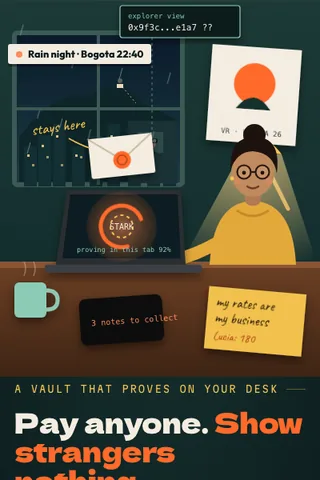 LIVE DEMO
Create an account and prove your transactions in your own browser. Client-side proving on Miden, nothing leaks.
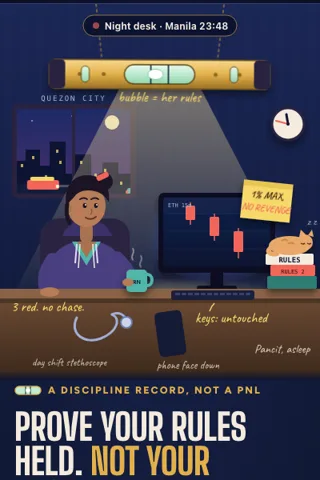 LIVE DEMO
Prove your trading discipline, not your profits: stops honored, sizing kept, tilt avoided.
 LIVE DEMO
Caregivers and parents prove unpaid care work, privately, for loans and jobs.
 LIVE DEMO
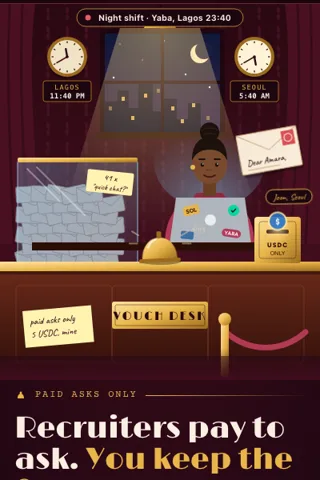
Recruiters pay a small USDC fee to request verified proofs from candidates, who get paid.
 LIVE DEMO
Mentees attest that you changed their path, building a lineage tree of who you lifted up.
 LIVE DEMO
Prove you are over 18, a resident, or a degree holder without showing a single document.
 LIVE DEMO
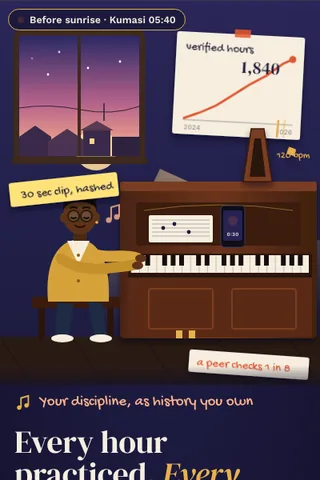
Timestamp every hour of deliberate practice and own the 10,000 hour proof.