 LIVE DEMO
Sentiment Oracle
Invite-gated: Ritual's testnet faucet needs a Discord invite. Get the invite, then contact us and we set you up. Not sold in the normal flow yet.
Ready now
$20Ritual
 Try it live
Put a claim to an impartial AI judge that reads the world and rules, on-chain.
Try it live, freeThe working app on your own wallet and git, one-click deploy, and the step-by-step guide that makes you the verifiable developer.
Reshape it entirely: new features, your flows, your brand end to end, integrations you need. We scope it with you.
The complete Verdict app: members file disputes against written house rules, several GenLayer validators agree on one ruling with a reason, and the community gets a public record, with a paywall, owner console and clerk agent built in.
Every buyer gets the same finished app. Basic branding and copy changes come through a quick form.
Your admin side: revenue, paywall editor, users, rules and the agent log.
Referral and growth mechanics, switched on when you are ready to grow.
A small community runs free. Each ruling carries a small fee paid by the filer, Court plans unlock appeals and the docket, and Boards serve bounty and prediction groups.
A ruling fee set by the owner, paid by the filer. Validator costs on GenLayer come out of that fee; mainnet pricing is not public yet.
Prices are yours to set. Illustrative, not a promise of income.
A neutral judge for online communities: several AI validators must agree on one ruling, with a reason tied to your house rules.
Problem: Moderators of challenges, jams and bounty boards end up judging disputes themselves, and every call looks biased to someone.
Solution: Members file a claim with links against written rules. Validators on GenLayer read the same snapshot and must agree, and the ruling and reason are written onchain.
Why now: Intelligent contracts on GenLayer make multi model consensus on subjective questions practical.
Market: Art challenges, game jams, bounty boards, prediction groups and Discord communities.
The ask: Pilot communities: two challenge hosts and one bounty board, plus GenLayer ecosystem support.
Funding is never guaranteed. Check each program's rules.
Many hackathons require code written at the event. See the Regatta Boardfor each race's rule.
Custom work from $300: your own answer sets and rules, bot integrations or a community branded court. Scoped on a call.
Online communities, contests and bounty boards argue about outcomes every week: was it late, was it copied, did the task get done. The moderator is usually one tired person who is friends with everyone, so every call looks like favouritism.
AI judging of disputes is not new on GenLayer itself: its own examples and early community apps include prediction resolution, bet settlement and bounty judging with validators running models under its consensus and appeal process. Kleros and UMA's optimistic oracle already resolve disputes onchain with human jurors or bonded proposers. What is different here is the packaging for one non-money community use: house rules written once, a fixed answer set (accept, reject, not proven, declined), source snapshots frozen at filing, a filing fee refunded for claims that are not judgeable, and a public ruling page. Novelty is modest; the mechanism belongs to GenLayer.
The community's house rules, each claim with its links, a snapshot of each linked page taken at filing time, the validators' votes and the final ruling with a short reason. Images and post text stay with the community owner; only fingerprints, the ruling and the reason go onchain.
Give every small community a neutral, explainable judge, so disputes end with a reason instead of a grudge.
Nobody plays favourites The moderator is no longer the judge. Several validators read the same snapshot and must agree.
A reason, not just a result Every ruling carries a short reason tied to a numbered house rule, on a page anyone can link.
Friday docket Members guess rulings before the seal drops, which turns disputes into a weekly ritual instead of a fight.
Intelligent Contract on GenLayer: A Python contract holds the house rules, accepts claims with links and a fee, and asks validators for one of four fixed answers plus a reason under 40 words.
Validator consensus and appeals: GenLayer's Optimistic Democracy has a leader validator propose a ruling and others check it under an equivalence rule. A split or an appeal goes to a larger validator set.
Source snapshots: At filing, the app fetches each link, stores the page and writes its fingerprint onchain, so every validator reads the same thing.
Wallets and fees: Members sign in with an embedded wallet (for example Privy). The filing fee is taken in a stablecoin and refunded automatically when a claim is declined as not judgeable.
Bot and ruling pages: A Discord or Telegram bot posts each ruling with a link to a public page showing the claim, sources, votes and reason.
Indexer and digest: A small indexer reads contract events and builds the Friday docket, the season chart and the appeal rate.
On GenLayer testnet, rulings cost test tokens only. On a future mainnet, each ruling pays several validators to run a model, so expect cents to low dollars per ruling depending on bench size and model; this is not yet priced publicly, so treat it as unverified. Hosting the bot, snapshots and pages runs about $10 to $25 a month. Example: 60 rulings a month at an assumed $0.40 each plus $20 hosting is about $44 a month.
Every ruling is a public page with the community's name on it. Members link it when a dispute ends, other moderators see a neutral judge at work, and file their own house rules.
The judges can be wrong: Models can misread a page. Show the reason and sources on every ruling, keep an appeal window, and let the owner override as a human moderator, clearly labelled.
Gambling law: Rulings on bets with money at stake can count as gambling in many places. Start with non-money disputes and check local rules before adding stakes.
Manipulated sources: Posts can be edited mid ruling. Snapshots at filing time and fingerprints onchain keep every validator on the same evidence.
Privacy: Never write member names, images or post text onchain. Store them with the owner and publish fingerprints only.
Testnet stage: GenLayer is pre mainnet. Fees, speed and validator behaviour can change, so tell users this is an early system.
Costs and tools are estimates at the time of writing. General information only, not legal or financial advice.
Nine routes from one vessel. Tap a port to open its chart.
Every bet, bounty and 'who was right' fight in your community ends with someone trusting a moderator. Own The Verdict and the ruling comes from a contract on GenLayer that reads the evidence and rules in public, deployed from your wallet with your name on it. The fees, the brand and the record of every case it settles are yours, not a platform's.
It can. GenLayer uses several validators running models that must agree, and you should show the reasoning on every ruling and offer an appeal window. Tell users plainly that it is a neutral process, not an oracle of truth.
Gambling rules vary by country. Start with non-money disputes (bounty acceptance, contest winners, quest proof) and check local rules before you let anyone stake value on an outcome.
You do not need to. The Verdict arrives working, deployed from your own wallet with a written guide for every step. You will click, paste and fill in names. If you ever want a change you cannot make, the custom option or a freelancer can handle it, but the first launch needs no code.
Yes. The contract is deployed from your wallet on GenLayer, the code sits in your own git repo, and the name and brand are yours. DEPLOYR does not hold your keys or take a cut of what The Verdict earns. If you stop paying anyone tomorrow, the app keeps running on your wallet.
That is the most likely early outcome, and it is fixable. The paths below start with you as the first user, then ten real online communities that argue about outcomes you can name today. If ten people you message do not care after you have shown it to them, you have learned something useful in a week instead of a year.
Charge a small fee per ruling (paid by the person filing the claim), plus monthly plans for communities, bounty boards and prediction groups that need a steady stream of rulings. This ladder is a target, not a promise.
Illustrative stages, not a forecast. Results depend on you and the market; nothing here is guaranteed.
LIVE DEMOInvite-gated: Ritual's testnet faucet needs a Discord invite. Get the invite, then contact us and we set you up. Not sold in the normal flow yet.
 LIVE DEMO
Teach an AI agent your craft, and every time it earns, you earn as the teacher of record.
 LIVE DEMO
An AI that guards your inbox and DMs and charges strangers a fee you keep to reach you.
 LIVE DEMO
Give your AI agent a wallet with house rules it literally cannot break.
 LIVE DEMO
Pay three independent AIs a few cents to check one answer, and get a signed receipt of agreement.
 LIVE DEMO
Your personal AI memory, owned by you, rentable to any assistant you choose.
 LIVE DEMO
AI labs pay you to rank their outputs, and your taste builds an onchain reputation.
 LIVE DEMO
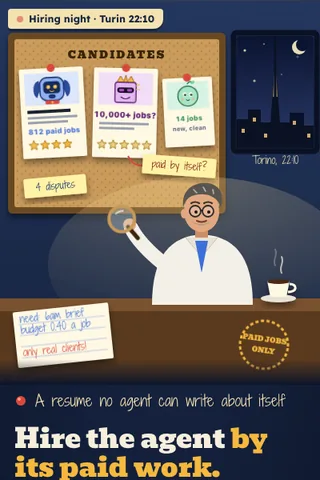
A public, verifiable work history for any AI agent, built from the jobs it actually finished.