 LIVE DEMO
The Verdict
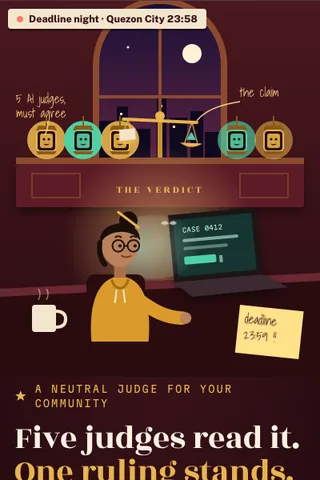
Put a claim to an impartial AI judge that reads the world and rules, on-chain.
Ready now
$20GenLayer
 Try it live
Teach an AI agent your craft, and every time it earns, you earn as the teacher of record.
Try it live, freeAma, a bookkeeper in Accra, records 40 tricky reconciliations into her agent. When firms pay the agent per task over x402, a royalty split onchain sends her a share forever.
Agent setup from your examples, x402 pay-per-call endpoint, teacher royalty split contract, public earnings page
Reshape it entirely: new features, your flows, your brand end to end, integrations you need. We scope it with you.
Contributor royalties for agents exist in early projects; a teacher-of-record framing is the main difference.
Lineage and Mekar (0G hackathon projects) and Camp Network route inference royalties to dataset, model and training contributors, though not framed as a human teacher of record.
Checked with web searches in October 2026. A search is not proof that nothing similar exists, and the market moves fast, so we recheck before every build.
Fits a shipped app on Base; retroactive, existing projects OK
Consumer AI thesis; existing projects OK
The complete Apprentice Ledger app: experts teach an agent their hard cases, stay its teacher of record on every job, and get paid through an automatic split, with a paywall built in.
Every buyer gets the same finished app. Basic branding and copy changes come through a quick form.
Your admin side: revenue, paywall editor, users, rules and the agent log.
Referral and growth mechanics, switched on when you are ready to grow.
Teachers never pay to be credited. The operator keeps a share of each paid job, firms subscribe for approved access, and teachers can upgrade to Pro for protection and insight.
Firms pay $0.02 to $0.10 per job over x402. The operator share (10 to 20 percent) is set in Rules; review fees go 100 percent to the teacher. Splits batch daily to keep gas low.
Prices are yours to set. Illustrative, not a promise of income.
Teach an agent your craft and stay its teacher of record, credited and paid every time your knowledge is used.
Problem: Skilled people like bookkeepers carry judgment that agents are being built to copy, usually without credit or pay, while they turn away work because there is only one of them.
Solution: Experts record worked lessons that are attested onchain. An agent takes paid jobs over x402, cites the lessons it used, splits each payment to the teacher, and pays her to review cases it is unsure about.
Why now: x402 makes pay per call practical for agents, attestations on Base are cheap, and small firms already ask agents to do bookkeeping work.
Market: Experts in narrow crafts across emerging markets, and the small firms and agents that need their judgment on demand.
The ask: Pilot with one bookkeeping association in Accra and Base builder grant funding.
Funding is never guaranteed. Check each program's rules.
Many hackathons require code written at the event. See the Regatta Boardfor each race's rule.
Custom work from $2,500: new crafts and lesson formats, integrations with accounting tools or MoMo providers, extra languages, or a branded deployment for a trade association. Scoped on a call.
Skilled people like bookkeepers, tailors' estimators and loan officers carry judgment that AI agents are now being built to copy, usually without credit or pay. Meanwhile the experts turn away work because there is only one of them.
Contributor royalties for AI already exist in early form: Lineage and Mekar (0G hackathon projects) and Camp Network route inference or usage royalties to dataset, model and training contributors. What is different here is the framing and scope: one named human teacher of record for a narrow craft agent, per-job citation of the lessons used, a paid escalation path back to the teacher, and x402 pay-per-call. Research verdict: rare, medium novelty; the royalty mechanism itself is not new.
The teacher's worked examples (the messy input, her steps, her reasons, the fix), a fingerprint and attestation per lesson, per-job lesson citations, x402 payment receipts and the split ledger. Client books are processed privately and never published.
When a person teaches a machine their craft, they stay its teacher of record, credited and paid every time that knowledge is used.
Named every time Each job shows which of her lessons it used. Credit is visible, not buried in a dataset.
Paid to be asked When the agent is unsure it stops and pays the teacher for a review, and her answer becomes a new lesson she owns.
Teach one on Saturday A weekly digest of the three cases the agent got stuck on. Teaching one keeps a streak and grows what it can do.
Teacher wallet and identity: Privy embedded wallet on Base for the teacher, with an optional Basename. No seed phrase needed.
Lesson attestations: Each lesson is encrypted and stored (for example on a private bucket or Lit-encrypted IPFS); its fingerprint and author are attested with EAS on Base. Earlier attestations settle copycat disputes.
Agent: Retrieval over the teacher's lessons plus a mid tier model (for example Claude Sonnet or a comparable tier via OpenRouter) for reasoning, with a cheaper tier for routing. Below an 80% lesson match it escalates instead of guessing.
Pay per call: An x402 endpoint: firms' agents or apps get HTTP 402, pay in USDC on Base, and receive the result. Failed or uncovered jobs are not charged.
Royalty split: A split contract (0xSplits style) on Base divides each payment: teacher royalty, operator, and a model cost reserve. Review fees go 100% to the teacher.
Indexer and earnings page: An indexer over payments, splits and citations powers a public earnings page and the weekly digest.
Per job: model cost on a mid tier for a few thousand tokens is roughly 1 to 3 cents, retrieval under 0.1 cent, and Base gas for the x402 settlement plus split is typically a few cents but can be batched (settle splits daily, not per job). At $0.05 a job, margins are thin unless splits are batched and routing uses a cheap tier. Example month at 8,000 jobs: about $160 model, $15 retrieval, $10 batched gas, $40 hosting and indexing, about $225 total against $400 in job revenue; at 10% the teacher receives $40 plus review fees.
Each satisfied firm sees the teacher's name on every result and asks for more teachers in other crafts. Teachers share their earnings page and the I taught a machine card, which recruits peers in the same trade. Copycat protection gives early teachers a reason to attest first.
Wrong answers with real money: Bad reconciliations can cost firms. Escalation below a confidence line, refunds for wrong jobs, and clear limits that this is assistance, not certified accounting.
Client data privacy: Firm books are sensitive. Process in isolated sessions, do not train on client data without consent, never put client data onchain, and comply with Ghana's Data Protection Act and similar laws.
Attribution is approximate: Lesson citation from retrieval is a fair signal, not proof of influence. Royalties follow citations, and the method is published so teachers understand it.
Copycat and plagiarism: Fingerprints and earlier attestations help, but cannot fully prove originality. Disputes pause listings and go to human review.
Demand is not guaranteed: Earnings depend on firms choosing the agent. The app must never present royalties as expected income.
Tax and payouts: USDC income has tax implications and off-ramp friction in each country. Offer local off-ramp partners where available and plain reporting.
Costs and tools are estimates at the time of writing. General information only, not legal or financial advice.
Nine routes from one vessel. Tap a port to open its chart.
If you teach a big platform's AI your craft, the platform owns the agent and your judgment becomes their margin. With Apprentice Ledger the agent, the x402 endpoint and the royalty split all deploy from your wallet, so every paid job names you as teacher of record and sends your share onchain. Your expertise stops being a one-time invoice and becomes a record and an income you control.
You teach by recording worked examples: the messy input, your steps, your reasons. Setup of the agent, the pay-per-call endpoint and the split contract is part of what you buy, and the guide covers the rest.
It handles the routine cases and stops on the unsure ones, paying you to review. Most teachers find it frees time for harder work. If a case should not be automated, do not teach it.
That is the real risk. Before teaching 40 lessons, find three firms who say they would pay a few cents per job. If they will not, change the craft or the task.
Lessons are encrypted, and client inputs are processed privately and never published. You still need to strip personal data from your examples and follow your local data rules. This is not legal advice.
The split contract pays your address on each settled job for as long as the agent runs and is paid. If jobs stop, payments stop. Nobody can promise income.
Firms pay your agent per job over x402 (for example $0.05 to $2 depending on the task) or on a monthly plan. You keep the platform share and the teacher royalty on your own agent, then recruit other teachers in other crafts and take a platform share on theirs.
Illustrative stages, not a forecast. Results depend on you and the market; nothing here is guaranteed.
LIVE DEMOPut a claim to an impartial AI judge that reads the world and rules, on-chain.
 LIVE DEMO
Invite-gated: Ritual's testnet faucet needs a Discord invite. Get the invite, then contact us and we set you up. Not sold in the normal flow yet.
 LIVE DEMO
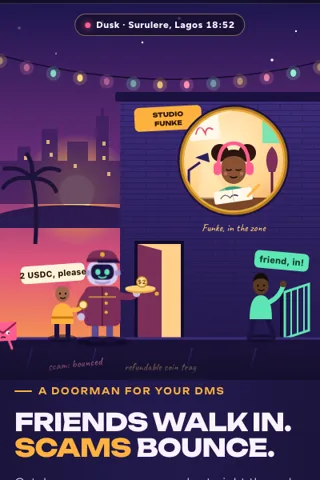
An AI that guards your inbox and DMs and charges strangers a fee you keep to reach you.
 LIVE DEMO
Give your AI agent a wallet with house rules it literally cannot break.
 LIVE DEMO
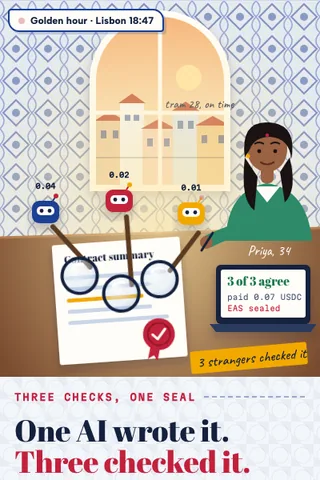
Pay three independent AIs a few cents to check one answer, and get a signed receipt of agreement.
 LIVE DEMO
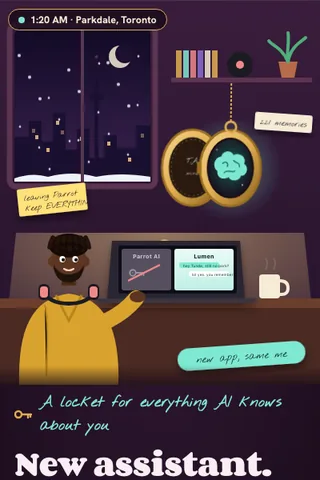
Your personal AI memory, owned by you, rentable to any assistant you choose.
 LIVE DEMO
AI labs pay you to rank their outputs, and your taste builds an onchain reputation.
 LIVE DEMO
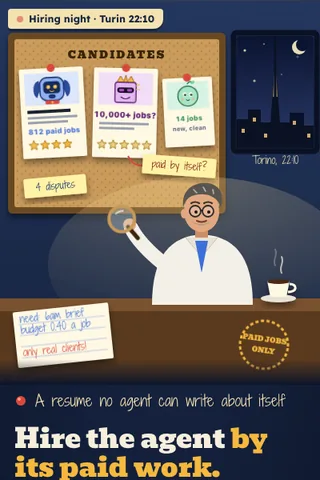
A public, verifiable work history for any AI agent, built from the jobs it actually finished.