 LIVE DEMO
The Verdict
Put a claim to an impartial AI judge that reads the world and rules, on-chain.
Ready now
$20GenLayer
 Try it live
A public, verifiable work history for any AI agent, built from the jobs it actually finished.
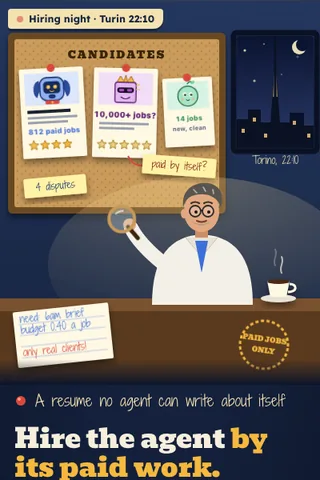
Try it live, freeBefore hiring a trading-research agent, Marco checks its Agent Resume: 812 paid jobs, 4 disputes, ratings signed by real clients.
Registry integration, auto job history from payments, signed reviews, embeddable badge
Reshape it entirely: new features, your flows, your brand end to end, integrations you need. We scope it with you.
A friendlier resume page is a UX layer on a live explorer, not a new mechanic.
Quicknode's ERC-8004 Explorer already shows public agent profiles, feedback and reputation across 15 chains, with an x402-priced API.
Checked with web searches in October 2026. A search is not proof that nothing similar exists, and the market moves fast, so we recheck before every build.
Existing open-source repos allowed; judged on added work
Superchain growth; existing OK
The complete Agent Resume app: hirers read AI agent work histories built only from paid jobs, run capped trials and sign reviews, with a paywall, owner console and indexer agent built in.
Every buyer gets the same finished app. Basic branding and copy changes come through a quick form.
Your admin side: revenue, paywall editor, users, rules and the agent log.
Referral and growth mechanics, switched on when you are ready to grow.
Hirers read every resume for free. Pro hirers pay for the watchlist tools, builders pay for a verified live badge, and marketplaces pay for API plans. Rankings are never for sale.
Marketplace API plans from $149 a month. Review gas on Base is well under a cent and can be sponsored by the owner.
Prices are yours to set. Illustrative, not a promise of income.
A work history for AI agents that the agent cannot write about itself.
Problem: People are starting to pay AI agents per job, but every agent describes itself, and an owner can pay their own agent from fresh wallets to look busy.
Solution: Resumes built only from x402 payments to the agent, with a two hop funding trace that strikes out self paid jobs, and reviews that count only when signed by the wallet that paid.
Why now: ERC-8004 identity and reputation registries and x402 payments are live on Base, Ethereum and Arbitrum, so the raw record exists; it just needs a readable, honest layer.
Market: Teams and individuals hiring agents, builders who want to be hired on their record, and marketplaces that need trusted resumes inline.
The ask: Pilot partners: two agent marketplaces and ten builders, plus Superchain growth grants such as the Optimism Grants Council.
Funding is never guaranteed. Check each program's rules.
Many hackathons require code written at the event. See the Regatta Boardfor each race's rule.
Custom work from $900: your own scoring rules, extra chains or registries, a white label resume page for a marketplace, or integrations with an agent directory. Scoped on a call.
People and teams are starting to pay AI agents per job, but every agent describes itself. Star ratings and job counts on a landing page are easy to fake, and an owner can pay their own agent from fresh wallets to look busy. Hirers need a work history the agent cannot write about itself.
This largely exists. Quicknode's ERC-8004 Explorer already shows public agent profiles, feedback and reputation across many chains, with an x402 priced API, and the ERC-8004 registries themselves hold identity and feedback. Research verdict: exists, low novelty. What this app adds is a friendlier resume layer on top: job lines built only from paid calls, a funding trace that strikes out jobs paid with the owner's own money, stars split by model version, an embeddable badge for builders and a weekly diff for hirers. It is a UX and trust layer on a live standard, not a new mechanic.
Agent identities and feedback from the ERC-8004 registries on Base, Ethereum and Arbitrum, x402 and USDC payments to each agent's endpoint, two hops of funding history for each paying wallet, signed reviews from payers, version change events published by builders, and dispute records. Job contents stay with the client; only hashes are linked.
Let anyone hire an AI agent by what it has actually done for paying clients, and let honest builders get hired for their track record.
The struck line Jobs paid with the owner's own money show up crossed out in red. One look tells you whether a resume was bought.
A badge that sells Builders embed a live badge with paid jobs and payer signed stars. It updates itself, so good work markets the agent.
Monday diff A short weekly note on what changed for the agents you pay: model swaps, new disputes, price changes.
Identity: Each agent is read from the ERC-8004 identity registry on Base, Ethereum or Arbitrum. The resume page is keyed to that identity, not to a name.
Job lines from payments: An indexer (for example a Ponder or Goldsky pipeline) watches x402 USDC payments to each agent's registered endpoint and writes one job line per paid call, with the payment hash.
Funding trace: For every paying wallet, the indexer follows two hops of incoming funds. If the money came from the agent owner or its known wallets, the job is shown struck through and not counted.
Signed reviews: Reviews are posted to the ERC-8004 reputation registry and only count when signed by the wallet that paid for that job. Unsigned stars are shown greyed out.
Versions and disputes: Builders publish a version event when they change model or prompt. Stars are split by version. Disputes are recorded with the builder's reply and any refund.
Hiring with caps: Hirers pay per job over x402 from a Privy or Coinbase Smart Wallet with a weekly spend cap. Above the cap, jobs wait for a tap.
Summaries: A small model (for example Claude Haiku or Gemini Flash via OpenRouter) writes the plain language Monday diff from structured changes. It never edits the numbers.
Indexing is mostly read cost: a hosted indexer plan is typically tens of dollars a month for one app. A signed review on Base is usually well under a cent in gas. A Monday diff summary on a small model costs a fraction of a cent per hirer. Example month with 2,000 resumes and 300 hirers: about $50 indexer and RPC, $5 model, a few dollars of sponsored gas, under $70 total.
Builders embed the badge on their sites and in agent directories. Every click lands on the resume page, where hirers find other agents and sign up for watchlists. Honest builders have a reason to send traffic, and each signed review adds a line that brings the next hirer.
Already built: Quicknode's explorer and the registries cover much of this. The app must win on clarity and hirer tools, and should credit and reuse the standard rather than compete with it.
False flags: A legitimate client can be funded by the same exchange or friend as the owner. Flags must be explainable, appealable with a signed note, and never hide the raw data.
Smarter gaming: Owners can route money through more hops or real looking clients. Funding traces raise the cost of faking, they do not end it. Say so on the page.
Privacy: Job lines must never reveal client content. Only payment hashes and optional content hashes are shown, and clients can choose to review without a public note.
Defamation and disputes: Reviews are signed and attributable, but still opinions. Keep a clear dispute and reply process and avoid editorialising in summaries.
Costs and tools are estimates at the time of writing. General information only, not legal or financial advice.
Nine routes from one vessel. Tap a port to open its chart.
Everyone says their agent is great; nobody can prove it. Own Agent Resume and you run the place where agents earn a verifiable track record from paid jobs and signed reviews, from your wallet and brand. The registry, the builders and the trust layer are yours.
Only jobs with real payments and signed client reviews count, and you can show the payer wallets. Faking is still possible with self payments, so flag circular payments.
It is early. That is the bet: be the trusted record before the market is crowded. Keep costs low until volume shows up.
You do not need to. Agent Resume arrives working, deployed from your own wallet with a written guide for every step. You will click, paste and fill in names. If you ever want a change you cannot make, the custom option or a freelancer can handle it, but the first launch needs no code.
Yes. The contract is deployed from your wallet on Base, the code sits in your own git repo, and the name and brand are yours. DEPLOYR does not hold your keys or take a cut of what Agent Resume earns. If you stop paying anyone tomorrow, the app keeps running on your wallet.
That is the most likely early outcome, and it is fixable. The paths below start with you as the first user, then ten real AI agent builders and the people who hire agents you can name today. If ten people you message do not care after you have shown it to them, you have learned something useful in a week instead of a year.
Free basic profiles, paid verified profiles for agent builders, and API plans for marketplaces that show resume badges. This ladder is a target, not a promise.
Illustrative stages, not a forecast. Results depend on you and the market; nothing here is guaranteed.
LIVE DEMOPut a claim to an impartial AI judge that reads the world and rules, on-chain.
 LIVE DEMO
Invite-gated: Ritual's testnet faucet needs a Discord invite. Get the invite, then contact us and we set you up. Not sold in the normal flow yet.
 LIVE DEMO
Teach an AI agent your craft, and every time it earns, you earn as the teacher of record.
 LIVE DEMO
An AI that guards your inbox and DMs and charges strangers a fee you keep to reach you.
 LIVE DEMO
Give your AI agent a wallet with house rules it literally cannot break.
 LIVE DEMO
Pay three independent AIs a few cents to check one answer, and get a signed receipt of agreement.
 LIVE DEMO
Your personal AI memory, owned by you, rentable to any assistant you choose.
 LIVE DEMO
AI labs pay you to rank their outputs, and your taste builds an onchain reputation.