 LIVE DEMO
The Verdict
Put a claim to an impartial AI judge that reads the world and rules, on-chain.
Ready now
$20GenLayer
 Try it live
An AI that guards your inbox and DMs and charges strangers a fee you keep to reach you.
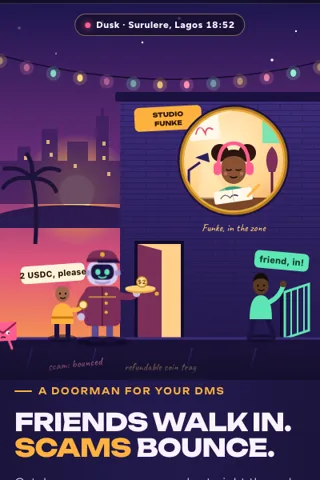
Try it live, freeFunke gets 300 cold DMs a day. Gatekeeper reads them, lets friends through, and asks strangers for 2 USDC refunded if she finds it useful.
Reach page, AI triage, refundable fee escrow, allowlist
Reshape it entirely: new features, your flows, your brand end to end, integrations you need. We scope it with you.
Pay-to-reach exists in several forms; combining AI triage with refundable crypto fees is the uncommon part.
VipInbox x402 pays recipients USDC for delivered mail, Heed (Taiko) charges onchain fees to reach a recipient, and Inboxly uses refundable deposits; none found adding AI triage.
Checked with web searches in October 2026. A search is not proof that nothing similar exists, and the market moves fast, so we recheck before every build.
Consumer onchain; eligibility unknown
The complete Gatekeeper app: an AI doorman for your inbox and DMs that waves your people in, bounces scams before they can pay, and asks strangers for a refundable USDC fee, with a paywall built in. The owner console and growth loops are optional add-ons.
Every buyer gets the same finished app. Basic branding and copy changes come through a quick form.
Your admin side: revenue, paywall editor, users, rules and the agent log.
Referral and growth mechanics, switched on when you are ready to grow.
Scam bouncing and the side gate are free for everyone. Creators pay monthly for the knobs, studios pay for a shared gate, and the owner takes a small cut of fees that gate owners choose to keep. Refunds are never cut.
Platform cut of 5% on the free plan and 2% on paid plans, only on fees the gate owner keeps. Escrow gas on Base (under $0.01) can be sponsored by the owner.
Prices are yours to set. Illustrative, not a promise of income.
An AI doorman for your inbox: friends walk in, scams bounce, strangers put down a fee they get back if it was worth your time.
Problem: Creators, founders and small business owners get hundreds of cold DMs a day. The few that matter drown under spam and polished scams, and blocking strangers shuts out real opportunity.
Solution: A triage agent waves known people through and bounces scams before a pay button is ever shown. Genuine strangers put a small USDC fee in escrow on Base, refunded if the message was useful or ignored.
Why now: Small fast models make triage nearly free, USDC on Base settles for under a cent, embedded wallets remove crypto friction, and x402 lets AI agents pay to reach humans under the same rules.
Market: Creators, founders, investors and small studios drowning in cold outreach, plus the coming wave of AI agents doing outreach on their behalf.
The ask: Ten design partners who live in their DMs, a creator hub for the first creator night, and a Base ecosystem grant for the escrow audit.
Funding is never guaranteed. Check each program's rules.
Many hackathons require code written at the event. See the Regatta Boardfor each race's rule.
Custom work from $900: extra inbox platforms through official APIs, your own triage rules and categories, CRM integrations, team routing for agencies, or a branded deployment. Scoped on a call.
Creators, founders and small business owners get hundreds of cold DMs and emails a day. The few that matter (a client, a supplier, a real collaborator) drown under spam and polished scams, and blocking strangers entirely shuts out real opportunity.
Pay-to-reach is not new. VipInbox uses x402 to pay recipients USDC for delivered mail, Heed (an open source Taiko project) charges an onchain fee to reach a recipient, and Inboxly uses refundable deposits. What we did not find is AI triage in front of the fee: an agent that waves known people through, bounces scams before they can pay, and only asks genuine strangers for a deposit that is refunded if the message was useful or ignored. The combination is the uncommon part, not any single piece.
Message metadata and text read locally or through the user's connected inbox, an allowlist (contacts, client list), link and domain age signals, sender account age, and escrow events on Base. Message content and the allowlist stay off-chain and encrypted; only escrow amounts, outcomes and a message hash are onchain.
Make a person's attention something they control and strangers respect, so that reaching someone new costs a little care instead of nothing, and scammers cannot buy their way in.
Silence ends The first night the inbox drops from 300 requests to nine is felt immediately. The weekly hours chart keeps that relief visible.
Fair to senders Senders get the fee back if the message was useful or ignored, so real people do not feel taxed and the owner cannot profit from silence.
The Sunday digest A short weekly ritual: paid messages waiting, refund deadlines, and senders the agent was unsure about. Clearing it keeps a streak.
Reach page and wallet: A public reach page per owner. Senders connect with Privy embedded wallets (email or social login) and pay in USDC on Base. No wallet is needed for allowlisted contacts.
Triage agent: A small fast model (for example Claude Haiku 4.5 or GPT 5 mini class via OpenRouter) classifies each message as known, stranger, spam or scam, then a rules layer checks link domain age, sender account age and bulk-send fingerprints. Scams are bounced before a fee is ever offered.
Escrow contract: A minimal escrow contract on Base holds each fee with a deadline. Owner marks useful (refund) or not for me (release, minus a platform fee). No action by the deadline triggers an automatic refund callable by anyone.
Payment rail: USDC on Base, optionally via x402 so agents and apps can pay to reach the owner programmatically under the same rules.
Indexer and inbox store: A lightweight indexer (Ponder or a hosted subgraph) tracks escrow state. Message bodies, attachments and the allowlist are stored encrypted per owner, never onchain.
Notifications: Quiet hours, a morning digest by email or push, and a Sunday summary. Allowlisted contacts can bypass quiet hours.
Shared blocklist: Opt-in sharing of hashed scam domains and phrasing patterns between gates, with no message content shared.
Per message triaged: roughly 600 input and 80 output tokens on a small model, about $0.001 at Haiku 4.5 class pricing ($1 per million input, $5 per million output). Per paid message: an escrow open and a settle on Base, typically well under $0.01 each at normal gas. Example month for one creator: 9,000 messages triaged (about $9 in model cost), 120 paid messages (under $2 in gas), plus hosting around $20. Roughly $30 a month to run.
Every bounce and every fee request carries a small line that the recipient uses a gate, with a link to make one. Senders who get refunds become owners. Creators share the six week card (scams bounced, hours saved), which is the strongest advert.
Perceived paywall: Some people will read any fee as rude. Guardrails: allowlist on by default, automatic refunds, and an option for free requests with a lower priority.
Fee as fake legitimacy: Scammers may pay to look legitimate. Scam checks run before a pay button is shown, and paying never adds a verified badge.
Misclassification: The agent will sometimes bounce a real person. Bounced senders see a clear appeal path, and the owner sees uncertain cases in the digest.
Privacy of inbox data: Reading DMs is sensitive. Content is encrypted per owner, never used to train models, and never put onchain.
Regulatory: Holding user funds in escrow may raise money transmission questions in some places. Keep escrow non-custodial in a contract, and get local advice before launching widely.
Platform terms: Some social platforms restrict automated DM access. Start with email and a reach page link, and add platforms only through official APIs.
Costs and tools are estimates at the time of writing. General information only, not legal or financial advice.
Nine routes from one vessel. Tap a port to open its chart.
Your attention is the scarcest thing you have, and right now every platform gives it away for free. Own Gatekeeper and strangers pay a small refundable fee into your wallet to reach you, under your brand, with an AI triage you control. The fees, the allowlist and the reputation of a well guarded inbox are yours.
Some will. That is why the fee is refundable when you find the message useful, and friends never pay. Frame it as 'I read everything that comes through here', not as a toll.
It will make mistakes in week one. Keep a manual allowlist, review the blocked folder daily for the first two weeks, and tune the rules from what you see.
You do not need to. Gatekeeper arrives working, deployed from your own wallet with a written guide for every step. You will click, paste and fill in names. If you ever want a change you cannot make, the custom option or a freelancer can handle it, but the first launch needs no code.
Yes. The contract is deployed from your wallet on Base, the code sits in your own git repo, and the name and brand are yours. DEPLOYR does not hold your keys or take a cut of what Gatekeeper earns. If you stop paying anyone tomorrow, the app keeps running on your wallet.
That is the most likely early outcome, and it is fixable. The paths below start with you as the first user, then ten real founders, creators and investors who drown in cold DMs you can name today. If ten people you message do not care after you have shown it to them, you have learned something useful in a week instead of a year.
Two streams: the owner keeps reach fees on their own page, and as an app owner you sell hosted reach pages to other busy people for a monthly plan plus a small cut of fees. This ladder is a target, not a promise.
Illustrative stages, not a forecast. Results depend on you and the market; nothing here is guaranteed.
LIVE DEMOPut a claim to an impartial AI judge that reads the world and rules, on-chain.
 LIVE DEMO
Invite-gated: Ritual's testnet faucet needs a Discord invite. Get the invite, then contact us and we set you up. Not sold in the normal flow yet.
 LIVE DEMO
Teach an AI agent your craft, and every time it earns, you earn as the teacher of record.
 LIVE DEMO
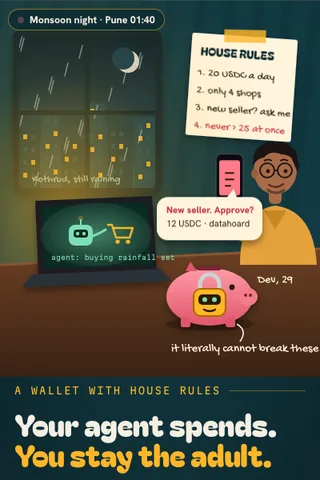
Give your AI agent a wallet with house rules it literally cannot break.
 LIVE DEMO
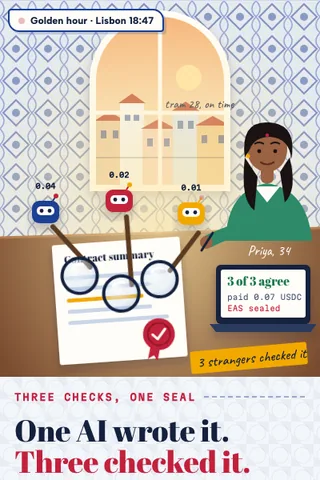
Pay three independent AIs a few cents to check one answer, and get a signed receipt of agreement.
 LIVE DEMO
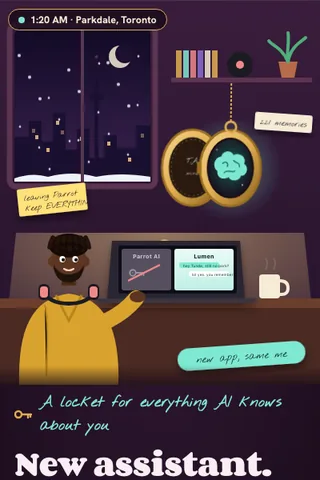
Your personal AI memory, owned by you, rentable to any assistant you choose.
 LIVE DEMO
AI labs pay you to rank their outputs, and your taste builds an onchain reputation.
 LIVE DEMO
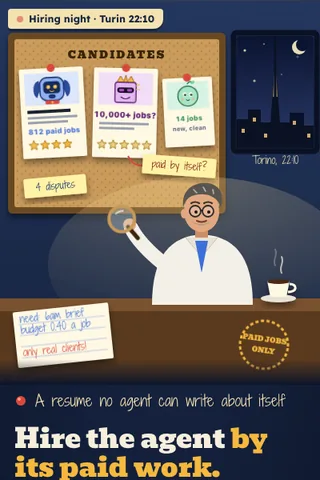
A public, verifiable work history for any AI agent, built from the jobs it actually finished.