 LIVE DEMO
The Verdict
Put a claim to an impartial AI judge that reads the world and rules, on-chain.
Ready now
$20GenLayer
 Try it live
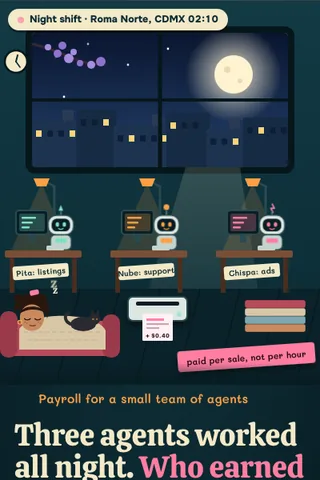
Hire a small team of agents, give each a budget and a job, and see who actually earned their keep.
Try it live, freeLola runs a tiny e-commerce brand. Night Shift pays her listing agent, support agent and ad agent per outcome, and shows cost per sale for each one each morning.
3 agent slots, budget wallets, outcome payout rules, morning P&L report
Reshape it entirely: new features, your flows, your brand end to end, integrations you need. We scope it with you.
Agent payroll exists in hackathon form; outcome-based pay with a per-agent P&L view is the less common combination.
WizAgent (Circle/Arc hackathon) batches stablecoin payroll for agents, and session-key tools enforce per-agent spend caps; none found pairing pay with per-agent P&L.
Checked with web searches in October 2026. A search is not proof that nothing similar exists, and the market moves fast, so we recheck before every build.
Existing projects OK
The complete Night Shift app: shop owners hire small AI agents, pay them per outcome from capped wallets and read one morning P&L, with a paywall, owner console and agent log built in.
Every buyer gets the same finished app. Basic branding and copy changes come through a quick form.
Your admin side: revenue, paywall editor, users, rules and the agent log.
Referral and growth mechanics, switched on when you are ready to grow.
Shops start free with two agents. Paid plans add agent slots and safety tools, agencies pay for multi client dashboards, and the owner can take a small fee on outcome payouts.
Optional fee of 0 to 3% on outcome payouts, set by the owner. Base gas for the nightly payroll batch is a few cents and can be sponsored.
Prices are yours to set. Illustrative, not a promise of income.
Payroll for AI agents: pay per outcome, cap every wallet, read one page in the morning.
Problem: Small shops now run AI agents overnight, but they pay per seat or per token, cannot see which agent earns its keep, and a tricked agent can burn the budget while they sleep.
Solution: Each agent gets its own capped wallet and a pay rule tied to outcomes. A nightly batch pays them on Base, and a morning page shows cost per sale per agent with one suggested decision.
Why now: Smart wallets with spend limits, cheap Base transactions and capable small models make it practical for a one person shop to run a team of agents safely.
Market: Independent online sellers, small service businesses and the agencies that run their marketing and support.
The ask: Pilot partners: two seller communities and one agency, plus programs such as a16z crypto CSX.
Funding is never guaranteed. Check each program's rules.
Many hackathons require code written at the event. See the Regatta Boardfor each race's rule.
Custom work from $2,800: your own agent roles and pay rules, store platform integrations, a white label version for an agency, or extra chains. Scoped on a call.
Small online sellers now pay for several AI tools (listings, support, ads) by the month, with no clear way to tell which one actually produced a sale, and no hard limit when an agent overspends at 3 AM.
Pieces exist. WizAgent (a Circle and Arc hackathon project) batches stablecoin payroll for agents, and session key tools enforce per-agent spending caps. Research found none pairing per-outcome pay with a per-agent profit and loss view. Research verdict: rare, medium novelty. What is new here is the combination: each agent gets a capped wallet, is paid only for outcomes the owner defines, and appears on a one page morning report with its cost per sale. The parts (session keys, USDC transfers, agent frameworks) are standard.
Pay rules and caps per agent (onchain as session key policies), USDC payslip transfers and agent spend (onchain), store orders and ad attribution from the shop platform and ad APIs (offchain), support ticket status (offchain). Customer messages never leave the support tool.
Small business owners manage AI agents like a founder manages a team: clear jobs, fair pay for results, and hard limits they can trust while they sleep.
Cost per sale, per agent One number per agent every morning. It ends the guessing about which tool earns its keep.
Caps that cannot be argued with Spending limits live in the agent's wallet. A wrong or tricked agent pauses at the cap instead of draining the account.
One decision before breakfast The morning page ends with one suggested change: promote, cap, or approve. A streak rewards the habit.
Owner and agent wallets: The owner signs in with a Privy embedded wallet on Base (Arbitrum optional). Each agent gets a smart account with a session key whose policy sets a nightly cap, allowed contracts and expiry.
Agents: Three agent slots built on a standard framework, each calling models through OpenRouter: a mid tier model (for example Claude Sonnet class) for listings and support replies, a small tier (Haiku class) for routing and summaries.
Outcome oracle: A backend reads orders from the shop platform (Shopify or WooCommerce APIs), ad attribution from ad platform APIs and ticket status from the help desk, and signs an outcome record per agent per night.
Payroll contract: Each morning the contract pays every agent's operator wallet in USDC per signed outcome and pay rule, as one batched transaction, and emits a payslip event per agent.
Spend guard: Ad and model spend come from the agent's capped wallet. Above a cost per sale threshold the agent pauses itself and writes a morning note.
Morning P&L: An indexer over payslips and spend builds the one page report, sent by push or email at a time the owner picks.
Model costs per night for a small shop: a few dozen listing rewrites and support replies on a mid tier model run roughly $1 to $4; routing and summaries on a small tier, under $0.20. Base gas for one batched payroll transaction plus a few spend transactions is typically a few cents. Example month for one shop: about $75 in model calls, about $2 gas, $20 hosting and indexing, so roughly $100 to run, before the agents' own outcome pay and ad spend.
Owners share the morning page and the paid per sale card in seller groups. Agent builders want to be listed with their real cost per sale, which brings their users along. A public leaderboard of agent templates by median cost per sale (opt in) pulls in new shops.
Attribution is imperfect: Ad and listing attribution can double count or miss sales. Show the method, cap total outcome pay per sale, and let the owner correct records before payroll runs.
Agents gaming the metric: Paid per item, agents produce volume. Pay only for outcomes that the owner values, with delays (such as 7 days to count a sale) and refund clawbacks.
Overspend and key compromise: Session keys with nightly caps, allow lists and expiry limit the damage. Owners can revoke any agent instantly.
Customer data: Support content contains personal data. Keep it in the help desk, send models only what is needed, and follow GDPR and Mexico's personal data law.
Platform terms: Ad and shop platforms limit automation. Use official APIs only and respect their rate and policy limits.
No guaranteed results: Agents can have bad weeks. The app reports, it never forecasts sales or income.
Costs and tools are estimates at the time of writing. General information only, not legal or financial advice.
Nine routes from one vessel. Tap a port to open its chart.
Night Shift lets a small business run a team of AI agents and see exactly what each one earned for the money it spent. When you own it, the budget wallets, payout rules and the morning profit and loss report all run under your name, so the operators who rely on it rely on you. You become the person who knows which agents actually pay their way, which is valuable knowledge to own outright.
Three agent slots, budget wallets, outcome payout rules and the morning report ship ready. You set roles, budgets and what counts as an outcome. Custom agent roles are paid options.
Each agent has its own budget wallet with a cap, so the worst case is that budget. Start with small caps, like $20 a week per agent, and raise them only after you see results.
Small operators already pay for agents and cannot tell which ones work. Start with one shop owner you know and prove cost per sale on their real numbers.
Contracts deploy from your wallet, the brand is yours, and client data stays in your deployment.
The agents will change; the need to budget and judge them will not. Night Shift pays by outcome, so you can swap agents without changing how you measure them.
Operators pay a monthly plan per agent slot, and you can add a small fee on outcome payouts processed. Agencies pay for multi client dashboards. The ladder below is a target, not a promise.
Illustrative stages, not a forecast. Results depend on you and the market; nothing here is guaranteed.
LIVE DEMOPut a claim to an impartial AI judge that reads the world and rules, on-chain.
 LIVE DEMO
Invite-gated: Ritual's testnet faucet needs a Discord invite. Get the invite, then contact us and we set you up. Not sold in the normal flow yet.
 LIVE DEMO
Teach an AI agent your craft, and every time it earns, you earn as the teacher of record.
 LIVE DEMO
An AI that guards your inbox and DMs and charges strangers a fee you keep to reach you.
 LIVE DEMO
Give your AI agent a wallet with house rules it literally cannot break.
 LIVE DEMO
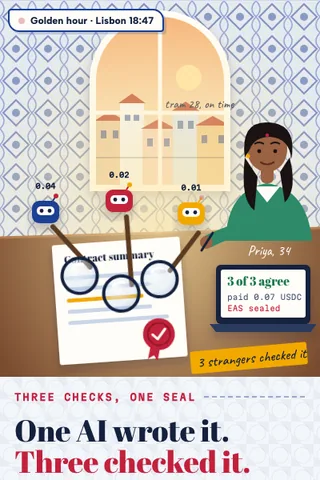
Pay three independent AIs a few cents to check one answer, and get a signed receipt of agreement.
 LIVE DEMO
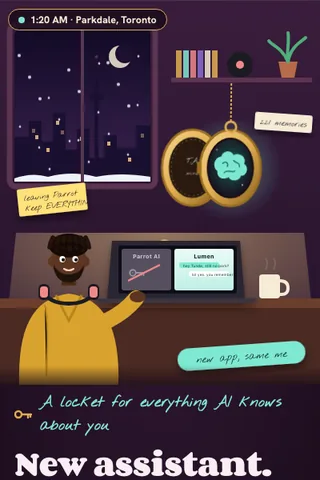
Your personal AI memory, owned by you, rentable to any assistant you choose.
 LIVE DEMO
AI labs pay you to rank their outputs, and your taste builds an onchain reputation.